
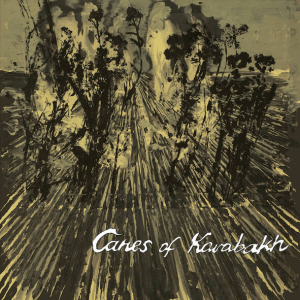
Cover art & design by Piotr „Zealot” Marzec
There is a deliberate restraint that feels ethical as much as aesthetic in Canes of Karabakh. The Polish trio of Stanisław Matys (duduk), Olgierd Dokalski (flugelhorn, SFX), and Paweł Bartnik (electronics) approach the Armenian duduk not as repertoire to be mined but as a site of tension: between access and loss, affordability and dispossession, breath and circuitry. The doubling of reed prices following the Nagorno-Karabakh conflict becomes, in their telling, not an aside but a structural element in the production process of the whole album—an economic tremor that ripples through tone itself, making the reeds increasingly unaffordable to locals.
The opening “Ghamish – The Place” makes this explicit. The title refers to the cane reeds sourced from Nagorno-Karabakh, with gamish meaning reed; here, the duduk tone enters on an undertow of field recordings and is unadorned. Matys resists folkloric inflection, holding hovering notes, sketching melodies without allowing them to unfold. Dokalski’s flugelhorn enters not as counterpoint but as shadow—its brass warmth subtly detuned against the duduk’s lament. Bartnik’s electronics are barely perceptible: air caught and redistributed, a soft convolution that extends breath into architecture.
“Sevan, the Wild Cane” gestures toward landscape—not only cartographically but also texturally, through field recordings—including sheep and the whistling of what one assumes to be a shepherd, further situating the music within an implied terrain. Melodies are fragmented by electronics to avoid narrativisation.
The album’s core arrives with “The Birth of Breath” and “Prunus Armeniaca”. The former uses the reed itself as instrument, manipulating breath toward primordial textures, with sound becoming cavernous and ultimately resonating with digital echoes. The latter (named for the apricot tree from which duduks are traditionally fashioned) pairs the duduk with flugelhorn from the outset, doubling the timbral enquiry. Electronics gather the overtones and suspend them in a faint halo, suggesting memory.
The miniature “His Sister, Anahit” is a fragment functioning as a musical haiku. Its brevity feels pointed: a refusal to monumentalise. By contrast, “Stories” expands into the album’s most immersive terrain. Looped motifs accumulate—not rhythmically but atmospherically. Bartnik’s processing catches stray harmonics and lets them bloom in slow motion, providing pulse while remaining mindful of overstatement, with Dokalski adding textural complexity and melodic phrasing.
“Narine” offers a near-song—a simple descending motif that briefly hints at lament without quoting any specific tradition. This avoidance of direct citation is central to the trio’s stated intent. Rather than risk appropriation, they focus on the material fact of sound: cane, brass, air. It is an ethics of timbre.
Whereas in previous works by the trio the duduk functioned as one element among several, here it becomes the project’s gravitational centre. Canes of Karabakh traces the life cycle of the instrument, immersing it in its ecological and human landscape while dissecting its socio-economic conditions. The tracks are deliberately shorter than those on the EP Eon (2025) or the album K. (2022), where pieces were allowed to unfold over extended durations, sustaining pitch to expose timbre and revel in resonance. The effect here is more stringent, less meditative, as though duration itself had become precarious. In this latest work, phrases are sometimes cut off or abruptly interrupted—as in “Ghamish – The Grief,” a track that mirrors the opener but shifts the focus from the geographical to the psychological.
Throughout, Canes of Karabakh eschews catharsis. There is no climactic purge, no dramatic arc—only a steady immersion in breath as a fragile continuum. The duduk, with its thousand-year lineage, is not exoticised; its body carries the weight of geopolitics without being reduced to symbol. This is a reminder to those who claim that art is not political that the very production process of art is often determined by politics.
Ultimately, this record feels less like a collection of composed pieces than an exploration of circumstances—of how we listen, how we inherit, and how we are implicated. The trio’s achievement lies in recognising that sometimes the most radical gesture is not to elaborate, but to withhold—to hold a note and acknowledge its provenance. (Gianmarco Del Re)


Pingback: A Closer Listen Reviews – Avant Music News