
 Over the past few years, we’ve come to know Natalia Tsupryk as the composer of some of Ukraine’s most poignant music. Her first post-invasion piece, 2022’s “Kyiv,” contained the sound of air sirens recorded on Ukraine’s Independence Day (August 24), which has been at the center of conversations on the triggering effect of air sirens in music. (For a breakdown, we recommend Gianmarco Del Re‘s ongoing Ukrainian Field Notes column and brand new book of the same name.) Later that year, the composer poured her grief into the EP When We Return to the Sun, followed by “beyond the cemetery wall,” an ode to a fallen soldier, included on the subsequent do nestyamy EP, which became even more personal when a friend was lost at the front. That EP, as well as 2025’s There Was a Field, recorded with Neil Cowley, made our year-end chart in the Modern Composition category. Tsupryk continued to write and release a series of singles in response to the invasion, and earlier this year released the stark EP Are We Alive?
Remarkably, until now the composer had not released an album. Vil’na fills that gap, billed as her “most personal works about Ukraine.” “Kyiv” is included, as well as the entire do nestyamy EP in reverse track order, the traditional Ukrainian wedding song “posey mate zhyto” and the 2025 single “bipolar,” about which Tsupryk writes, “When I get asked, “How are things going?” I never know if I should tell the truth or nod. I usually nod. People struggle to understand that, despite it being very tough and grim, we still laugh, love, make art, eat good food and live each day just as it is. But we also see our dearest friends go to war. We see them come back with no legs. Often, we bury them. We have missiles and drones trying to kill us when we are asleep.” The album is bracketed by two new pieces, “Anti-Drone Nets” and “A Blue Road,” the first a dark, dirgelike piece with mournful, wordless vocals, the latter a bit brighter, but by no means bright, a bulwark against the storm.
The following paragraph was written by Gianmarco in a recent edition of Ukrainian Field Notes:
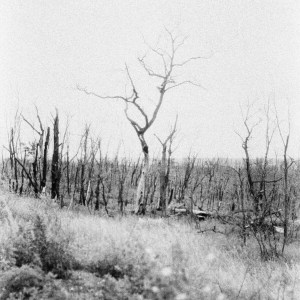
On Vil’na (Free), Natalia Tsupryk assembles a stark, deeply personal cycle of pieces that blur chamber minimalism and folk memory into a quietly devastating portrait of wartime Ukraine. Vil’na unfolds like a sequence of elegies attentive to the textures of place and loss. “Anti-Drone Nets” frames the album’s atmosphere with slow, tensile string layers, its title referencing the makeshift mesh canopies now stretching across the streets of frontline cities. Elsewhere, the composer turns fragments of lived reality into strange beauty. At the centre sits “posiy maty zhyto,” a traditional wedding song from Mykolaiv region reimagined here as a meditative folk lament. The vocal by Oriole Nest floats over Tsupryk’s layered strings, connecting fragile archival memory with the album’s present-tense grief. Across its nine pieces—titles drifting between sacred architecture, cemeteries and water — Vil’na maintains an elegiac tone: an ode to lost friends and interrupted lives without slipping into sentimentality. Like its stark black-and-white cover of scorched earth, the record stands as both memorial and quiet act of resilience.
It’s extremely hard to write about war while immersed in war. But by writing consistently since the start of the invasion, Tsupryk has gained the beginnings of perspective, and by choosing these pieces to represent her experience and the experience of her people, she has created one of the most definitive Ukrainian albums to emerge since the war began, joining Henaili’s Kyiv Eternal, 2025’s Blackout Tape and a small but growing shortlist. Vil’na is an incomplete elegy whose pain runs even deeper because the end is still unwritten. (Richard Allen and Gianmarco Del Re)


Pingback: A Closer Listen Reviews – Avant Music News