
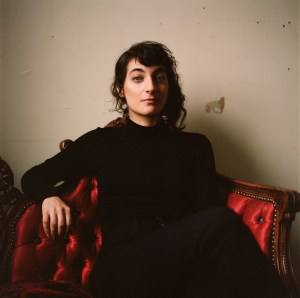
Photo by Katherine Finkelstein. Courtesy the artist.
Lea Bertucci is a mainstay of the US experimental music scene, bridging ideas from sound art into recorded music and viceversa. We had the chance to converse with her, over email, about her new album, entitled The Days Pass Quickly Immersed in the Shadow of Eternity. The title comes from a quote by Father Michael Holleran, in the context of an interview about how the monk order he was a part of was focusing on spiritual life after having prioritized the production of a digestive liquor for so many years. Below, you can find the interview with Lea in full, edited collaboratively with the artist.
David Murrieta Flores (ACL): Hi Lea, could you please talk a bit about yourself, for readers unfamiliar with your work, and what initially led you to the Days Pass Quickly project?
Lea Bertucci (LB): My background is generally in the world of experimental music, where I mostly work with woodwinds and electronics. I’ve played saxophone since the age of nine, but in recent years I’ve been writing more and more for other instruments, usually with electronics in tandem with some kind of spatial element. In light of this, I’ve also been interested in early music for a number of years now, after stumbling across a CD of Studio der Fruhen Musik, French troubadour songs. From this burgeoning interest, I saw Norbert Rodenkirchen perform in New York City with his medieval group Sequentia at the behest of our mutual friend Robbie Lee. I was totally blown away by the program in general, and with the amazing sounds coming from Norbert’s swan bone flute in particular. Norbert and I stayed in touch throughout the pandemic, doing a few remote collaborations and from there I sort of got the idea of writing a piece for him. Much of my solo work features multitracked woodwind sounds, where tones are overlaid on top of one another and interact in interesting psychoacoustic ways. So in many ways, The Days… is an extension of my own music for woodwinds but that is expanded to different instruments.
ACL: I’d like to begin with some questions about the religious dimension of the work. What is Days the bridge towards, in spiritual terms?
LB: This piece is rooted within the deep and ancient tradition of human musicking. I am fascinated by thinking about the creative and cognitive leap that must have been made by our ancestors, to fashion a bone into a flute, and to play that flute within a cave, and what that effect may have been on both its listeners and creators. It is about speaking to something that is greater than ourselves, of channeling some kind of higher energy and simultaneously tapping into the actions and imaginations of our ancestors. It was a crucial act of human ingenuity, to spend time and energy fashioning an object that is beyond basic survival and instead to create an object that pursues beauty or elucidates something about our experiences in our environment. I hesitate to call this work “religious” in the sense that the music is secular (unlike much in the early music canon, which is very much about JESUS…) But if I can make something that connects us to our past, and to these important actions in the pre-civilization taskscape, then that is where the spiritual dimension lives.
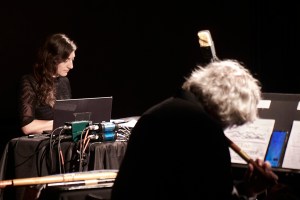
Photography by Cameron Kelly McLeod. (@ca_ke_mc) Courtesy of ISSUE Project Room.
ACL: Every ritualization is a materialization, in the sense that something concrete results from rites, which pull the threads of various social relations into an object renewed, people changed, and so on. What would you say Days, as an artwork, matters into being?
LB: I hope that when people leave a performance of this piece, they are somehow changed. It is certainly an aspiration I have for the work! I think we live in a sort of unfortunate time where the personality politics of artists and their individual experiences are kind of driving the bus. It is definitely an era of the “I” above all else. My oppositional impetuses drive me in the other direction: to create something where we can get outside of our individuation and instead tap into a collective experience. The flute is an instrument that is found in nearly all human cultures, with varying morpohologies of course… but it does tend to have a universal presence. There is something very deep in that, of understanding something that is an archetypal commonality within us all. Perhaps it can be something of an antidote to the toxic individualism of our time.
ACL: How do you see the three iterations of the work connecting with something that is beyond the here and now? Given their differences, do you think they enact the same effect, or does each produce a different spiritual relationship?
LB: Yes so this work exists as a live performance in an 8-channel sound array, as a stereo recording and (eventually) as an installation. The differing configurations of this work keeps it alive as an ever-morphing experience. A durational installation version would not exist simply as a playback loop of the composition, but rather, different samples would be triggered randomly at various moments, creating a piece that is never the same. The installation and the recording can exist without my or Norbert’s physical presences, so it is a format that can transcend our physical time.
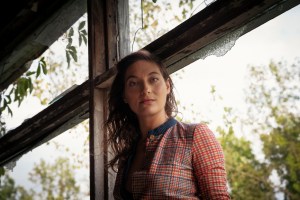
Photo by GP Selvaggio. Courtesy the artist.
There is a kind of beauty in allowing a degree of subjectivity into the experience. An artist can try to control the listeners’ experience all they want, but one can never know what it feels like in someone else’s body, or what someone said to that person five minutes ago, or any of the extraneous factors that feed into the way a person perceives an art experience. I am kind of interested in playing around in this field, to create to something that can be adapted and transformed in different contexts. The leap between a spatial sound experience and a stereo one is quite huge, and occurs all the time in the world of experimental music, so I’m interested to make iterations of this piece that stand alone as prescient experiences in an of themselves, although it is true that the live 8-channel one is the sort of progenitor of the others.
ACL: Why is the notation system you chose the most apt to realize this work? Do you see it as having a closer relation with that spiritual environment? If so, why, and how so?
LB: I wanted to use a notation system that allows for some degree of improvisational flexibility in the music. In the process of making the score, I looked through many examples of neumic notation from early music. This type of notation is both practical (Norbert is used to reading it) and keeps in line with the conceptual elements of the work. I never like to painstakingly and precisely notate, as I want to create music that allows the performer to take some liberties with the interpretation.
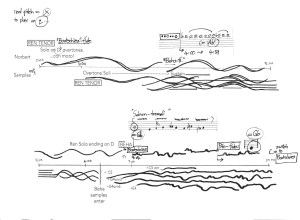
First page of The Days… Score, by Lea Bertucci. Courtesy the artist.
ACL: It’s interesting to think about the loose relationship between neumic and pneumatic in this context, in the sense that the breath becomes sign. As an extension of breathing, the flute produces meaningful connections shaped as sounds: what is the role of the body in your work, and how does it become part of the materializations that ensue from the work’s spiritual side?
LB: Ultimately this piece of music is one that arises from the breath. The performer must literally breathe life into the work, so it naturally connects to our life force. In many ways this piece can be seen as a ritual around the breath: it begins with a solo on the renaissance tenor flute, unamplified, then this sound expands outward into an 8-channel speaker array. This movement conjures ideas around making something larger than ourselves, that is in a state of constant transformation.
This piece takes materials related to the past and presents them in the simultaneity of the present to envision some kind of future. I’m not doing like world building or anything goofy like that… I guess you could say that I’m just layering it all together to see what happens. In Zen practice we try to ground ourselves completely in the present, but it is always a challenge when we ruminate on the past and feel anxiety about the future. It is sort of a basic human thing, and I like making human music.
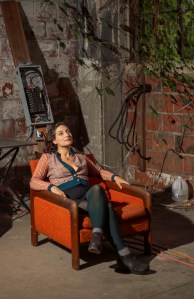
Photo by GP Selvaggio. Courtesy the artist.
ACL: Rituals tend to have deep implications about time. It is fitting, then, that time is so important in Days. There is time from a physical perspective, as an experience of being in the world, but there is also time from a historical perspective, as a fabric of events that may or may not coincide with the physical side of it. What would be, to you, the differences between physical and historical time?
LB: In many ways, this piece can be seen as an exercise in time travel. Using instruments that are from the historic record, their tunings and the melodies inhabit the piece and speak to the past, yet somehow this work also feels futuristic while also utilizing the technology of the present. So I would say that this work presents a multistable perspective of time. Sounds from the past are transformed in the present to evoke images of the future.
[In this sense], these are sounds that have never been heard before, created with objects that relate to the long history of music. I’m essentially taking a melodic instrument and turning it into a big crazy spatialized organ by stacking tones on top of one another. The resulting harmonies are weird and psychoacoustic – out of tune by contemporary western standards. I like to wonder about how our ears will be tempered in the future. Will the future turn out to be so industrial and sour that we need a music that speaks to that kind of experience? I’m not really sure how it happens, but it is something I feel when I hear this piece.
ACL: How, perhaps even why, does musical time fit into that conceptualization? I know the following is a trick question, but I think it’d be interesting to read your own artistic perspective on this: for you, is musical time more of a physical phenomenon, or a historical one?
LB: It is important to remember that music is a time based medium, like film or dance or theater. That doesn’t mean it needs to be linear (I don’t really believe in “sound art” as distinct from music). I would say that musical time is a cognitive phenomenon. I’ve experienced the stretching or compression of time while experiencing music (like, “oh god when will this end?!” To, “oh god I have just spent four hours listening to this LaMonte Young piece and it feels like ten minutes”).
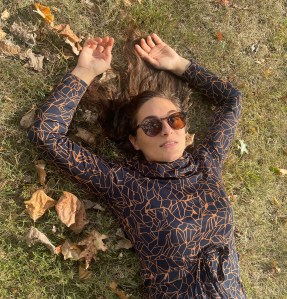
Photo by C. Monteith. Courtesy the artist.
ACL: I believe anachronism could be a useful key to think about Days, particularly understood as the non-coincidence of temporalities. How do you think someone from, abstractly and hypothetically speaking, a culture that conceives of time in a cyclical fashion, would engage with the temporalities of the three iterations of this work?
LB: Much of this work is based around looping sounds, so a sound that repeats itself is arranged over a non-repeating larger temporal form. I think this work would resonate well with people who dig non-linear time.
ACL: There’s a debate in the historical field about the definition of contemporaneity and the way Western societies currently relate to past and future, which can be reduced – sort of – into the idea that the present has already eroded all the qualities that make up “pastness” and “futureness”. We’ve only got a perpetual state of undefined transformation; the past becomes irrelevant, and the future is so contingent it becomes meaningless. How would you see your work under the light of this framework?
LB: A while ago I watched a documentary on the history of the toilet. It was a fascinating watch, and it taught me something very important about ideas of time and civilization and progress. In the Roman era, the toilet consisted of aqueducts underneath an open seat that would wash away human waste. This was good for not spreading disease and it helped civilization flourish, then as the dark ages descended on Europe and the aging Roman infrastructure was abandoned, people went back to shitting out of castle windows and disposing of their waste in gutters, leading to more contact with raw waste and a higher incidence of disease. This is all to say that time and “progress” do not move in the same direction together. I think for someone born in the USA in the 20th Century, this is an important thing to remember. There is much to learn and hold on from the past, and it is our imperative to remember, build and transform these elements of the past in order to responsibly steward our species into the future.
ACL: Thank you so much for your time, Lea. Is there anything you’d like to say to our readers before we close up the interview?
LB: Thank you for these thoughtful questions. My hope is that whoever hears this piece of music can tap into our deep humanness and find something inspiring in the sounds.


Pingback: A Closer Listen Reviews – Avant Music News