
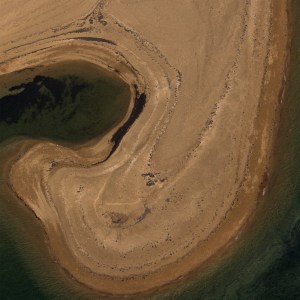
 Fathom Tides is an LP of incremental change. Best heard as a single, slowly-developing piece, the album reflects the pace of nature over that of humanity. The earth is in no hurry; the trees are not multi-tasking; the streams do have somewhere to go, but save for times of torrent, they are in no rush.
The album begins with a trickle of water, a rustle of wood, a suggestion of wind. One must acclimate in order to hear more. As the first movement starts to wind down, one begins to hear a low, background hum, like a drone, an amalgamation of sounds that will continue to grow. By the second movement, one can hear flocks chattering, brooks flowing, and the gentle breeze blowing into the microphone.
Lawrence English‘s coastal field recordings lie at the heart of the LP. When passed to Werner Dafeldecker for treatments, they became something larger than a reflection. Like all 21st century nature-based field recording albums, Fathom Tides cannot help but comment on climate change, but it does so obliquely. Instead, the beauty of the album is its attention to detail: the low-pitched calls of the third movement, like night creatures seeking their mates, chased by loud, mechanical crashes that imply the intrusion of Homo sapiens. Still, nature continues to find a way, and the piece continues to develop, working around any jutting forces like water around a stone. While humanity may claim dominance, they have been around for only 0.004% of the planet’s life.
In the meantime, as English and Dafeldecker display, coastlines may erode, but they also replenish. Fires destroy, but also produce seeds. Glaciers melt, devastating certain habitats while awakening others. While it’s hard to convey geologic time through a 40-minute piece, the gradual introduction of new elements and subtraction of the old mimics it in microcosm. Even 40 minutes is far longer than the average human attention span: to understand, one must hear, and to hear, one must listen. By “Fathom Tides VII,” small changes have produced large results: the sonic field is different at the end, altered by the interaction of organisms and impassive forces.
More than anything, Fathom Tides is simply a lovely composition, one that may lead listeners to surrender to the flow of time, putting aside distractions to focus on the biophony. In the closing minutes, the electronics recede, producing the same sort of peace one might feel beside a stream: until the final seconds, when the sounds pitch down and end like a record whose plug has been pulled. Scientists warn we may be pulling the plug on nature; in time, it may be the other way around. (Richard Allen)


Pingback: Lawrence English / Werner Dafeldecker ~ Fathom Tides – Music You Need To Hear
Pingback: A Closer Listen Reviews – Avant Music News