
 THALASSA begins and ends with the sound of breath. The Greek goddess for whom the album is named is the literal personification of the sea, and SHHE (Su Shaw) traces her footsteps across the Mediterranean Sea, channeling her spirit and voice. Inhalations and exhalations become the rhythm of the waves; subtle shifts become currents; recurring patterns become tides; and when the electronics foam and surge, they become the storm, both literal and ecological.
Frustration was involved in the genesis of the project, as Shaw was commissioned to perform an impossible task, a hydrophonic study of the Mediterranean from the Egyptian coastline. Thwarted by the Alexandrian military, the artist was left with no choice: in order to reflect the sea, she had to become the sea itself. The scope of the project widened, becoming the expression of voice for those who have no voice, an approach that reflects global waters in the face of climate change, but can be extended to other subjects as well.
But before one works to save the sea, one must love the sea, and SHHE makes this possible through personification. At first, there is only breath, the proof of a presence. The sea is alive. Lower tones enter, reflecting the mysterious, uncharted depths; the notes become an extended plea, mirroring the loneliness of whalesong. A pulse develops in “Katávasi,” further proof of life, tracks blending together like hydrogen and oxygen. The sonic water is turning from one thing to another: from ambient to drone, from clear to murky, from safe to dangerous, from protected to endangered.
“Alexandria is fated to be underwater,” writes Shaw. “The city has already sunk twice – and by 2050, it’s predicted that a third of Alexandria will be underwater or uninhabitable.” A similar fate is predicted for Shaw’s home city of Dundee, Scotland. In “Allásso,” the music becomes electronic, the voice of the sea a lament. Will anyone intervene? Ben Chatwin’s mixing adds urgency to the sound, which begins to bubble and in a rush of surging beats, threatens to explode.
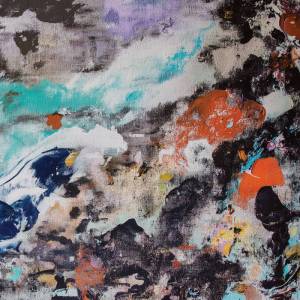
By the middle of the album, one can sense the urgency and the anger. A protective force was stripped of agency, treated as a tool, and mistakenly identified as a self-renewing resource. The militarization of the coast reverses the ocean’s role as nurturer and provider. The gorgeous cover suggests coral, but it also suggests debris. The music foams and boils, a reminder that the sea, as placid as it may seem on halcyon days, may also rise up, may punish, may destroy.
In the end, the album returns to breath, beautiful breath, a reminder of Thalassa herself, whose breath formed and shaped the earth, who gave every species life, and who may one day reclaim the land for herself, insisting on balance if the creatures of clay do not. The cyclical nature of the album imitates not only the sea, but the potential impact of time. (Richard Allen)


Pingback: A Closer Listen Reviews – Avant Music News