
 Field recordings are often presented for their own sake, but on a trio of new recordings under a variety of aliases, Ká offers field recordings as a reaction to current events: on his latest set, as Letters Without Words. His travels through Bohemian forests have produced a sense of peace that the artist shares as both solace and encouragement. Adding a musical tone to the latter, he also connects past and present, allowing its lessons to be heard.
We begin with the 12-minute Fraternity, recorded as Wild Orchestras of Garden of Star. There is indeed a sense of fraternity in the woods, or as the artist writes, consonance: the voices are in balance, each occupying its own sonic niche. Despite the food chain, there is equilibrium. The birds are active and vocal, joining other creatures along with the wind and water as a “park orchestra.” A dog barks happily; a plane passes overhead, drowned by the sound of a stream; motor drones appear on the periphery and threaten, but fail to overwhelm the calm. Here lies a parable of disturbing news v. comforting constants; the piece is a reminder that the second retains its power.
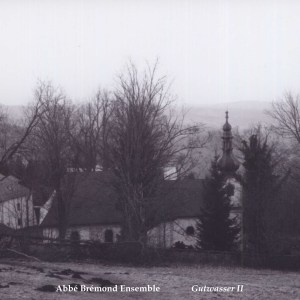 Next is the slightly longer Gutwasser II, recorded as Abbé Brémond Ensemble. The sounds of “Die Quelle guten Wassers erinnert sich” were captured at a “pilgrimage site near the Czech-German border,” a second parable. The “Good Water” remembers, if Google Translate can be trusted; it has descended from mountain streams and burgeoning clouds, and will flow back to the sea or evaporate; it stops only momentarily at the pilgrimage site, where the spring is considered a source of healing. The focus on life’s cyclical nature is another balm. Health fades and returns; societies crumble and rise. The sounds of traffic rest on the periphery, as if people drive by the source of healing without knowing it exists, or fail to believe that healing can be possible. Another thread connecting the first two releases: the barking of a single dog, like a voice crying in the wilderness.
 And now the latest release, much longer at seventy-three minutes, presented as Ká. These ten tracks are presented as Letters Without Words, to be sent around the world in digital form to any who need what they have to offer. Already “Blushing” is more active, with fireside crackle met by the sound of a rushing stream: fire and water, resting alongside each other. Having seen “the fog that shrouds the modern era,” Ká looks into history and sees possibility; as a church bell tolls faintly in the distance, one remembers the echoes of faith. “Flickering Colored Lights” contains a rainbow of distinctive voices, a birder’s paradise; “Shame in front of the Rain” is a glorious drenching. A sheet of rain, as if cut from this cloth, re-descends toward the end of the following piece.
The emotion deepens at the end, as “Visions” samples Bedřich Smetana’s opera Libuše. Recorded in the National Theatre in 1939, the excerpt speaks across the generations, bearing a dual message of trepidation and hope. We all know what happened next: things got much, much worse before they eventually began to improve. To compare eras, one must ask, “Are we in the equivalent of 1939 or are we in the heart of the Holocaust?” A further question might be, “Will we repeat the sins of the past?” By planting the opera in a bed of field recordings, the artist implies that humanity speaks a different language than the forest, and that the trees and the birds, the rain and the streams, and even the lone dog may have something to teach, if only we would listen. (Richard Allen)


Pingback: A Closer Listen Reviews – Avant Music News