
Metastasis move through sound as if traversing an unstable dimension, where compositions emerge as temporary formations within a larger sonic flow. On Dineba—a title translating loosely as “flow” or “current”—the Georgian electroacoustic ensemble construct an environment in constant mutation, shaped through improvisation, field recordings and live transformation. Emerging from Tbilisi’s electroacoustic scene, the quartet—Kuji Davituliani, Alexander Khkhiashvili, Nasi Chavchavadze and David Dkikabidze—treat all sonic material as fluid, endlessly reorganised through intuition.
The opening track, “The Kármán Line”—the internationally recognized invisible boundary that marks the beginning of outer space—introduces the echoing voice of a French child, a fragment of memory drifting through the drone landscape and grounding the album in the tradition of musique concrète. Elsewhere, “Coronal Mass”—a massive, explosive release of plasma and magnetic field from the Sun’s corona into the heliosphere—channels the tactile physicality of free improvisation through trumpet, drums and cello. This analogue immediacy is countered throughout the album by colder digital spaces such as “The Gulf Stream”, where reverberation opens into a vast sonic void. “Dipole” introduces the pulsation of a mechanical body, while by “Zone 2” turbulence begins to gather, pushing the album into darker terrain.
By the time the closing track arrives—”Léthē” indicating “forgetfulness”—the music seems suspended between dissolution and continuation, drifting through a weightless zone where memory and oblivion blur. Dineba never aims to provide closure. For Metastasis, these tracks are only fragments of a much larger sonic dimension—an endless flow where samples, improvisation and electronic processing continue to mutate beyond the album itself. Released through Bassiani’s experimental Zenaari imprint, the record also feels inseparable from the atmosphere surrounding it: a Georgian underground scene navigating repression and exile.
Here’s what Kuji Davituliani had to say about the production process over an email exchange.
 Could you begin by introducing yourselves and telling us about your background, and how the project Metastasis came into being?
We met each other at Ilia State University, on the electroacoustic music program. We were among the very first students of that studio from 2008, a program open to people with little or no formal academic musical background. We were students there and later worked there too. Alexander, Nasi and I met in that context and took our first steps in electroacoustic composition. Since we were never framed by strict academic duties or limitations, our path in electronic music developed differently from classical electroacoustic approaches. David joined the studio a few years later.
In the beginning we were performing more fixed media compositions where the composer was not on stage but at the mixer much like in the 1950s. But after finishing the program we took that experience, mixed it with our musical intuition and somehow found our own way.
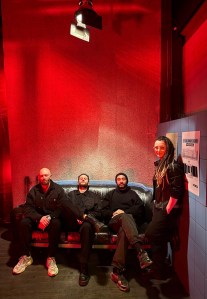
Metastasis formed in 2017. We started playing together at anti-government demonstrations as an experimental, improvisational ensemble. Myself, Kuji Davituliani, on electronics, Alexander Khkhiashvili on drums, Nasi Chavchavadze on cello and David Dkikabidze on trumpet. Not always all together, but when the moment was right, we all were there. After many demonstrations we realized we were doing something meaningful and transformed into a proper band and project.
Dineba is described as a “dimension” rather than an album—a space where beginnings and endings are conditional. How did this idea shape the way you approached composition and structure?
When performing live I always prepared one long continuous musical material without any pause . It was like one unbroken flow, organic to us, playing alongside drums, cello and trumpet. We used all the audio, samples and compositions we had ever recorded, organizing them as one unified whole guided by intuition, taste and will.
Dineba in Georgian means flow, current, stream. Every composition is part of this flow, it can be rearranged, reorganized, resampled in many ways for different concerts and shows, depending on our vision for that particular day. At the same time, the dramaturgy of that flow is the key point. It is not just a minimalist background, development within the time frame is very important. But in general, everything we make for a concert transforms into part of one large continuous flow. We somehow perceive all our audio works as part of one imaginary audio dimension, as if they tend toward unity. It is something spiritual and not easy to explain briefly.
The track titles reference scientific, geographical, and mythological concepts—from the Kármán line to Léthē. Do these function as conceptual entry points, or are they more like traces left behind after the music is formed?
There are many answers to that. There are connections you can feel between the music and the titles, but they function more as associated markers of memory. These compositions could have had other names, or none at all like every one of them is Dineba even without numbers, because they are all equal. When you listen, certain things emerge in the mind. The connections between earth and cosmos, life and afterlife, permanent existential questions, these things appear. But ultimately the titles are our human attempt to name something that, in the larger picture, is part of this audio dimension, something self-sufficient that doesn’t need names at all.
Many of the pieces seem to evolve without a fixed form, moving between drone, ambient, and more experimental textures. How do you work with this sense of “chaotic order” in practice—do you begin with a sound source and let it unfold, or is there an underlying architecture guiding the process?
The great majority of our sounds began as samples made through field recording over many years edited and transformed in many ways across different live performances before finding their final form on the album (but this is not the end of transformation). The underlying architecture is our intuitive inclination toward something we know how it sounds but cannot classify through any fixed order or rules. We simply recognize it when we hear it.
The opening track introduces midway through a child’s voice in French, almost like a fragment of memory interrupting a drone landscape and a musique concrete marker. How do you think about the role of voice and found sound within this otherwise abstract sonic environment?
Musique concrète is a key starting point for this music not in the way Schaeffer might have preferred, with dogmatic rules, but in the sense that the sample is the beginning of everything. Like patient zero. And then never-ending editing. The voice in that composition is not about narrative or plot; it is about form. That voice is personally significant to me and reminds me of some early works of Luc Ferrari.
There’s a strong sense of flow across the album, even with genre change, as if each track is part of a continuous field rather than a discrete composition. Did you conceive Dineba as a single uninterrupted space, or did it emerge from assembling separate pieces?
As I mentioned before it is one unified space, one dimension.
The concept of cycles—of unity, complexity, and endless return—runs through the album. Does this relate more to philosophical ideas, personal experience, or to the internal logic of sound itself?
It is internal logic. It is all about our intuitive inclination and this audio dimension, something we are always trying to reach. When we feel that a sound is part of that dimension, we allow it in. After that it can certainly be reinterpreted, but the dimension itself acts as a filter first.
The final track, Léthē, carries a more elegiac tone, invoking forgetting and oblivion. Do you see the album as moving toward dissolution, or is it more about transformation within that cycle?
We absolutely don’t belong to any fixed template or standard, we simply follow our musical and experimental intuitions, whatever circulates in our minds. We don’t avoid anything, we just don’t think according to any rules besides our own instincts. We love musique concrète as the core of our musical approach as a starting point, as a message: “start with a sample and follow it.” But what happens after that is not under any particular influence.
Your music sits between electroacoustic composition, musique concrète, and experimental electronics, yet avoids settling into any one category. How do you position your work in relation to these traditions, if at all and what can you tell us about the way you combine the analog and digital worlds?
Actually, I don’t see a big difference between the analog and digital worlds; we simply use everything that sounds, regardless of the source. Any material can be the subject of music. The source is not important at all. What matters is the flow of what it will transform into. When in the early 1950s Karlheinz Stockhausen was working in a student hostel, making a workspace with a desk and nails, trying to cut tapes with scissors and Ableton Live today I believe they shared the same goal: just make music with whatever possibilities you have.
It is simply the end of that particular journey for the listener. But as part of the larger dimension itself, it never truly ends. What I want to say is that there are two contexts: the local, specific context of listening to this album and the larger dimensional context. This album, with its local contextual journey, can be understood as a small trip to a micro world that is part of a vast dimension. All the track titles belong to that micro associative context. But the audio itself is part of a never-ending, non-physical flow that exists beyond any single dimension.
Dineba was released through Bassiani, a label and club more commonly associated with techno. How do you see your work relating to that context—does it challenge or expand expectations of what that ecosystem can hold?
Bassiani is mainly associated with the techno scene, but for me it has always been a space of underground culture. Since I consider Metastasis an underground sound, there is no gap between us. At the same time, Bassiani and I have a long history together. I was project manager and co-author of a side project launched in 2018 on the Bassiani stage called Zenaari, an event series focused on the alternative electronic music scene. At the very first event, Metastasis shared the stage with William Basinski. Over time we hosted many other guests including Fennesz, Lubomyr Melnyk, Yves Tumor and many others, alongside local projects.
Our release Dineba is catalogued as ZNR 001 meaning it as the first experimental electroacoustic release under the Bassiani/Zenaari collaboration.
How would you position Metastasis within the electronic and experimental scene in Sakartvelo and how has the music scene changed since the elections over 500 days ago, when many people were leaving the country?
I can’t really speak to the positioning of our project. We simply want to make music, we have our sound and our flow, and we keep trying to do that.
After the last election, many things changed and not only because of emigration. There is now a deeply oppressive regime in Georgia. Hundreds of people are in prison. Laws around demonstration have changed so that free protest is nearly impossible. They arrest you, remove you from your job, cut any EU funding you receive, it is no longer legal to receive support from abroad. If they cannot stop you directly, they threaten your family, or plant drugs or weapons in your home. Drug policies have been made even more brutal as a tool of control through fear. This is the darkest period in the history of Georgian democracy. Everything has changed and people are in a state of depression including us. I myself emigrated a few years ago but still visit Georgia very often.
Unfortunately, this is destroying the local ecosystem. Alongside other parts of the local art ecosystem, they have recently closed the majority of university programs including the electroacoustic music program at Ilia State University, the place where we all met, where we grew up as musicians and later as teachers. Fifteen years of enthusiastic work by so many people, thrown away in a single month. But there are still people who fight.
I want to believe music always finds a way to survive, like water that always finds holes to drain through, or makes them if they are not there. During my last visit to Georgia, our friend, colleague and professor of electroacoustic music who is one of the main reasons we make this music at all Reso Kilnadze said something that stayed with me: “Sometimes you can feel more freedom in a cage.” I hope this dark time in Georgia is just one more step that we will pass through. (Gianmarco Del Re)


Pingback: A Closer Listen Reviews – Avant Music News
Pingback: A Closer Listen Reviews – Avant Music News