
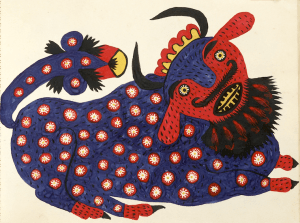
Artwork by Mariia Prymachenko
This episode of Ukrainian Field Notes comes to you from Lviv, where I have been attending the Lviv Media Forum, whose theme this year is Reality Under Attack: Flight, Freeze, or Fight?
Alongside the talks, there were also video installations, including You Shouldn’t Have to See This (2024) by Yarema Malashchuk and Roman Khimei [UFN XXIX], who filmed sleeping children who had been forcibly taken to Russian territory and later returned to Ukraine, foregrounding one of the most disturbing crimes of the Russian-Ukrainian war.
By crossing the line between intimacy and voyeurism, the artists question the ethics of looking and the status of war imagery itself: these images are first evidence of violence and only secondarily aesthetic objects. The work exposes the tension between empathy and spectatorship while insisting on the political necessity of such images as acts of testimony against erasure.
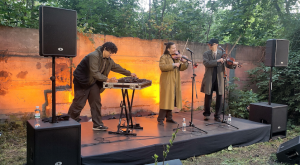
Symonenko with DvaTry
The opening night party for the LMF was a riotous affair thanks to Symonenko and DvaTry performing as part of the CMYK formation — despite DvaTry, which translates as “TwoThree,” currently consisting of only two members, as band member Herman Klymenko has now joined the army.
But back to UFN: this month I spoke to Andy Nechaevsky about homemade kalimbas and his memory archive; to Cells Interlinked about creative flow and making abstract, luminous music; while Random Field reflected on her formative journey into the world of minimal techno, and NACHASI praised his mother-in-law’s borsch.
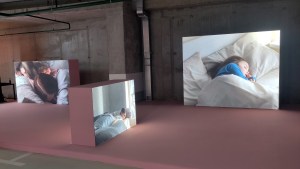
You Shouldn’t Have to See This (2024) by Yarema Malashchuk and Roman Khimei
Also, plenty of new releases to check out including new works by Koloah, Radiant Futur, Fedir Tchakov, Oriole Nest, Tongi Joy, Sasha Pervukhin, DID: Didge and Digital, støïbrok, Anton Humenyuk, Travis or Alice, Moon Projection, CJ Plus, Saturata, SI Process & Dennis Adu, Daniela Mars, Natalia Tsupryk & Angus MacRae, Danya Pilchen & Kali Ensamble, STROOM.tv, Vlad Suppish, kyïvite, Low Communication, Mormon Tea, Vlad Yakovlev, TĒMNA RÁDIST,Yana Pavlova & Pavel Milyakov, 58918012, Human Margareeta, Kotra, and äsc3ea.
In our Viewing Room, we have the latest from Krhystyna Kirik who will be releasing a new album on Iriy Records.
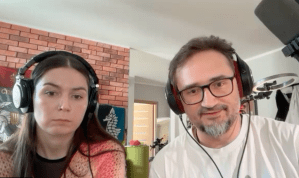
Ptastvo and Katya Karaptan
For our monthly podcast I had the pleasure of talking to Ptastvo and Katya Karaptan about the making of The Grit, out on I Shall Sing Until the Land is Free, and processing the war experience through theatre.
Tracklist
- Ptastvo – Will (2025, unreleased)
- Ptastvo – North Saltivka Noire (2026, The Grit)
- Ptastvo – Shovels Dig Holes (2026, The Grit)
- Ptastvo – Trailer (She The War 2022)
Ptastvo – Dina the Artist – The Road (She The War, 2022) - Ptastvo – Yevhenia the Volunteer – Friend Soldier MIA (She The War 2022)
- Andrii Ponomarov – Kyiv soundscape by (natural flanger, Jericho trumpets)
Finally, I would also like to to remember Bohdan from the band Nonsun [UFN VII] and Tima aka Cruel Blu / dumbtoxicsub [UFN LI] who both sadly passed away recently. Finding out on social media is never ideal but such are the times we live in.
APRIL 27, LVIV
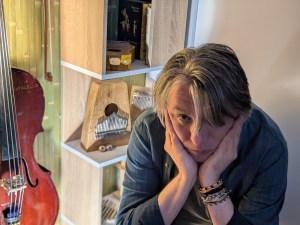
My background in music is simple: for most of my life, I was a visual artist who loved music and collected it, but the thought of recording anything of my own never even crossed my mind. All the right ingredients were there from the start: my mother was a pianist, so classical music was a constant at home; my father was a jazz enthusiast who dragged me to every possible festival since I was in diapers.
But these elements didn’t lead to the desired synthesis. When I was sent to study jazz saxophone, I only lasted two years—I mostly just hid in the closet because I was too embarrassed to play such a loud instrument in a house where all the neighbors worked at the Opera House. Meeting them on the stairs, they would ask me in their booming bass voices: “What exactly were you trying to play yesterday, boy?”
So, that was it. My friends played music, I painted, and that was enough for me—until the start of the war, when my eyesight suddenly deteriorated, and painting simply became too painful to continue.
Has the full-scale invasion changed the way you think about music and sound in general, and how has it affected your motivation to create?
Drastically. In fact, that is how it all began. In the first days, a huge number of refugees from the occupied towns near Kyiv arrived in Lviv. As “first-wave” displaced persons ourselves, we took in a dozen people with children and two cats—everyone was shocked, terrified; lives were shattered in an instant. Add to that the news, the air raid sirens, the explosions…
During one of the raids, I picked up a kalimba my wife had given me—a standard Chinese one in C Major. I started playing, and there was this strange feeling that it made things a little less unbearable—for me and for the rest of our household. It felt as if a sound vault was being built around us, and the outside world receded for a moment. It was wonderful, but something was missing, so I built my first resonator kalimba using an ukulele body, tuned to the Ukrainian Dorian scale (Mi Shebeirach)—for some reason, that specific mode resonated with me most at the time.
Then, almost in passing, I set up a studio and recorded my first album, “silent night almost no bombs”—composed almost entirely of the melodies I played during the air raids. It’s hard to believe years have passed since then; now the house is full of instruments, but I still have the impression that “I didn’t do it” intentionally—it was simply a natural reaction of the soul to unbearable stress.
Secret Life of Button Boxes: Red Box reads almost like a memory archive—part childhood recollection, part imagined space. How do you approach translating such tactile, sensory memories into sound?
I would quietly lock myself in the studio immediately after waking up, usually while it was still night (when you are sleepy, it’s easier to remember yourself being sleepy in another era). I’d turn off the lights, wait a bit in the silence, and essentially “dive” into the memory I had managed to recall—into the anchor.
There, I would record one track—completely improvisational and unconscious; I called it the “tide”—and I always left it as is: the first take, no editing. Then, after some coffee, I’d layer the remaining tracks—structured improvisations on other instruments—to the point where the memory is developed and fixed, like a photograph. I re-recorded these later tracks many times to ensure they didn’t conflict with that first, drowsy “tide,” discarding even successful takes if they led the composition astray. I tried not to lie, just as I am trying now.
The image of the button box feels central—an intimate universe of small, overlooked objects that expands into something infinite. Do you see your compositional process as a form of collecting, sorting, or rediscovering these fragments?
Collecting, sorting, rediscovering, reinventing, searching for substitutions—and sometimes even manufacturing fragments that fit perfectly into the gaps of memory. It is like repairing a mosaic using whatever parts from other mosaics are at hand—Lviv tiles, shards of broken dishes, letters, gears, someone else’s old photographs, various junk, imaginary notes, and, of course, buttons.
I’ve explained the “how,” but I’d like to explain the “why.” When I left our home in Crimea, my entire life remained there——down to the last point. I couldn’t even take my photo albums. It was like dying and being born again—in a new place, empty-headed, but with a pain in my heart. I walked the ancient streets of Lviv and tried to imagine that I remembered my previous life here, my new legend: “Here is where I learned to ride a bike, here I spent hours in the library, and in this theater, I was an extra on stage as a small child.” It wasn’t true. My real memories didn’t fit the city; my imaginary ones wouldn’t take root. The further I went, the more shattered I felt; the existing “me” wasn’t enough.
So, I tried to glue myself back together, starting from the first place I could remember—the box of buttons—and fitting everything else into it, anything at all. Kintsukuroi, where everything is considered evenly broken, and the gold is only sound.
I want to note that this scattered, jumbled past is not my personal flaw or trauma; no—every person confidently remembers that they have a memory, that they must have one. They remember there was a table, or a cabinet, a dog ran by… or maybe a cat… someone from above was saying something, and there was sun. Sun, and that’s it. To catch this glint, to enter this picture, to look around, to see the empty spaces and try to repair this entire universe with gold—so that people on the outside see only the gold itself, hear only the gold.
Now, I can tell you about hundreds of tiny details that emerged during the recording, but whether they are real or invented memories, I can no longer say. Now, there is simply “me” and there is this album. These two albums, actually—there will also be Blue Box on July 28, which is somewhat different. Stay tuned.
Everyday details—doors, telephones, radios, distant voices—take on a kind of quiet magic in your writing. How do you navigate the boundary between the ordinary and the mythical in your work?
Oh, Gianmarco, it is quite easy: I have yet to encounter anything ordinary or non-magical in my entire life. It would be interesting to find something like that, but even my holy left sock is so improbable in this Universe—a void of time filled with sorrow and stray protons—that it is impossible to look at it without a sense of mystical ecstasy. Matter, by some incredible coincidence of entirely non-obvious factors, took this form, this purpose, and then was worn through by my left foot (which is somehow mine, yet possesses such a strange construction of five toes entirely incapable of music). What is there even to say about doors, telephones, radios, and especially—distant voices!
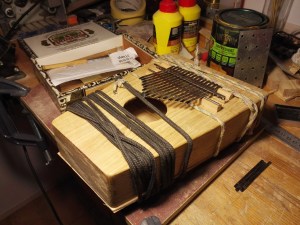
Hisilicon Balong
Your practice often involves building and performing on handmade kalimbas. How does working with self-made instruments influence the intimacy or material presence of your music, especially in a project rooted in childhood memory?
At the beginning, it actually hinders and slows things down, specifically when it comes to kalimbas. I have to imagine, at least approximately, the combination and sequence of scales where the improvisation will take place, the desired timbre, and their interaction. So, every project is preceded by several months of experimentation on “breadboard” kalimbas, just to find that specific sound. Then comes the crafting of additional instruments if retuning existing ones isn’t enough.
But all this preparatory work turns into a strange lightness when later, in the darkness of the studio, I take the kalimba and simply wait for it to play everything it has. I just sit beside it as if in a trance: here is my old house; I walk through corridors of memory, opening a lopsided door with a worn-out mailbox—there is a small “me” with my buttons. Or, I don’t open it; I wander the streets of imaginary cities—it doesn’t matter; one can even hang in a blue void, there’s plenty of interesting stuff there, too. The main thing is that I no longer have to do anything regarding the music, because I’ve already built the instrument—it has become “me” and it plays. It’s a pity it doesn’t last long—usually about four or five minutes per piece, and then I go to make coffee.
Compared to Rain in Spain, which evokes external landscapes, Red Box feels more enclosed, almost interior. Do you see these works as complementary—one moving outward, the other inward?
I must thank you, Doc—this hadn’t occurred to me, but the diagnosis seems correct. It appears that that time I took advantage of resemblance in experience, culture, and simply the warm weather to escape from myself to Iberia. I wanted to feel like all those peoples who were also forced to hide their identity, to pretend loyalty to their latest “saviors,” only to abandon their homes, flee, and eventually melt away—dissolving into the tide of the next civilization.
It was very tempting to believe in that escape. My Crimea, my garden, the sea—they still shine before my eyes as soon as I close them. Return seems impossible, but this new project is the return—to myself, to my memory, to the world of small things and big discoveries that existed at the beginning, in my pre-Columbian era. Well, this is all quite personal and subjective, but in general, when I was writing the Secret Life of Button Boxes series, my imaginary horizon was limited to a dusty box, an old room, at most—a hallway, rooftops, or whatever is visible through the window. No seas, no sails, no mountains, no ladies’ towers of the Alhambra, and no endless roads with wagons.
What does it mean for you to be Ukrainian?
You know, for so many years I was told that I wasn’t Ukrainian at all, that Ukrainians didn’t even exist. I was told I should appreciate “native” Russian nature—the birch trees, Lenin and other wild mushrooms—that I should be proud to belong to a “great family of nations” and love my Russian ballet and the Russian space…
And all that time, it felt to me that behind the thunder of all those victorious orchestras, behind the parades and timpani, there was a simple, quiet, almost invisible answer—a sense of comfort in the midst of an endless typhoon of shouting and radio music. Being Ukrainian, I suppose, is exactly that. I like my country—it is modest and without pathos; you can live as you love here, without being distracted by coarse ideology or feigned greatness. It’s just a pity that the moments for actually living here happen so infrequently.
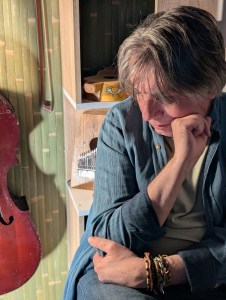 Are there any Ukrainian works—music, literature, or visual art—that have helped you process or understand the present moment?
Honestly? The work that helped me process the war, endure it, gave me hope, and supported me in the most difficult moments is a cartoon—and not even a Ukrainian one. It is Yellow Submarine. I know how naive that looks in writing, but here I am—safe and sound—and I owe it not to Ulysses, nor to the Black Square, nor even to Webern’s Symphony Op. 21.
Finally, if you had to point someone toward a few cultural references that capture something essential about Ukraine right now, what would you choose?
Countess Kapnist and the Young Pioneers by Rescale Musicbox. It’s not just the music—though the tender wailing of those crazed modular synths struck my heart and polished it with microtonal textures. But I must highlight the project’s fictional “found history” which is both incredibly dark and hilariously funny once you see through it. All in all, it’s mad, it’s loud, and it’s deeply rooted in the kind of intellectual mischief I admire.
MAY 5, 2026 – Lviv
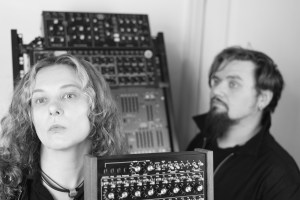
Cells Interlinked is a project of two people, Maria and Albert. We live in Western Ukraine, in Lviv – a city that has historically been a crossroads of different cultural influences. We are a couple and have been together for almost our entire conscious lives, just as we have been involved in music for nearly 30 years.
We’ve had and still have other musical projects across very different genres: dark/minimal wave, synth pop, industrial, psychedelic trance, IDM/downtempo. But despite all these explorations, we have always been drawn to slower electronic music – “music for the ears” – which we discovered in childhood and which shaped our musical worldview.
For a long time, we had the idea of creating a project where we could express our deepest inner states. It so happened that we began working on it during the first months of the full-scale Russian invasion of Ukraine. The beginning of the war was a devastating shock. What was happening outside became so unbearable that the only possible response was to turn inward. And although war is often associated with harsh emotional states, the music we created turned out to be abstract and even luminous. We chose to work with analogue synthesizers, or virtual analog instruments that come as close as possible to that sound.
Has the full-scale invasion changed the way you think about music and sound in general, and how has it affected your motivation to create?
Perhaps the main change is that music has fully become a path of therapy and self-discovery for us. When everything around you is collapsing, any creative person feels an intense urge to create. When reality itself becomes absurd, you start asking: what am I, and what is reality?
For us, the answer was to immerse ourselves in the flow of creation, where we stopped looking back at the social context of the music industry or the expectations of others. It became just the music and the one who creates it.
The physical dimension of making music also became especially important. Naturally, there is no AI involved, and almost no software – except for final arrangement and mixing. What matters is the physical presence in the studio: knobs, keys, sliders under the hands.
Cold Spring Notes is framed as a kind of notebook of inner states during a “cold and otherworldly spring.” How did this specific moment – both seasonal and historical – shape the atmosphere and structure of the album?
A year ago, at the end of winter, we released our first album “Within” on the small Argentinian label Sincronía del Viento. At that time, we were thinking about how to develop the project further, and the idea emerged to base new material on live jams recorded in nature. It was the fourth year of the war, with ongoing missile attacks and blackouts.
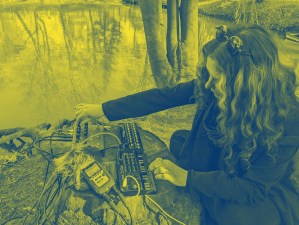
In such moments, one clearly experiences that nature exists as a parallel, silent layer of eternity. The smoke from an attack may still be dissipating – but birds are already singing, clouds are drifting, fish are moving beneath the surface of the lake. It has always been this way, regardless of human events. Last spring was unusually cold, and its foggy uncertainty created a space where only our attention remained – along with sequencers, synthesizers, and a lake with a watermill.
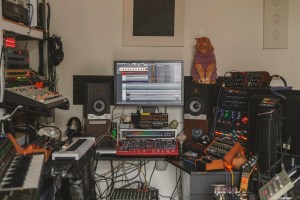
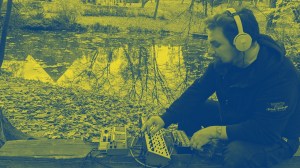
Technically, our process was simple: we would go to a natural location, bring a compact setup (step sequencer, two small synths, reverb/delay pedal chain, and a Zoom recorder), and take turns recording a base sequence improvisation, which immediately defined the duration and structure of the piece. At the same time, we recorded field sounds capturing the atmosphere of the moment.
Later, in the studio, we added a few more layers to complete each track – usually using larger, more demanding analogue instruments that are difficult to use outdoors (like a Vermona Synthesizer, Moog Slim Phatty, and SPL Vitalizer processors). An important rule was not to radically rearrange the material in the studio.
So, the result of this creative process was the album Cold Spring Notes, which we recently completed and which is scheduled for release on May 22nd on the Cyclical Dreams label, known as an important hub of contemporary Berlin School electronic music, ambient, and space music.
 You describe recording in brief moments of silence between attacks, often in natural environments. How did these conditions influence your listening process and your relationship to field recording?
People who have not experienced life during war often don’t realize that missile strikes themselves are not always the most critical moment. If the strike is over, you survived, and your home is intact, it may seem that life can continue – but if critical infrastructure is damaged, such as the energy system, then there is no electricity, and your studio is powerless. The entire city is plunged into darkness. But people adapt. Very quickly, the city fills with the sound of generators. We also discovered for ourselves portable power stations, which can be used for outdoor performances.
This situation teaches us to develop one-pointed concentration. You find yourself in silence, with only one source of sound, and your entire attention gathers around it. At first, it is the soundscape of nature. Then it becomes your sequence, responding to it. Field recording becomes a similar practice: you choose one voice of nature, listen deeply, and capture it.
There’s a strong sense of dialogue between nature and synthesis – lakes, birds, and old watermills interacting with analogue electronics and effects. How do you approach blending these worlds without one overpowering the other?
We don’t try to oppose synthesis to the voice of nature. Instead, we try to express the voice and language of nature through synthesis. Perhaps our neurodivergence (we are both AuDHD and non-binary) helps us in this. The autistic mind can function as an empty observer, reflecting the Other without distortion, without mixing it with personal identity. Our goal was to preserve the authenticity of what we perceived.
 Your music draws on Berlin School traditions while remaining very personal and contemporary. What does that lineage mean to you, and how do you reinterpret it in the context of your own lived experience in Ukraine today?
Early electronic music of the 1970s was described as “kosmische Musik”. The works of Tangerine Dream, Cluster, Klaus Schulze seemed to exist beyond personal emotion – like sound from a cold, infinite cosmos. But later, psychedelic culture and contemplative practices revealed that this cosmos exists within us. Music that opened access to this inner space formed a unique language unlike anything before.
We value the compositional approach of the Berlin School, but we don’t see it as something to replicate. We’ve worked across many genres, but have always felt constrained by rigid forms. Genre labels can be useful, but they only point toward reality. Perhaps the shock of war helped us let go of these constraints. When you create in freedom, your work naturally becomes both contemporary and deeply personal.
The album also gestures toward an inner dimension – what you describe as a “fluid movement of an undivided stream of consciousness.” Do you see composition as a form of meditation or a way of accessing that state?
We have both practiced one-pointed concentration meditation with mantra for over 20 years. This has taught us to see everything – not only formal meditation – as a form of practice: cooking, walking in the forest, routine work and creating music. Wherever attention gathers, it becomes a path to presence. Music is one of those paths.
Does the role of an artist change in times of war?
In peaceful times, there is always a risk of becoming a servant of the music market and trends. In wartime, an artist has a chance to become something closer to a mystic. The difference is freedom. It is also important to remind the world that people in war-time Ukraine continue to live and create.
 Are there any specific works by Ukrainian artists that have helped you process or understand the present moment?
Despite the war, the Ukrainian music scene continues to develop. The spectrum of genres in contemporary Ukrainian music is very broad, but unfortunately, no one except us is currently exploring traditional electronic music/Berlin School. Therefore, our inspiration among Ukrainian musicians lies in other genres.
One important influence for us is composer and pianist Lubomyr Melnyk. His “continuous music” combines intense speed with a sense of stillness.
We would also like to mention Yuriy Sharyfov, a legendary Lviv musician and musicologist. In Soviet times, he was a dissident figure, promoting jazz and electronic music. In the 1990s, he performed long live improvisations on analogue synthesizers and created sound environments for vocal performances.
What does it mean for you to be Ukrainian today?
It means becoming more and more free – both individually and collectively. During the 2013 Maidan revolution, there was a sign that read: “Freedom is our religion.” This idea still defines our identity. Freedom is the most important thing for us – including in music.
Finally, if you had to point someone toward a few cultural references – a book, film, album, food, place, or even a meme – that capture something essential about Ukraine right now, what would you choose?
Ukraine’s cultural context is vast and complex, so we’ll mention what feels closest to us.
The first is the archetype of “the cherry orchard by the house” – a line from Ukrainian poet Taras Shevchenko. It is something deeply familiar to many Ukrainians. We live in a small house on the outskirts of Lviv, and near the house there is an old cherry tree growing, it is in bloom now. It is a place of silence, reflection, and renewal – where many of our compositions are born. It feels like a personal version of the axis mundi – the tree of life. This is reflected in our track “Tree of Life” from our first album “Within”.
The second is Kazimir Malevich’s Black Square. Many people know it, but not everyone knows its connection to Ukraine. For us, it is one of the most important artistic manifestos. We even created our own hand-made copy for our studio. It carries the same idea expressed in Malevich’s words: “The purpose of music is silence.”
The third is a quote by Ukrainian philosopher Hryhorii Skovoroda:
“The world tried to catch me, but did not succeed.”
For us, it reflects the path toward authenticity as inner freedom.
MAY 13, 2026 – LVIV
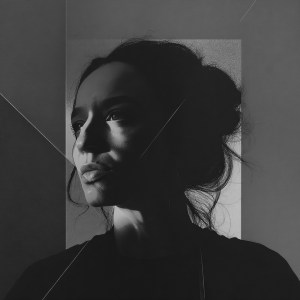
Could you begin by introducing yourself and telling us a bit about your background? How did you first get into electronic music production, and what initially drew you to hypnotic techno and progressive trance?
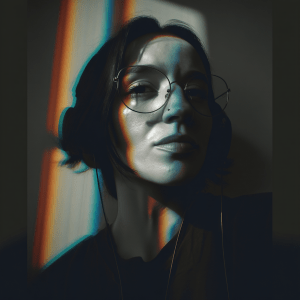
I’m Viktoriia, a music producer originally from Lviv, Ukraine.
My relationship with music started early and quite intuitively. I don’t have a formal musical education. It was more about listening, absorbing, and reacting to what was around me — mostly what the electronic and underground culture scene was offering at that time.
A key shift happened when I discovered Coil. That was a clear turning point in how I understood music. After that, I moved into more experimental directions — ambient, dark ambient, noise, and other non-standard forms of electronic music. That period shaped my listening and later my approach to production. I’m generally drawn to music that doesn’t follow conventional structures — more focused on texture, atmosphere, and sound design than traditional composition. I didn’t start producing with a genre in mind. It came from a need to express internal states. I don’t feel attached to a specific style. Whatever I make is usually a reflection of a moment rather than a defined direction.
Your music balances deep rhythmic propulsion with a strong atmospheric and emotional dimension. When working on tracks, do you think more in terms of physical movement and the dancefloor, or in terms of building immersive inner spaces for listening?
I don’t think in terms of the dancefloor when I work. The process is internal. It’s about translating a feeling or state into sound rather than designing something for a specific context. I don’t approach tracks with function in mind. It’s not about structure for DJ use or audience reaction. It starts from something personal and develops from there. Of course, I can imagine the music being played in a club or experienced physically, but that’s not the starting point. It’s a secondary layer. The focus is always internal first. The external context is not part of the decision-making process.
Your debut Conception feels both very refined and intentionally raw in places. Did you approach it as a statement of intent, or more as a document of where you currently are artistically?
It’s a document of my current state. Not a statement or a concept in the traditional sense — more a direct reflection of where I was at that point. What mattered most was honesty. Not referencing ideas or styles, but capturing something more immediate and internal. I’m interested in contrast — combining elements that don’t naturally belong together and seeing how they interact. That tension is something I often return to. Conception reflects that approach. It’s not about consistency or definition, but about coexistence of different states.
As a young producer coming from Ukraine, how have you found your place within the electronic music scene? Did you feel welcomed into an existing community, or did you have to carve out your own path?
I never approached it as something where I needed to “break through” or position myself in a specific way. I try to stay realistic about how the industry works. It’s a long process, not an immediate one. The main focus for me was releasing my debut album Conception. That felt like a personal milestone rather than an entry into a scene. After the release, I received feedback from both listeners and other artists, which was important and encouraging. But I don’t see it as an endpoint. There are ideas and directions I want to continue exploring. I see everything as ongoing. I feel connected to a wider community, but I don’t think of it as something fixed. It’s more about individual connections than belonging to a defined structure.
How would you define the current Ukrainian electronic scene from your perspective? Are there specific characteristics or sensibilities that distinguish it from scenes elsewhere in Europe?
It has a specific emotional intensity. There’s often less separation between music as a functional object and music as a form of expression. A lot of artists are processing real experiences through sound rather than referencing external trends. Compared to more established European scenes, it feels less rigid in terms of genre boundaries. There’s more openness to ambiguity, atmosphere, and emotional weight. It’s not a unified aesthetic — it’s more fragmented — but there’s a shared sense of depth and seriousness in approach.
Minimal and hypnotic techno seem to have evolved significantly in Ukraine over the past few years, often becoming darker, more textured and emotionally layered. What recent developments within Ukrainian minimal or deep techno have interested or inspired you the most?
What interests me most is the shift away from “minimal” as reduction, toward minimal as texture and tension. It’s not about stripping things down anymore, but about detail — subtle noise, instability, micro-shifts in atmosphere.
I’m drawn to tracks where the rhythm stays stable but the emotional layer keeps changing underneath. That creates a different kind of hypnosis — not purely based on repetition, but on internal variation. It feels less functional and more psychological.
Over the last four years, are there any Ukrainian artists, labels, albums or specific works that have been particularly important for you personally, either musically or emotionally?
There are many artists I respect, but the influence is more atmospheric than direct. What has been important is the overall shift in tone within the scene — toward more introspective, emotionally complex music. It’s less about individual references and more about being part of that general evolution.
The war has inevitably changed the conditions under which music is produced and experienced in Ukraine. Has it altered the way you think about sound, rhythm or the role of electronic music itself?
Yes, but not in a literal or conceptual way. It’s more about perception. Sensitivity to tension, silence, and dynamics becomes more pronounced. Rhythm can take on a different role — not just structure, but something grounding, something stabilizing. At the same time, I’m aware of not turning real events into aesthetic material. That boundary is important. Electronic music can function as escape and as processing space at the same time. Sometimes those overlap.
Looking ahead, how do you see the Ukrainian electronic scene developing in the coming years? Do you feel a new generation of artists is beginning to redefine what Ukrainian electronic music can be?
It’s already happening. There is a younger generation that is less focused on fitting into external frameworks and more focused on developing its own language. That will likely lead to more diversity rather than a single direction. Some artists will move further into experimental territory, others will reshape club music in more emotional or conceptual ways. There’s less dependence on external validation now. That shift is important. The result is a scene that is more self-defined, but still fluid.
What does it mean for you to be Ukrainian?
It’s not something I approach as a fixed identity. It’s more about perception — a certain sensitivity and awareness of tension between fragility and strength. It’s something lived rather than defined.
MAY 15, 2026 – KYIV
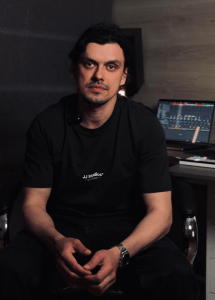
First of all, I’d like to thank you for the opportunity to do this interview — it really means a lot to me.
I was born in Ukraine, in a small city called Poltava. My love for music started in childhood — back in the days of cassette players and endlessly replaying the same tape. At different times I listened to all kinds of music: rock, rap, and more.
At the same time, I started taking guitar lessons, and I was especially inspired by classic rock like Led Zeppelin — Jimmy Page completely blew my mind. That was a great time.
Closer to my twenties, around the mid-2000s, I got deeply into electronic music. But not the kind everyone was listening to, like The Chemical Brothers — I was more into niche sounds. I had a friend who used to share this kind of “exclusive” music with me. I remember he gave me a CD with “Tresor” written on it, with some kind of cosmic music. At the time I thought Tresor was an artist, but later I found out it was actually a club in Berlin.
My taste was shaped by artists like Adam Beyer, Chris Liebing, and James Holden. I’d especially like to mention Thomas Schumacher’s album Home — it really supported me through different periods of my life. I also remember a 5-hour experimental set by Gabriel Ananda that I came across back then — it left a strong impression.
Later on, I felt the urge to start making my own electronic music. I launched my first project under the name Valde Bene. It was a strong start — I worked a lot on it and released probably more than 50 tracks on different labels. The music ranged across deep techno, techno, and electronic sounds, and it kept improving year by year.
But in 2022, due to the war in Ukraine, I had to take a long pause, and eventually I decided to close that project.
Has the full-scale invasion changed the way you think about sound and music in general, and has it affected your setup in any way?
Yes, after the full-scale invasion began, I went through a very difficult period — full of anxiety, depression, and a complete lack of motivation to create. This ultimately led to me closing the Valde Bene project.
After some time, I slowly recovered and started a new project — NACHASI. Interestingly, I became deeply interested in modular synthesis and eventually built my first modular system with some great modules.
It’s been an amazing journey — full of experimentation, sound design, and, of course, a lot of money spent  Huge thanks to my wife for her patience — I honestly thought she might kick me out at some point when I kept bringing new modules home
This whole modular journey helped me distract myself from everything happening around me and gave me hope and new energy for developing the NACHASI project.
What can you tell us about the production process for your release Aether?
Aether is my first release in a long time under the NACHASI project. It was created using Ableton, some modular synthesis, and a couple of Elektron machines.
Over the past six months, I made around 20 tracks, but only four of them made it into the release — simply the ones I liked the most
I’m really happy about this release. And big thanks to the guys from the Vortex label, where Aether was released — they did a great job, and I can definitely recommend working with them.
How would you describe the techno scene in Ukraine, and what have been the most interesting developments over the past few years?
To be honest, I haven’t been very active in the scene lately — it’s a difficult time in Ukraine right now. So it’s a bit hard for me to fully evaluate everything that’s happening.
But from what I can see, the scene is still alive, and that’s something really important. That’s also one of the reasons I decided to release my music on a Ukrainian techno label — as a way to support the culture.
Generally speaking, how has the full-scale invasion impacted the clubbing scene in Ukraine, and has martial law with curfew hours changed the way live sets are approached? How do you see it developing?
The biggest change, in my opinion, is the timing of events. Many parties now take place during the daytime, inside dark clubs — and it’s a very unusual feeling to be at a “night” event during the day.
It’s hard to predict how things will develop, but I believe many people hope and believe that after the war ends, there will be strong growth in many areas — including the techno scene.
Are there any Ukrainian releases from the past four years that have captured the current times for you or felt particularly innovative?
I really enjoy listening to Ukrainian artists like Stanislav Tolkachov, Svarog, and Na Nich. In their recent releases, you can feel the depth of what’s happening, as well as an innovative approach to music production.
What does it mean for you to be Ukrainian?
I’m proud to be Ukrainian. But at the same time, sometimes I just want to take a breath and feel like an Italian or Spanish person for a moment
What book / film / poem / building / dish / album / song / meme best describes Ukraine for you right now?
I’d say it’s my mother-in-law’s borscht
I hope she reads this interview
I’d also like to include one of my compositions from a previous project, written back in 2016. It’s a track that still feels relevant to me today — it reflects the sound I was exploring at that time and, in a way, connects my past and current artistic direction.
NEW RELEASES
Yana Pavlova & Pavel Milyakov ~ Thrill
Thrill — the third full-length album which we recorded together with Yana Pavlova is out today. We started working on it back in 2021 and it was emotionally challenging to finalize the mixes and to prepare it for the release throughout the last year. It felt particularly important to pay the deserved tribute to Yana’s legacy and to make it sound the way she’d love it. Burnt out and heartbroken after months of relistening to different versions of these songs, I really hope it will find its listener.
Our first ever performances were planned at @boursedecommerce and at @rewirefestival back in April ‘22, tho it never happened. I am still forever grateful to @cyrusgoberville and Bronne Keesmaat for inviting us to perform. I remember how Yana was happy and excited about it and how sad she was about having to cancel these and all the following concerts.
We never shared the stage together and last time we’ve seen each other was exactly 4 years ago. It was a sunny spring day, just like today. We had a nice walk at the sunset, hugged and promised each other to meet soon. Since then we were constantly in touch and were working on these songs remotely up until Yana left this world.
Your strong spirit and unique sense of humour helped to go through the darkest days. I dedicate this album to you and I urge everyone who will like this record to support it and to spread the word about it. 🎶 [Pavel Milyakov]
V/A ~ Aftermath and Transitions (Traces Of The Ukrainian Underground in Cologne (1994-1996)) by STROOM.tv
The album compiled 20 tracks recorded between 1986 and 1992 by 14 bands out of Kharkiv and Kyiv – music beyond the usual Perestroika records, often with jarring dissonances over grooves that fans of Captain Beefheart or The Fall would certainly enjoy. On the other hand, there are tracks featuring flute and trumpet that seem inspired by folk, classical music, and punk. Ghostly chamber prog miniatures by Cukor Belaya Smert (lit. Sugar White Death) from Kyiv featuring, among others, the classically trained pianist and singer Svitlana Nianio (née Ochrimenko) and guitarist, visual artist, and spokesman Yewgeny “Yenia” Taran. Nianio sang in her native Ukrainian, as did two more of the bands. Today, this seems more relevant than ever, more culturally and historically significant from a Ukrainian point of view than it was even in 1993. Young Ukrainians were amazed at that time that rock music sung in their native tongue could work!
Koloah ~ You Can Get Me
MUSAR is proud to introduce Koloah, the newest voice in the family. Making his label debut with You Can Get Me EP, the Kyiv-born, Berlin-based artist arrives fully formed: three original tracks that move between restless grooves and expansive, immersive sound design, accompanied by a brain-melting remix from rising French star Binary Digit.
Radiant Futur ~ Critical Mass
During his ten-year musical career, Ian managed to crystallize a clean and recognizable electro sound with endless cascades of synths and quite hopeful and bright melodies, even when it comes to tracks on rather gloomy topics, such as the Chornobyl disaster. You will not find samples in his compositions now, or even field recordings, despite his professional activity as a foley artist for special effects in films (check out his profile on IMDB!). Waldorf Blofeld, Electrons, Korg Monologue, 303s & 808s and God knows what else can be heard in his compositions under 432Hz.
Mystictrax invites you on a science fiction journey into a bright future on the “planet-cracker” class spaceship «Critical Mass» from one and only Cherkasy-born genius nugget Radiant Futur! In support of the three original tracks, a radiation demagnetized proggy remix (for adults only!) by Kyiv-based eccentric Luschn is added.
Fedir Tchakov ~ Warnings
I was always happy to rediscover this recording while sifting through old drives and backups.
The first release of the new Legacy Series, “Warnings”, is a dynamic and emotional cello improvisation with a sound-on-sound delay, recorded in 2016. It remained hidden all these years – until now!
Back then I wasn’t thinking of music in terms of narratives and stories connected to it. But today, this long track and its movements feel like warnings from the past – about how things are now, and where they might go next. Warnings of events I couldn’t even imagine I’d witness in my lifetime.
Going forward, the Legacy Series will give a spotlight to different music I produced over the years that was either released, but not really noticed, or not even shared with anyone outside of the closest circle.
Oriole Nest ~ Ode to Love
Ode to Love is an intimate exploration of love in its various states: from fragility and intimacy to loss, memory, and returning to oneself. Oriole Nest (Tetyana Osin) — a folklorist and researcher of traditional music, co-founder of the band Vilce — combines her own sound with traditional song materials. The album is based on folk songs recorded during folklore expeditions to Polissya, poetry by Osyp-Yuriy Fedkovych, and the performer’s own lyrics. The sound of the album balances between an intimate vocal presence and minimalist, almost meditative structures, where tradition exists as a living form of experience.
Tongi Joy ~ Saliva Pond
just a little album of musical mischief that served as a makeshift shelter during unfriendly days. though, to be fair, it was quite drafty.
when you download it, you’ll get a PDF file with links to demo recordings from its creation period.
Sasha Pervukhin ~ Kharkiv Techno City EP
W & P in 2026 in Ukraine/Kharkiv during tha war / 20km to frontline
DID: Didge and Digital ~ Shrooti Loops
Anton Boldenko – shruti box, pedalboard, roland microcube, didgeridoo
Stanislav Bobrytskyi – recording, mixing, mastering
støïbrok ~ outpatient treatment
Mixing pure improvisations with recordings by phone recorder with old laptop. Noisy, harsh, doomed sound representing feelings when you on treatment you don’t like.
Anton Humenyuk ~ Life Goes On
Three compositions combining an improvisational approach, poetic sensibility, and a rich palette of sound. Written between 2019 and 2022 in Uzhhorod.
Travis or Alice ~ Travis Goes Deep
The boy within the girl and the girl within the boy, laughing when it’s time to cry and completely lost when faced with joy. She was a child when someone told her feelings were too much. So they stayed small. Only irony remained. Something she’d forgotten came back all at once when a silhouette placed a sampler in her hands: she smiled. Then a tear dropped, half from happiness, half from grief for the years spent numb.
On this debut EP, ‘Travis Goes Deep’, Alice explores creation through a spectrum of these polar states. She scrapes a nail file across a DIY contact mic — a jagged ritual that warps the signal into something hauntingly human. Her world is built from the friction of pink noise and glitch textures, grounded by distorted basslines and raw, punk-tinged vocals that suddenly break into sweeping, melodic light.
It’s the anxiety of recognizing an identity formed by both the heavy and the light; a movement between raw fear and the physical tremor of self-realization. The remix by Na Nich anchors this story with a monolithic line of dark DnB, adding a final, grounding dimension to the journey.
The visual world of the project was shaped by Berlin-based artist Sophus. Working on textiles, he channels emotional and spiritual states into raw, living forms. His tactile imagery — reminiscent of neural networks or internal fractures — becomes a natural extension of the physical world Alice captured in her music.
This EP drops the listener into a space where external landmarks vanish. And leaves them there — to listen inward.
The digital release of the EP was created in collaboration with the Ukrainian label Mystictrax.
Moon Projection ~ Breath of Life
CJ Plus ~ Black Pulse
Classic electro filtered through the industrial roar of factories and club techno.
The album takes the listener on a journey through mysterious cosmic worlds: 80s analogue synthesizers intertwine with pounding techno beats, acid basslines and the metallic clang of machines. Cold neon groove, deep cosmic hypnosis and dark energy that makes you move to the rhythm of distant galaxies
Saturata ~ Wavetrain
Saturata has said little about the recording process except that portions were made “somewhere on the Odesa waterfront, very late, in poor weather” and that the source material for Wavetrain came from a sound recorder left running on the pier overnight, capturing nothing but the sea and the faint bell-like clang of a buoy shifting in the swell — a rhythm so slow it barely registers as rhythm at all. Delayed (Indefinitely) closes the record — a loop that is almost recognisable, almost a melody, before the delay network swallows it entirely
SI Process & Dennis Adu ~ Just to be a human (2026)
In a world where everything is constantly accelerating, almost 9 minutes is an unattainable luxury for some, but when reality is rushing into the abyss before your eyes, these minutes don’t seem so long anymore. Please find them. Just stop for a moment. Calm down, remember, dream and thank yourself. Let go of everything that defines you in this moment and just be a human. Just to be a human. Enjoy the dive.
Daniela Mars ~ Protected
Protected is Daniela Mars’s first soundtrack album for Joel Espi’s documentary film Protected. The film follows the artist Halyna Andrusenko and the work she created during the war. Here is a short introduction which you can find in the album booklet:
Introduction
I really wanted this album to act almost as an extension of the film. Music and the moving image are two art forms that you cannot hold or touch. You can only experience them in the moment. That very moment. And then they are gone. Their ephemerality is part of their beauty. I wanted to offer something we can actually hold in our hands, almost as if freezing the music and the images of the film so they can exist beyond the screen and our speakers.
Finding the music for a documentary filled with elements of both war and life was a challenge I had never faced before. Thankfully, Joel, the director, was incredibly helpful and clear in explaining what he wanted.
The first piece is called Life is Beautiful. Towards the end of the documentary, Halyna, the featured artist, mentions how much she loves this film by Roberto Benigni, and how the father protects his son from the reality of the war. She said she would want to do the same for her child. In this way, the album opens with the themes of life and pure parental love.
I also wanted to create a leitmotif for Halyna. Her melody appears several times throughout the album, each time in a different context, reflecting the various aspects of daily life that have changed since the beginning of the war in Ukraine.
I cannot explain here what each piece means, both to me and within the context of the film. Or perhaps I could, but I choose not to. I would rather the listener arrive at their own conclusions, and some of these meanings may simply be too personal.
With texts from the director, reflections from the featured artist, and images from the film, I am very happy to share this with you. [Daniela Mars]
Natalia Tsupryk & Angus MacRae ~ Inventions
Atmospheric, plaintive and deeply nostalgic, ‘Inventions’ is the debut album from Ukrainian violinist Natalia Tsupryk and British pianist Angus MacRae. Spanning 12 intimate tracks recorded over a period of 5 years, the album brings together music from their two EPs, 2021’s Silent Fall and 2023’s II, into an album for the first time, preceded by three brand new tracks. Drawing on influences from Ukrainian and Scottish folk, film and electronic music, this unflinchingly honest debut has a pastoral, earthy quality that resonates with a deep sense of yearning.
Danya Pilchen & Kali Ensamble ~ Paper Braids
Paper Braids came out of a long collaboration between me and the wonderful musicians of the Kali Ensemble. Through a series of workshops, residencies, and performances over the course of four years, we built up a collective practice focused on three topics: listening as the basis of musical interaction, awareness of how sound interacts with the performance space, and using that spatial awareness as a basis for both the duration of individual sounds and the temporal unfolding of an entire piece.
All three focal points of our practice are represented in this piece. Paper Braids is tailored specifically to the acoustics of the Orgelpark hall and the tuning and timbral specificities of the four organs I used: Utopa and Sauer controlled algorithmically via the Hyperorgan console, the romantic Verschueren, and the meantone Van Straten organ. At the same time, the speakers and microphones are placed at four different spots in the hall to induce acoustic feedback in response to the organ sound.
The idea of feedback is a core structural principle of the piece: not only is acoustic feedback responding to the sounds of the organs, but so is the listening of the musicians to the sound in space is guiding their performance: their scores look like ‘maps’ of the sounds in space, and they orient and build their own trajectories based on the sounds they hear. Simultaneously, the algorithm controlling the Hyperorgan reacts to certain sounds as they occur in the space, triggering different events on the organs in turn. — Danya Pilchen, November 2025
Vlad Suppish ~ Drones & Noises for Every Wednesday
Something ends, yet something begins.
What started as preparation for live performances at ‘Noise at Every Wednesday’ events, became independent compositions when ‘Noise at Every Wednesday’ itself unfortunately ceased to exist.
“Everything is broken up and dances” as Jim Morrison said.
Drone as the initial point of focus and noise as the potential infinity of the soundscape.
And also atonality that tests and changes the boundaries of what is permitted.
The space between notes that makes the space between the ears work.
This is a modular release made mainly on a modular synthesizer.
Switch from drone to techno whenever you want, or listen to the release in its entirety from start to finish for maximum trance=fixion (sic!) and immersion.
This is a solo release without any compromises
Loud, uncomfortable, incredible
Noise – it’s real
Noise – it’s us
Low Communication ~ Encounter with Aliens
Bohdan Linchevskyi, performing as Low communication, makes his debut on Not Yet Remembered, offering four tracks that balance between tense melodies, cosmic synths, cold and acidic sequences, crushing basslines.
“Encounter with Aliens” is crafted in an old-school fashion, featuring a rather chaotic kick drum; however, this rhythm is enough to allow the cold synth parts to unfold and drive the track forward amidst a resonant ambience.
“We Don’t Trust”, with its house-inspired structure, brings a sense of brightness to the album, where a disco bassline and acid elements go hand in hand, intelligently complemented by strings and sweeps.
The EP concludes with two high-tension electro tracks, “Supernatural Force” and “Acid Won’t Help”. Both are written in the Locrian mode, which gives them their signature dissonant sound. The former features layered hardcore kicks, metallic synths and unpredictable sequencing. The latter also maintains a hard-hitting beat, moving through sweeps and horns before being joined by a “brain-melting” acid line, altogether creating a true space blast.
kyïvite ~ broadcast 08/05/26
Format: radio broadcast.
Samples: recordings from Mikhailo Khai’s folk expedition (90s-00s).
Recorded by: Mikhailo Khai, Mykola Semynoh, Oleksandr Kytastyi, Valentyn Honcharuk
Performers: «Fesia» children’s ensemble, Mykhailo Tymofiïv
On air: radio “Kyïanochka”.
Del Cano ~ Farvater
“I see this album largely as a nostalgic reflection and a reminder of home, freedom and carefree days.
It’s also an album for those moments when life feels like no life at all, when everything is on hold and you don’t know what to live for – whether it’s thoughts of the future or sinking into nostalgia.”
(words by Serhii Vovk @del.cano_, @vovk.ss, Lviv/UA, April 2026)
****
“Klikerklub would like to thank Serhii for his courage and openness in entrusting his music to me. I would also like to express my deep respect and humility for his ability, in times like these, to create something truly beautiful and valuable – something that will endure and stand the test of time. Thank you, Serhii!!”
(words by Heiko Jungnitz aka @klikerklub, Berlin, April 2026)
Mormon Tea ~ Into the Pond
äsc3ea ~ ARMAZI: Score for Performance by Fagatta, Queer Deities
TĒMNA RÁDIST ~ Ligth of Shadow
My electronic mosaic. A dance of light and shadow. These opposites forge the whole universe. This endless cycle of contrasts reminds us that every shadow unfolds into light, and every beam carries the echoes of night. By embracing this duality, we discover true selves.
The second track was written together with my beloved husband, composer and cellist Mr. Sad Vlad aka INVISIBLE KIDS.
Vlad Yakovlev ~ Човники
58918012 ~ Amoeba Project
Hello! This album is pretty spontaneous, and I would even say that this is more of a collection of tracks from different time periods than an album. Anyway, it’s here. I have a few words to explain what it is.
I have the ambient YouTube channel: www.youtube.com/c/sleeptrip I have been running it since 2020 (since I began to release music as 58918012), and sometimes it was hard to find something to upload. Amoeba was my way out. I made this project up and wrote a track every time I needed to fill the gap between uploads.
Recently, I figured out that there are already 10 tracks of the Amoeba project. I put them all together, slightly remastered, and decided to release this stuff on Bandcamp Friday. Because why not? Honestly, I like this music. It sounds raw, dark, somewhat rough, and emotional (reminds me of my early releases). Just in case, the tracks are sorted chronologically from the oldest to the newest one (from top to bottom).
This album will only be available on Bandcamp. Maybe someday, I will release it all around the DSPs, but at this point, I don’t plan to. So, I am happy that Amoeba now has its “face”, and you can listen to it. Enjoy the music, and stand with Ukraine!
NACHASI ~ Aether
Balance between minimalism and intensity is evident in the four-track debut release from Kyiv-based techno producer NACHASI, formerly known as Valde Bene.
Each track unfolds as a separate story, combining layered textures and a gradual, hypnotic progression. The raw yet refined presentation gradually immerses the listener in a dense space, emphasizing detail, tension, and a full-bodied sense of dimension and the experience of sound.
Human Margareeta ~ help me
The track was made in 2023 as a message to the nocturnal void: a cry for help, a plea for silence and balance in a chaotic world. The sensation of frustration was enhanced by a decade of sleeping disorders experienced by human margareeta. The line “I just wanna sleep” is both the crescendo of the track and the exaltation of this frustration.
Looped, distorted vocal phrases dissolve into a texture where barely intelligible words are imbued with a sense of tension. The composition has an abruptly shifting BPM – from 120 to 176. Parts of the vocal were recorded through an old-school telephone receiver. In some ways the composition is a plunderphonic omage to “Maiden Voyage” by Herbie Hancock.
Kotra ~ Dim Ren
“I know that I hung on the windy tree
For nine whole nights
Wounded with the spear, dedicated to Odin
Myself to Myself”
– Odin, Hávamál
Музична Шкатулка ~ Події
✂️ Imagine that you could take a stream of events, straight from the raw output of your perception, slice it thinly, and examine every possible cross-section. Then you would be able to observe the constancy of movement and the movement of constancy, and see what the entire process of your own perception truly is.
That is exactly what I did on the album Podii. It is a non-narrative conceptual album built entirely on the peculiarities of my own perception of the world.
Work on the release continued for two years, from spring 2024 to spring 2026, though some tracks use samples or were written years earlier. In a way, this work encapsulates the direction of my work since 2022, but not the work itself.
Thank you to the friends who gave permission to use their music for samples, and thank you to those who inspired me to create these compositions and offered advice during the endless revisions.
Each composition embodies a moment stretched out in space.
Each composition has a sister.
Each composition means nothing.
VIEWING ROOM
(Gianmarco Del Re)


Pingback: Ukrainian Field Notes LV: interview with Cells Interlinked – Cells Interlinked
Pingback: Ukrainian Field Notes LV: інтерв’ю з Cells Interlinked – Cells Interlinked
Pingback: A Closer Listen Reviews – Avant Music News