
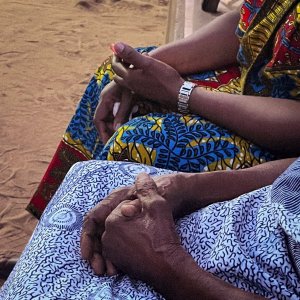
 You can’t go home again, writes Thomas C. Wolfe in Look Homeward, Angel. Paris-based artist Aho Ssan (Niamké Désiré) experienced this feeling of disconnection when he visited Ghana, his ancestral home. The friction between home and homeland led to The Sun Turned Black, an intense and visceral LP characterized by the physicality of sound. One can hear him working through dissonance, sculpting impressions as if they were cascades of sound.
At the direct center of the album is “The Children of Noise,” the first track to be composed, featuring ASIA on violin. The piece may remind some of Ego Death, the artist’s collaboration with Resina. Building and collapsing, sinking and resurfacing, the track, and its central melody, struggle to find definition, mimicking Aho Ssan’s ancestral journey. One wonders at the phrase children of noise, and whether it might imply that we become what we hear. “The Sun Turned Black” contains great struggle, but also underlying beauty, a continuing theme in the artist’s work.
The bracket works, “Sunrise” and the title track, create a framework for the set. At the start, a soft rustle expands and explodes like a burst of morning sun, brief yet sublime. Shimmer launches the closing piece, which flutters like dappled light, reaching even greater heights before its dissipation. But the bulk of the album is given over to the four-part “100 Suns,” which is also the title of a book by Michael Light chronicling the era of visible nuclear testing, and obliquely refers to the Bhagavad Gita’s vision of a thousand suns rising at once. The common thread is one of obliteration: light too powerful to view. During the peaks of “Pt. I,” this is translated into what sounds like a hundred or a thousand tracks being played at once: a sound almost too powerful to hear, engulfing all other sounds in its vortex.
“Part II” adds electronic patterns, which include micro-melodies and copious blasts. Were it not for those bracket tracks, one might wonder at the structure; the hundred suns threaten to break loose, liquifying the surface with their mighty rays, and their containment unit is worryingly thin. Just as the second movement threatens to topple into abstraction, the violin surfaces, offering to lead the way out, while “Pt. III” introduces surprising clarity before pulling the rug from underneath. The ten-minute “Pt IV” slowly grows in intensity until it flames out, popping and sputtering to the end like the final embers of a fire.
At no point in the album does the listener feel safe, settled, reconciled or at home. The restless nature of the set reflects the spirit of the artist, to whom neither birth home nor ancestral home feels authentic. Giving voice to this “state of “diasporic in-betweenness,” Désiré – whose name in this context seems poignant – reflects the feelings of immigrants and the displaced, who discover that the home for which they yearn may only exist in the mind. (Richard Allen)


Pingback: A Closer Listen Reviews – Avant Music News