
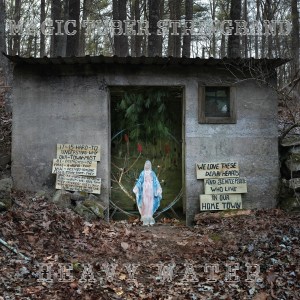
 Imagine living in the “best town,” a rural community of friendly neighbors surrounded by natural beauty, and then being forcibly displaced so the government could make nuclear bombs. This is what happened to the shellshocked citizens of Ellenton, South Carolina in 1951. A research project at the nearby Savannah River, testing birds to see if they were still radioactive (they were) prompted the members of Magic Tuber Stringband to compose Heavy Water, a soundtrack to a centuries-spanning tragedy whose environmental and social consequences are still being felt today.
The opening track and lead single, “The Death of Ellenton,” loops and processes the 1951 track of the same name by the Johnson Family Singers. As the members of the ensemble improvised over these recordings, past and present merge into a statement of outrage and grief. Even the banjo, so often heard as comforting, seems to wail and moan. “Marker of a Drowning” recalls a couple who fell into the river and drowned in the century prior to the arrival of the power plants, marking the area as a site of sorrow, foreshadowing the fate that was yet to come. “Sound of a Million Stars” connects South Carolina to Japan, an homage to Tomonari Nishikawa’s buried and irradiated film of the same name. The track is an exercise in cacophony, a vast, unrelenting drone of excessive sound that imitates the local experiments. This bleeds directly into “Woodpeckers,” a short yet serendipitous piece that captures that sound of alarmed woodpeckers responding to military training exercises.
The ensemble spares no effort to connect its music to time and place, while reflecting the tone of a haven transformed into a killing field. Even the little church – because perhaps it couldn’t bear to watch – was hauled away. For the full story, we recommend the copious liner notes found on the release page. The use of fiddle, banjo and pump organ recall the 20th century Appalachian South, while the tape loops and avant manner of play anchor the album firmly in the 21st. On occasion, the two nestle against each other, as when a sublime melody rises from dissonance in “Blooms in the Rapids.” “Where the Place Becomes Forgetting” showcases the sounds of peepers and cricket frogs in a lake beside a chemical waste plant, underlining the fact that nature will find a way; this should not, however, be seen as encouraging as the conditions are far less than ideal and the area, once home to thriving ecosystems, remains inhospitable to all but the hardiest creatures.
Heavy Water is marked by a balance between sweet and sour, welcoming and dislodging. Sample the album in just the right area, and one will recall with some poignancy the former communities of songbirds and settlers. Drop the needle on dissonance, and one will feel the discomfort of rich industry ruining yet another treasure. As Bonner Smith writes on the sign seen on the cover, “It is hard to understand why our town must be destroyed to make a bomb that will destroy someone else’s town that they love as much as we love ours.” As “Wintering Grounds” breaks into a jig with a snatch of happy song, one thinks less of the area’s current status than of the dreams that once sustained a populace. The reverie is snapped by the atonal beginning of”Soft and Pliable,” which leads to the denouement, inspired by the story of St. Christopher, who once carried Christ across a river – the antidote to “Marker of a Drowning” – expressing hope that miracle might yet occur.
Even today, New Ellenton is only one-third the size of the original Ellenton. Their city motto: “We didn’t move away. We just moved.” Visit the area, and one will see children wearing atomic logos on their chests; their nickname, whether given in pride or jest, has stuck. Welcome to Atomic City. (Richard Allen)

