
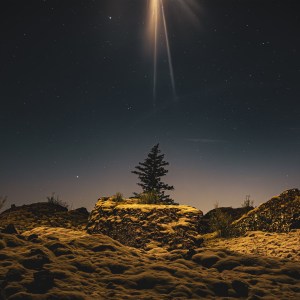
 What would happen if one were to mix LSD with fundamentalist Christianity? Hammock‘s Marc Byrd learned the answer when watching the moonrise and mistaking it for the apocalypse. Looking back, Byrd writes of “letting go of toxic shame and bad religion, while holding onto what is good, beautiful and true.” Rather than lamenting the delayed rapture, he writes, “Seeing and experiencing a moonrise is a miracle in itself.”
The Second Coming Was a Moonrise reimagines Christianity as a religion of seeking and sometimes finding, in which beauty possesses more power than dogma. The fact that Byrd references Philippians 4:8 in his description – and that by adding ten guests, he and Andrew Thompson end up with a group the same size as the twelve disciples – demonstrates the manner in which faith follows the duo, even when unintended. But often the associations are direct; the title “We Close Our Eyes So We Can See” conjures John 9 and the concept of spiritual blindness, while offering a humble alternative.
Amusingly, Byrd speaks of fans who call the duo’s offerings “loud Hammock or quiet Hammock.” The Second Coming Was a Moonrise is loud Hammock, jam-packed with post-rock and shoegaze timbres, immersive in sound and confident in approach. This is not to say that everything is loud, but that the quieter segments support the loud rather than the other way around. “Inbreaking” allows the music to inch forward for a minute before the drums surface, but already one knows that this will be one of Hammock’s more rocking affairs.
The density of the swirling guitars provides a sense of comfort, communicating in sound what religious passages convey in words. This being said, there are a few words on the album, such as “maybe we will see the light,” an overture that prompts the eyes to look to the heavens. The very fact that Hammock keeps the torch burning through all manner of suffering (see the topics of past albums) is encouraging. The duo continues to hope through “Sadness” and setbacks, such as the tornado that hit Thompson’s home and studio, inspiring “Like Sinking Stars.” When hearing the blurry lyric, “the stars came tumbling down beside us,” it’s hard not to hear the last two words as “Messiah.” After a reflective period in which losses are absorbed like lyrics in a sonic stream, the album arrives at its peak moment: the triumphant title track.
“The Second Coming Was a Moonrise” is the epitome of loud Hammock. Beginning with gentle, reverberant guitar, the piece opens up swiftly to expose a prairie of instrumentation: the strings stretch across the horizon like moonbeams, the percussion creeps like shadows across the grass, and then the entire production explodes like a revelation: I was blind, but now I see. Additional power is provided by the coda: two minutes of quiet Hammock, reflecting on the experience, accumulating insight, attempting to translate a peak experience into a lifetime learning.
The closing tracks return the listener to reality, offering a challenge: can one apply the wisdom that one has gained to the next struggle? The track titles “Everything You Love Is Buried in the Ground or Scattered Into Space” and “All the Pain You Can’t Explain” recall Mysterium, Silencia and Love In the Void. Sometimes there will be no answers. Sometimes the pain will continue. Sometimes the Messiah won’t appear, but will send a moonrise. And will that be enough? One might ask Job, who was reminded of the glories of this world, and was satisfied, even without the restoration. The fact that the album ends in another massive crescendo implies that a second summit has been reached. The pain may remain unexplained, but the presence is a healing balm. (Richard Allen)

