
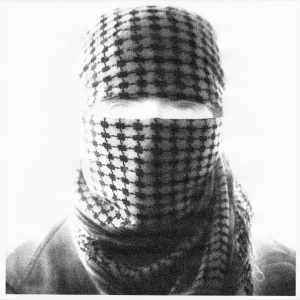
Firas Shehadeh’s Depth Map transforms noise music into an act of forensic listening. Where 2025’s The Heaviest Shrouds Are The Smallest Ones unfolded like splinters of raw grief and collapse, Depth Map feels colder, more systematic: an attempt to trace what Shehadeh calls “the infrastructure of technologically advanced barbarism.” Built from live improvisations in noise, loops, and field recordings, the album maps the machinery of contemporary warfare: drones, surveillance systems, AI infrastructures, and media propaganda.
The opening title track immediately establishes this tension. Urban field recordings and fragments of street chanting surface two minutes into the piece before being swallowed by distortion and electronic interference, as if reality itself were being obfuscated in real time. Across the record, traditional Arabic melodic lines appear only to be interrupted, fragmented, and dissolved. On “Diss Track to F.T. Marinetti,” alluring instrumental motifs never fully cohere into melody, jammed and silenced by glitches before they can stabilise. The gesture is deliberate: culture under siege, continuously erased and reassembled.
The album’s conceptual backbone — linking Marinetti’s Futurism to the techno-capitalism of Palantir’s Alex Karp — gives the work unusual precision. For Shehadeh, contemporary AI and surveillance systems are not accidental distortions of technology but the continuation of a fascistic logic that glorifies efficiency, domination, and mechanised violence. Noise here is stripped of industrial fetishism and returned to lived experience. As he explains in the following interview, these are not abstract sonic textures but the actual sounds Palestinians live under: drones, bombardment, psychological terror, and continuous surveillance.
Yet Depth Map never settles into pure assault. Tracks such as “Kill-Feed” and “Dhulfiqar” develop ritualistically through repetition and slow accretion, allowing tension to build without cathartic release. The barrage remains sustained, infrastructural. Elsewhere, “Pure War” plays out as a direct indictment of international complicity, while the closing “No Agreement” deconstructs traditional motifs into glitches and broken rhythmic fragments, mimicking the disintegration of collective memory itself.
What makes Depth Map so unsettling is not simply its brutality, but its clarity. Shehadeh understands contemporary warfare as inseparable from systems of representation — livestreams, algorithms, predictive models, social media edits, and AI-assisted targeting. The album functions as a form of counter-mapping, exposing the hidden architectures through which violence is managed, aestheticised, and normalised. This is not noise as abstraction, but noise as political testimony: a record that insists technology is never neutral, and that every signal carries the imprint of power.
To better understand the context of the album, Firas Shehadeh kindly agreed to discuss the production process and articulate the intentions behind the work.
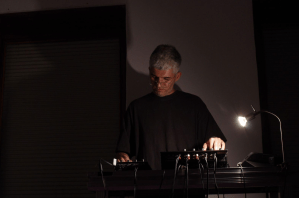 Could you begin by introducing yourself and talking a bit about your background? Your practice moves between sound, film, gaming, installation and speculative worldbuilding — how did these different strands come together in your work?
Firas Shehadeh: I am a Palestinian artist and a refugee from Al-Ramleh, and I grew up in a refugee camp in Jordan. For me, sound, film, gaming, and digital media are not just mediums I chose to work with, they were the very environment I was surrounded by.
Living in the camp, these forms of media initially served as an escape from a harsh immediate reality, a way to cross over into the world beyond. Alongside constant political coverage, I watched live breaking news that permanently shaped me: the bombing of the Al-Shifa pharmaceutical factory in Khartoum in 1998, the killing of twelve-year-old Muhammad al-Durrah in 2000 in Gaza, and the bombardment of Baghdad in 2003. Media became a vehicle to transcend the physical borders of the camp, allowing us to connect with other Palestinians isolated in different camps, to connect ourselves to our stolen land, and to see the world outside.
I became fascinated by the sheer potentiality these media held, particularly as tools to communicate and share my people’s stories and ongoing struggle. My worldview was forged in the friction of the late 90s and early 2000s: caught between the heavy geopolitical realities of the Intifadas and the Gulf Wars, and the reality of the camp. Yet, this was also juxtaposed with gaming consoles, satellite images, Flash videos, the early internet, building local HTML personal websites, and trip-hop. This contrast sparked an early obsession with questions of the real versus the hyperreal, how technology influences societal development, and who controls the media apparatus that dictates these narratives.
Sound, film, gaming, and installation all share a unique trait: they are not just containers of information, but portals. By bringing them together, I am able to move past passive storytelling and enter the realm of speculative worldbuilding. It allows me to deconstruct the rules of media and actively participate in constructing a world that reality currently denies us.
Your latest album Depth Map is described as tracing “the infrastructure of technologically advanced barbarism” through noise, loops and field recordings. What first sparked the idea for this project, and why did you choose the concept of the “depth map” as its organising metaphor?
FS: A depth map is an AI tool known to professional film colorists; it calculates spatial distances within an image to give a better reading of dimension and simulate an artificial depth of field. But like so much of our consumer media, it began as military technology designed for the battlefield, just like the camera or the sound recorder or the internet. Whether utilized in surveillance, propaganda, or psy-ops, Western technological advancement has historically been engineered for domination and exploitation. In response, the dominated and the exploited, the natives, have always had to reverse-engineer these tools to counter the technological apparatus used by colonial powers. It is a continuous arc, stretching from the 1840 naval bombardment of Akka by British and Austrian forces to the ongoing genocidal campaigns in Gaza and Southern Lebanon. For Western colonial powers, this systematic barbarism is reduced to a question of efficiency, logistics, body counts, and perception management.
The idea for this record is anchored in these parallel realities across Palestine, Lebanon, Sudan, Yemen and Iran. I wanted to examine how these technologies are actively marketed to us through a sanitized narrative of global progress, prosperity and transparency. The only difference now is that Silicon Valley no longer feels the need to advertise its innovations in the language of “connecting people”, it is explicitly about managing people.
We see this infrastructure laid bare in the American “Israeli” war on Iran, where corporate and military interests collide, the war itslef becomes a testing ground for new products and an advertisement opportunity for other fascists to see these killing machines in the real world.
Openly fascist Political figures like U.S. Secretary of War Pete Hegseth publicly clashed over the guardrails of Anthropic’s AI model, Claude, pushing for its integration into military applications. Now, firms like Palantir utilize these exact models to power Lethal Autonomous Weapon Systems (LAWS) and mass surveillance infrastructure. The horrific endpoint of this “automated efficiency” was realized in the Minab school massacre, where American and “Israeli” military forces blindly executing automated target data murdered over 175 school girls and their teachers in a horrific double tap strike. Depth Map is an attempt to map this terrifying grid through sound.
The album traces what you call an “industrial arc” from Marinetti’s The Battle of Adrianople to the Alex Karp manifesto. Why was it important for you to connect early Futurism and contemporary techno-capitalism? Do you see today’s AI and surveillance industries as continuations of a specifically fascistic aesthetic logic?
FS: Filippo Tommaso Marinetti and Alex Karp share the same ideological premise: the glorification of technological dominance and the celebration of the machine as an instrument of state power. While Marinetti codified this into Futurism, co-authoring the Fascist Manifesto in 1919 for Benito Mussolini. Karp operates within a contemporary mutation of that same logic. As the co-founder of Palantir Technologies alongside Peter Thiel, Karp represents the integration of techno-facism with the US empire and its military-industrial complex.
For the last two decades, Silicon Valley positioned technology as culture. The “tech bro” claim a counter-cultural stand, while their project is fundamentally anti-cultural, reducing human experience to algorithmic optimization. Artificial intelligence, predictive surveillance, and social media are simply the modern manifestations of Marinetti’s original desire for total technological domination.
As a war correspondent, Marinetti used avant-garde art and poetry to mimic the roar of gunfire and engines, actively aestheticizing industrialized warfare in his The Battle of Adrianople. In which, for him, war wasn’t horror, it was an excitement and an autistic inspiration. Fast forward to the present day,
Palantir’s recent manifesto echoes this exact core idea: the glorification of data-driven warfare and colonial domination. To bridge these two eras is to recognize that modern surveillance capitalism hasn’t stumbled into authoritarian tendencies by accident, actually, it inherited a fascist aesthetic logic that always put speed, power, and domination over human life.
I know that this could sound strange or even extreme these days, but Futurism is Fascism by definition.
Depth Map incorporates field recordings and sounds associated with warfare and technological violence. How did you approach the ethics of using these materials artistically? Was there ever a tension between testimony, documentation and aestheticisation?
FS: That’s a very important question and is essential in my work. It’s also an ethical question, to decide when the work becomes about the contained world of the work itself, where “beauty” is the leading force, not the human and the human condition. While some go with absolute separation between the work of art and environment and context which this work was produced in, like most of the commercial generative works.
But also there are these works that understand the contemporary art market system, and decide whether to infuse a bit of what sounds like politics or socially engaged. But still keeping it within the safe political stand, by this, i mean, when politics is already a non-disputed, market friendly, uncontroversial topic.
Others, decide to fully extract and aestheticise politics, which is basically an extractive and fascist aesthetics. These ethical questions, I personally view them more essential than the work itself, to ask where I can as an artist work, where I can’t, has to do with human dignity and what politics these works serve. To basically invert the equation and politicise art. Aestheticisation is the worst practice that artists can introduce to the work of art, it leads to no change, extract and manipulate human needs.
Aestheticisation of politics and politicisation of art is an old new question. To respond to this, Amiri Baraka’s poem and performance of Black Art, where he used similar artistic techniques Marinetti used, to subvert and confront Marinetti’s The Battle of Adrianople. Instead of the glorification of violence or aesthetic, Amiri Baraka calls to confront this violence. Building on Frantz Fanon’s theory, specifically in The Wretched of the Earth.
In Depth Map, I am not using the same point of departure that is commonly used in western art canon, or in western approach to noise and sounds associated with warfare and technological violence. The opposite, I, and my people are the target of those noises, that is to say, I am not using drone sound as an aesthetic choice for pleasure, I am using drone sounds as this is what I and my people are targeted by, this is the sound that the children of Palestine, and specially in Gaza strip, listen to 24 hours for almost 3 years now, to a level that when drone sounds stop, there is a sense of fear of what might come after.
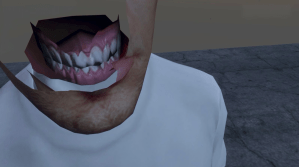
Like an Event in a Dream Dreamt by Another—Dreamcore
Across your recent works — particularly the Like an Event in a Dream Dreamt by Another series — you explore gaming environments as spaces where colonial violence is reproduced but also resisted through glitches, hacks and rewritings. Do you see a connection between those strategies and the sonic architecture of Depth Map?
FS: Exactly, that’s basically it, my people’s story and struggle is my inspiration, these methods and strategies to resist colonial violence. Palestine is the final frontier for the European planetary colonial enterprise, and it uses all its state of the arts technologies to eliminate the native the population, of course this old obsession with Palestine stretched back to the murderous barbarism of the crusaders.
Then to the Napoléon Bonaparte colonial attempt of Palestine where French troops massacred Palestinians in my city of Al Ramleh and Yaffa in 1800 before he was defeated in Palestine and Haiti around the same time. To the current western colonial war on Palestine, with its extream manifestation in the ongoing genocide in Gaza. An amount of colonial violence humanity never witnessed on such scale and technology, where artificial intelligence since day one of the genocide was employed.
More than two million Palestinians, most of them refugees from the land that “Israel” colonized in 1948 Nakba, concentrated in a small strip of land, bombarded day and night, with full western media propaganda, constructing an old white supremacist colonial narrative of the native savage and innocent settler. then attack and surveillance drones covering the skies, artificial intelligence full automation from collecting data, storing on cloud services, making the assessments of those “targets” to finally making the decision to kill.
Like an Event in a Dream Dreamt by Another research started in around 2021 as part of my now discontinued PhD research, where I was studying Games, gamification of colonial context, native usage of mods and hacks to subvert games, game engines, and rehearsing life and liberation. This usage of game architecture and reverse engineering of a piece of media that was never meant to be part of the people of the camp. How the camp used this architecture to break out the siege to build a world where they are free, living as the main character, each with their own story, not statistics in a camp (zone of non-existence) to be managed.
Depth Map continues this journey on exploring natives technology, which is mostly hybrid, reverse engineering, improvised, analogue… In contrast to the settler’s technology which is based on cold digital information and machines that have one purpose, to hunt and kill Palestinians. Datifying humans, Human predictability, storing them in clouds, transmitted, computed and processed. The question of the settler’s technology is mostly round up of efficiency and logistics.
Your work often examines how technology mediates violence, whether through drones, livestreams, simulations or digital infrastructures. Do you think contemporary warfare has become inseparable from systems of representation and media technology themselves?
FS: Absolutely, the camera is literally attached to first person (FPV) view drones, peak mediation. We moved from Baudrillard’s The Gulf War Did Not Take Place into taking place everywhere all the same time. And of course, the usage of media to construct a narrative about the enemy, is an old story, as old as the story of the war. But what’s happening with the introduction of media, and I’m talking about cameras and audio recorders, it’s something that was never imagined before. This expansion of information and disinformation wars, memes warfare, genocide influencers… we’ve seen it all, at least for now. Maybe readers remember how “Israeli” soldiers posting video captured and edited by them, probably in cheap social media friendly softwares like capcut, videos captured by cameras like GoPro, Insta 360, iphones and dji consumer drones. Doing hyper edits, click-baits, rage-bait horrors to push the algorithm for wider reach, of not any crime, but the crime of all crimes, The Genocide they are perpetrating in Gaza Strip.
Noise music historically has often flirted with militaristic aesthetics or industrial fetishism. Your work uses similarly abrasive sonic materials, but to very different ends. Was reclaiming or redirecting the language of noise part of the project?
FS: I absolutely agree, from the very inception of contemporary western western noise music, but on the other hand, noise and improvisation was always part of Arab music tradition, they are actually foundational to Arabic and middle eastern music, with Maqam and especially Taqsim (improvisation). Arabic noise play with different sounds that play a usually a role or a ritual, instead of the industrial sounds, you have more “natural” sounds, instruments, language, ululation… also to remember that first attempt to create what was after called music concrete, was an Egyptian composer and recordist Halim El-Dabh, playing and manipulating tape music, with his Ta’abir al-Zaar recorded in 1944. What I want to say here, and despite how loud and self entitled western music, or Berlin calming the beginnings of all things, it’s not.
Of course in contemporary Arabic noise, it reflects sounds that sound similar to western noise. But with an absolutely opposite end, while western noise anesthetise violence and fetishise death. Arabic sound is simply a reflection of the sounds we grew up hearing all day, affected directly by these sounds, they shape our day to day life and death. They are not a sound you enjoy in a bar made bunker looking. No, its actual continuous genocide elimination campaign. In Palestine, from the 1948 Nakba.
On the other hand, as much as noise is associated with horror in the Arab world, it’s also associated as I mentioned earlier with rituals, with struggle and with all day full of life. Ululation for example, is a sound people make to celebrate a wedding, birth, completing an academic degree, and also a practice used in anti-colonial struggle to encourage the resistance and to put fear on the European colonists, for example in Libya’s anti-colonial resistance against Italian colonialism, which was led by Benito Mussolini, and Marinetti celebrated and covered as a news reporter.
There is a strong sense throughout the album that technological systems are no longer merely tools but active agents shaping perception, ethics and even reality itself. Do you see Depth Map as a critique of technological acceleration, or as an attempt to map the psychological conditions it produces?
FS: What society knows now as technology is basically cables, satellites and screens. But I strongly feel that there is a need to distinguish between Western technologies and non-western technologies, as there are very specific characteristics to the west or europe to technology. For example, Western technologies centred around capture and domination, usually promoted as “civilisational peak”, while it was invented to ship abducted people (children, women, men, old and young) from one continent to another, note that the contemporary global trade and global supply chains descend directly from that infrastructure. Telecommunication followed the same logic, a system to manage vast territories and the populations newly captured by the empire.
Before the current dominant model, technology in the Arab and Islamic world was built around human need and worship. Al-Khwarizmi (every algorithm running every piece of technology today carries his name) developed algebra for practical use, inheritance law, the distribution of Zakat, the legal obligations that structured Muslim communal life, and Islamic Sharia (Law). Water systems were engineered to provide, to irrigate, to support the hygiene that Islamic practice demands. Stars were named and skies mapped to give travelers navigational systems for night movement, including the routes to Mecca.
Reverse engineering came from this same place, taking what the colonizer had built and turning it for survival. In almost all colonial contexts across the Americas, Africa, Asia and Australia this became a method of self-defence, using the tools of the death machine against the death machine itself, specifically to keep people alive. We have witnessed this just recently in Gaza, where Palestinians recycled unexploded U.S. manufactured “Israeli” bombs that, as is well established by now, were launched on United Nations schools, hospitals, refugee camps, kindergartens, even tents on the shoreline.
Accelerationism and what followed with the so-called dark enlightenment goes in the same line and method: the usage of liquid fueled engines in colonial campaigns, to the atomic bomb, the telecommunication, to the current processors and data centers. It’s one timeline of science and technology that is invented to dominate the colonized and establish a death world.
Depth Map is engaging with technology in both, on the ethical and aesthetical, the horrors that western nihilist technology have brought to humanity. And in contrast what natives, and here with focus on Arab radical tradition, Islamic engineering and Haitian revolutionary history, can bring to counter this death world, or what these “tech bros” call “Future.”
Technological determinism, marxist materialism and in Ibn Khaldun’s framework, the surrounding environment shapes individuals and societies, the question is for what end? Is it to socially design a world in which people in the empire core can dictate if a group can live or not, or if a forest can be burnt, or launch a war to get cheaper goods and better oil prices.
Your previous album The Heaviest Shrouds Are The Smallest Ones felt like a work of mourning and rupture centred on Gaza as well as an indictment on the collapse of meaning. Does Depth Map continue that trajectory, or do you see it as opening a different phase in your thinking and artistic practice?
FS: The Heaviest Shrouds Are The Smallest Ones was a pure stream of deep pain, grief and collapse of meaning, this current campaign is aimed to destroy the Palestinian people as a whole and to erase Palestine from the map. Of course the systemic targeting of children has left a moral mark on me personally as many around the world. Those daily images and videos, all day everyday on the feed, the doom scroll was real. But also this was a threat to anyone in the world, if you decide to be free this is what you get. We will never recover from Gaza.
Gaza has been besieged by the European colony in Palestine since 2007, imagine, this is the longest military siege in history. All of this is happening under the so-called international law, I mean how can anyone just look away from such injustice, 2.3 million people, are being starved, killed, abducted, tested on, literally skinned, and the world just continues with western media actively participating in falsifying the truth.
Depth Map, somehow both continues on this trajectory and opens a different phase, trying to reconstruct Palestine from fragments, in the aftermath, we see the world that was established, where the Nakba is globalized. And the call for courage and justice become visible. Dhulfiqar, a legendary double blade sword in Arab and Islamic history, was the sword of Imam Ali Ibn Abi Talib, gifted to him by the Prophet Muhammad (S.A.W.), its a symbol of courage and justice in the face of great powers and injustice. This sword was featured on the cover of the The Heaviest Shrouds Are The Smallest Ones, and becomes track seven in Depth Map.
How do you see the response of the arts community to the events in Gaza?
FS: The art community is, despite of the shameful stands by many, especially those who claim to be humanists, anti-racist and progressive, there are still people, friends, artists and writers who since day one stood firm against propaganda aimed to dehumanize and demonize Palestinians their right to be free, and to return to their colonized land. They didn’t back down or be deceived by racist propaganda. On the other hand, those who cast doubts in the beginning of the genocidal campaign are also responsible for this massive slaughter of children and destruction of the Palestinian people in Gaza and the current genocidal campaign in South Lebanon, even though many realized later on that “oh, this is very wrong” it was late already. And instead of apologizing publicly, and joining in the global movement, they decided to hide in the background, continue their lives like nothing happened.
The art community plays a big role in this, even if many try to convince themselves and their communities or audience that they are simply doing “art”, apathy is what colonial barbarism and fascism rely on, and this is what makes these dark forces gain more power that eventually will hit those same artists in their home countries wherever they are. And it is already happening, I remember the first months of the genocide how many were in complete silence, and when I met them, they would say stuff like, I am with you, but I can’t speak, I don’t want to lose funds or shows, while simultaneously, continue to do those works and shows under progressive banners. While I and many colleagues from Palestine and Lebanon and our allies were literally cancelled and hunted for a shared Instagram story that literally calls for a ceasefire! As in the words of Omar El Akkad, “One day, when it’s safe, when there’s no personal downside to calling a thing what it is, when it’s too late to hold anyone accountable, everyone will have always been against this.” but we will not forget.
Still, and in spite of this dark moment in history, I see so much work being done centred around humanity and solidarity, whether by immigrants or Europeans in the west, or by people of and in the third world, and while at it, the need to re-establish a third worldist cultural movement has never been greater. (Gianmarco Del Re)


beautiful I bought the album on Bandcamp, thanks for your work
Pingback: A Closer Listen Reviews – Avant Music News