
On Music For Tombak & Synth, Paris-based Iranian musician Cinna Peyghamy transforms a technical experiment into something deeply personal. What began as research into contact microphones and live improvisation gradually evolved into a meditation on exile, double identity, and inherited memory. The dialogue between the Persian tombak and modular synthesis — “a piece of wood and skin” confronting a hyper-technological electronic system — becomes both sonic method and autobiographical metaphor.
The album’s greatest strength lies in the extraordinary physicality of its sound design. Peyghamy gives space to every resonance, allowing intricate rhythmic patterns, modular modulation, and acoustic textures to breathe and circulate within the stereo field. Tracks such as “Truth is Possible” unfold patiently, while “Glass Teeth 94” ripples with carefully spatialised detail, the analog and digital constantly folding into one another. The result never feels like a collision between traditions but rather an unstable, evolving ecosystem.
Improvisation remains central, even as Peyghamy moves decisively beyond merely documenting live performance. After years of touring improvised sets, he realised that what worked in the immediacy of performance did not necessarily translate to a fixed recording. Instead of reproducing his live setup, he embraced the possibilities of the studio: layering multiple tombaks, manipulating impossible rhythmic phrases, and developing more elaborate digital processing chains. The album retains the volatility of improvisation while gaining a compositional depth absent from straightforward live documentation.
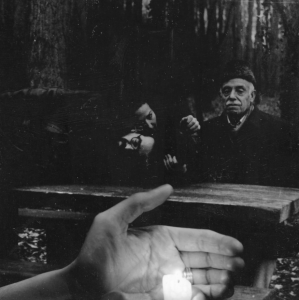
There are moments where the emotional dimension surfaces with particular clarity. “Slow Eaters,” featuring Quelque Bourdon on clarinet, adds an almost spectral melancholy, while “Dar Shab در شب” introduces Peyghamy’s father reciting poetry by the Iranian poet Ahmad Shamlo. Shamlo’s imagery — rooted in Persian poetic tradition while fractured by modernist tensions — mirrors the album’s own movement between inheritance and reinvention. Family memory runs throughout the project, reinforced by the cover photograph taken by Peyghamy’s father depicting several generations of the family. The record’s title may sound technical and functional, but behind it lies a story of migration, displacement, and cultural transmission.
What makes Music For Tombak & Synth particularly compelling is that it refuses simplistic binaries. Peyghamy avoids framing the work as “traditional versus electronic” or “acoustic versus modern.” Instead, the album occupies an unstable middle ground where modular synthesis, Persian tuning systems, processed setar samples, and tombak rhythms become part of the same sonic vocabulary. In doing so, Peyghamy joins a broader generation of diasporic artists reclaiming cultural forms once exoticised by Western listening frameworks and reshaping them into something radically contemporary.
Rather than treating identity as a fixed category, Music For Tombak & Synth presents it as an ongoing negotiation — unstable, improvised, and constantly reconfigured through sound.
To help us navigate better the different layers of the album, Cinna Peyghamy has discussed the production process with us over an email exchange.
 Your new album Music For Tombak & Synth feels deeply personal, almost like a way of mapping your relationship to your Iranian heritage through sound. At what point did you realise that the dialogue between the tombak and modular synthesis had become a metaphor for your own identity?
It took me a couple of years to realise that actually… Since this project emerged from my master’s thesis, I had a very scientific approach to it in the first years. It really was about nerding out on the possibilities of the modular and making the craziest patches to interact with the tombak.
After a while, my partner told me something like “funny how your instruments really reflect your double identity as a French-Iranian”, and she told me that thinking that I’d obviously already figured it out on my own. Well I hadn’t lol. I guess I was nose deep into the technical aspect of the project and never took the time to zoom out to approach it on a more philosophical level. Thanks to her, my vision of the project evolved around that time and it allowed me to create a deeper connection with the tombak and the modular, leading to the creation of this album.
You describe the tombak and the modular synth as “polar opposites” — one handcrafted and deeply rooted in Persian musical tradition, the other hyper-technological and globalised. What kind of tensions or unexpected affinities emerged between these two instruments as you developed the project?
My relationship with the tombak is really physical : it’s about how I hold it, play it, touch it. It’s about the contact of my fingers on the skin and how this gesture will create a certain kind of sound. I have multiple different ones made of clay, wood, plastic, metal… They don’t weigh the same, the friction on the skin differs from one to the other. Hence I play differently on each one of them.
The connection with the modular is more scientific : I actually spend more time planning the circuitry rather than playing it. I read manuals, watch videos, talk to the manufacturers, in order to find the best ways to transform the sound of the tombak. Once a year, I empty the case of all the modules and make a new patch based on all the research that I have done during the past year. So the instruments evolves all the time. It grows more complex, it offers more sonic possibilities.
Because of these very distinct places they hold in my mind, they appear very synergistic and complementary to me. They amplify each other, kind of like a positive feedback. Happy accidents happen all the time during states of improvisation, for example when the modular would accidentally amplify a specific frequency which happens to be the resonant node of the skin, thus creating an unexpected sound. When I improvise, I often see myself as a kind of mediator trying to moderate a debate between two very different speakers.
Persian classical music has a very rich rhythmic and spiritual dimension, but also a strong relationship to poetry and oral transmission. Did learning the tombak change the way you listened to traditional Persian music, or your understanding of that musical lineage?
I’m not the biggest expert on classical Persian music. I’ve learned the basic concepts of improvisation, structure and tuning during my first years of playing the tombak, but this is not the kind of music that my parents were listening to at home when I was a child. Despite that, I’ve always felt a deep connection with it. When I hear classical Persian music, and especially some specific instruments like the tar or kamancheh, I experience a deep resonance of those sounds within me. Learning the tombak surely strengthened that bond, also because I’ve listened to more and more of it during the past years.
The goal of the album is not to make “modern” or “electronic” classical music, but rather to refer to it through a specific Persian tuning applied on my synth, a sampled setar that has been processed through my modular, or the voice of my father reciting poetry.
Your father’s presence runs throughout the album — from his recitation of Ahmad Shamlo’s poetry on Dar Shab در شب to the cover photograph he took of your parents and grandparents. How important was it for you to embed family memory so directly into the record, and did that transform the project from a sonic experiment into something more autobiographical?
It was extremely important for me to dedicate this album to my family. My father is a photographer and his artistic practice has always been inspiring to me as it covers a dual identity: he’s both an accomplished visual artist and a renowned craftsman in the field of analog photography printing. This complementarity between his art and his mastery of the technical skills of his craft always drove me to push my work further.
Without hearing any of the music, the title and the cover art reflect this idea. Music For Tombak And Synth is a technical description of the setup and the picture of my family tells the story about how this idea was born in my mind: a story of immigration, diaspora, double identity.
The album was written, recorded, produced and mixed entirely by yourself over a period of five years. Given how central texture and physicality are to the record how important was it for you to maintain complete control over the sonic quality and production process?
Actually, the 8 tracks of the album were entirely composed between January and September 2025, but there were 4 years of trial and error before that where I had to figure out how I wanted to make the album and how I wanted it to sound.
I’ve been producing electronic music for 15+ years, having a background in leftfield bass music. Sound design was always a way for me to express my feelings, long before learning the tombak and the modular. This aspect is still at the center of my work, even though the music I make has changed. I consider mixing an entire part of the songwriting. Since we’re dealing with mostly synthesized sounds, how the sounds fit in the mix really affects the story told by the music. So I mix and write at the same time. Even for mastering, I work closely with my mastering engineer Adrien Pallot. It’s impossible for me to write music without thinking about how I want it to sound.
A lot of your music seems to emerge from improvisation and live performance. What were the biggest challenges in translating the energy of your improvised sets into a composed studio album without losing that sense of immediacy?
It actually took me quite some time to realize that some of the things that I do live don’t really work on a fixed track. A lot of the “tricks” that I used live and the muscle memory that I developed after years of playing live improvisation were not interesting enough musically once fixed on a record. There are many reasons to that, the main one is that you certainly don’t experience music the same way when you’re listening to it from a speaker or headphones rather than being in the same space as the person performing it.
It was a big challenge because I had to entirely rethink what this project meant. So I decided to go full producer mode and do stuff in the studio that I cannot do live: recording multiple tombaks at the same time, speeding them up, creating musical phrases that are impossible to play in real time, using more complex layers of digital processing that the computer environment allowed me to do…
So the idea wasn’t really to capture the essence of my live shows in the studio, but rather to tell a new kind of story with the same characters: the tombak and the modular. Live and studio are two ways for me to explore the infinite possibilities that this setup offers, but they are paths that go in different directions.
Now that the album is out and that I have to tour it, I won’t try to exactly reproduce the record in a live situation, but rather quote it : its themes, atmosphere, moods… and make something new and spontaneous out of it.
You’ve spoken about being born in France while carrying a cultural heritage that is simultaneously yours and distant from you. How do you navigate the relationship between imagination, memory, and inherited culture in your work?
When you’re a second-generation immigrant, and especially when you’ve never been to your parent’s home country like me, you feel a rift between you and your cultural heritage. You feel like a sort of anomaly, like you were not born in the place that you were supposed to be born in. You create an imaginary vision of this homeland, a distorted one.
At the beginning of my twenties, I realized that I had inherited from my parents’ exile, and that I had to deal with that. This project is a way for me to address this identity crisis, to channel all the contradictions of my situation into gestures, sounds and emotions.
Over the past decade, Iran’s electronic and experimental music scene has been gaining increasing international attention. What has been your relationship to musicians and artists inside Iran, and how do you perceive the current state of the electronic underground there and how compromised would you say the situation is now?
Persian culture is one of art. Every person knows a few lines of poetry, can tap a traditional rhythm, and is eager to sing and dance. Because art is always present in this culture, Iranian artists have a rich depth in their craft. When you add the diasporic situation on top of that, I think this engendered a generation of artists that have a lot of things to say and emotions to share.
I’m not the best person to speak about the situation inside Iran, simply because I’ve never been there, and also because it’s hard to communicate with people inside the country, especially in these times of war and internet blackouts.
The Iranian artists that I know are all from the diaspora and live in France, Germany, Norway, Canada, USA… They’re either immigrants, or second-generation like me. I hold a very close connection to the Iranian artists that I meet. One simple reason is that I grew up only speaking Farsi with my family members, so when I speak Farsi with someone, I can’t help but feel a close connection to this person.
Your music avoids simplistic oppositions like “traditional versus modern” or “acoustic versus electronic.” Do you feel that younger Iranian and diasporic artists are increasingly moving beyond these binaries, and if so, what new musical language do you think is emerging from that shift?
I think we’re now experiencing a total shift in electronic music where the narratives behind the music are getting more recognition. It’s not about mastering the tools anymore. It’s not about applying digital effects on a traditional instrument. It’s about how these digital effects on this specific traditional instrument will tell a story about the person that wrote this music. This is especially true with artists coming from a diasporic background, because by doing so they reclaim instruments, methods of composition, tunings, time signatures, that for a long time were western-gazed and classified as “exotic”, “ancient”, “ritualistic”, and the list goes on… For me, the music emerging from these initiatives is extremely innovative, futuristic, and helps shape a new world of sounds that go beyond this western gaze. (Gianmarco Del Re)


Pingback: A Closer Listen Reviews – Avant Music News