
 After spending the month of May in Ukraine, I am back in Rome. There has been a 22% increase in the number of drones and missiles on Kyiv and Ukraine in general from the month of April. I have witnessed the devestation waged on the capital after a night sheltering in the undegraound in the Podil district. There is much I still need to process, but suffice to say the following evening I attended two noise / screamo punk gigs taking place simultaneously next door to each other with a young audience moshing and reveling in noise.
Once again, it was great reconnecting with so many musicians I have spoken to over the years and getting to know new people.
I was also lucky enough to be invited to the choir rehearsals for The Mothers of Kherson, Maxim Kolomiiets’ opera which opened at Kyiv’s Opera in a concert version before the official premiere in Warsaw and at the Met in 2027. Furthermore, I also visited Kharkiv, the first time for me, but I will leave that for a future episode of UFN.
For the present episode, however, we get to hear from Toishy Koshimi striking the hearbeat of industrial modernity and Музична Шкатулка who expresses his frustration at narrative music while Strup rejects the notion of “cultural front”.
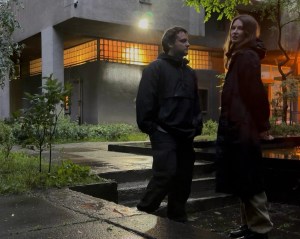
Pasha and Daria from Iriy Records
Our monthly podcast was recorded in Podil with Pasha and Daria from Iriy Records who discusssed the Ukrainian ecosystem and sound as well as latest trends.
tracklist
- Cruel blu – “Кучеряві штори”
- Second Sort – “vivid dreams”
- human margareeta – “fffffuuuuucccckkkk”
- Mertvi Dereva – “Отруйні Ікла”
- nizhna – “Tokyo Drift”
- pants – “Unrun Citizen”
- Alexander Stratonov – “The Sky in the Nets”
As for new releases we’re feauturing Alexander Stratonov, Díréadú, Dirtbag Loris, Octopus Kraft, Ryndin, støïbrok, Ulværn, Vyr Muk, некрохолод, Bohdan Stupak, and старанний олег.
In the viewing room we have a live recording from Hidden Element and Rebuilding on the Edge a documentary by Suspilne with a soundtrack from Alexander Stratonov.
JUNE 1, 2025 – KYIV
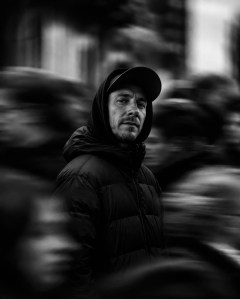
Hello, I’m Toishy Koshimi, a producer and musician based in Kyiv, Ukraine. My journey into music started with a deep curiosity about sound design and electronic production. I found my way to dub techno through years of exploring electronic music, gradually drawn to its unique combination of minimalism, vast atmospheric space, and hypnotic repetition. What captivated me most was how dub techno creates emotional depth through restraint — using echoes, reverb, and subtle textures to build immersive worlds with just a few elements. The genre’s ability to balance simplicity with profound sonic richness felt like the perfect medium for expressing both introspection and cosmic wonder.
Your new EP is titled Carbon Pulse. What was the starting point for the record, and what does the title mean to you?
Carbon Pulse represents the heartbeat of industrial modernity — the rhythmic flow of energy through concrete, steel, and machinery. The starting point was exploring the tension between organic life and mechanical systems, imagining how carbon (the element of life) merges with pulse (the rhythm of machines). To me, the title symbolizes the living breath within cold, brutalist structures — the idea that even in the most mechanical environments, there’s a pulse, a rhythm, a form of existence.
The liner notes describe the EP as a meeting point between brutalist architecture and cyclic electronic rhythm. Have architecture and physical spaces influenced your music, and were there any particular places or environments in mind while making these tracks?
Absolutely. Architecture has profoundly influenced my music. While creating Carbon Pulse, I was constantly thinking about brutalist structures — their raw concrete, geometric forms, and the way they impose order on space. Kyiv itself has many brutalist buildings from the Soviet era, and walking through these spaces inspired the EP’s aesthetic. I imagined corridors of abandoned concrete complexes, the echo of footsteps in empty halls, the rhythm of machinery in industrial zones. The physical weight and permanence of these structures translated into the heavy, grounded basslines and the spacious, echoing reverbs that define the record.
Tracks such as “Carbon Pulse” and “Pressure Chamber” evoke images of underground structures, industrial machinery, and immense physical forces. Were these tracks conceived as narratives or environments, or do you prefer listeners to create their own associations?
I approach these tracks as environments rather than linear narratives. I create sonic landscapes that listeners can inhabit, explore, and project their own stories onto. “Carbon Pulse” and “Pressure Chamber” are designed to evoke specific atmospheres — underground tunnels, pressurized chambers, industrial complexes — but I prefer leaving room for personal interpretation. Music is deeply subjective, and I find it more powerful when listeners bring their own experiences and associations to the sound. The tracks are invitations to journey inward, to lose yourself in the rhythm and texture, and to discover your own meaning.
Dub techno is often associated with warmth and spaciousness, yet Carbon Pulse feels darker, heavier, and more industrial. Did you consciously push your sound in a different direction on this release?
Yes, this was a conscious decision. While I love the warm, spacious qualities of traditional dub techno, I wanted to explore a darker, more industrial side of the genre — one that reflects the reality I’m living in and the aesthetic of brutalist architecture. Carbon Pulse pushes into heavier bass frequencies, more aggressive textures, and a colder sonic palette. This doesn’t mean abandoning the essence of dub techno; rather, it’s an expansion of its emotional range. The warmth is still there, but it’s buried deeper, more concealed, like heat trapped beneath concrete.
Repetition plays a central role throughout the EP. What fascinates you about cyclical rhythms and slowly evolving textures, and what kind of listening state are you hoping to create?
Repetition is the key to transcendence in dub techno. Cyclical rhythms create a meditative state where the mind can let go of linear thinking and enter a more fluid, immersive experience. What fascinates me is how small variations in a repeating pattern — a slightly delayed echo, a subtle filter shift, a textured layer fading in — can create a sense of constant evolution without breaking the hypnotic flow. I hope to create a listening state where time feels suspended, where the listener can drift into a trance-like zone between consciousness and meditation. It’s about finding stillness within motion, clarity within repetition.
How has the full-scale invasion affected your creative process? Has it changed the way you think about sound, space, and atmosphere in your music?
The full-scale invasion has profoundly impacted everything — including my music. Living through war has changed how I perceive sound, space, and atmosphere. There’s a weight to silence now that wasn’t there before, and sounds carry more meaning when you’ve experienced the absence of safety. My music has become darker, more introspective, and more urgent. The spaces I create in my tracks feel more like refuges — places where listeners can escape, even if briefly, from the chaos outside. The atmosphere is heavier, but there’s also a deeper sense of purpose. Music has become both a form of resistance and a way to process trauma, to find beauty and meaning amid destruction.
How would you describe the electronic music scene in Ukraine today? Have you noticed any new developments, aesthetics, or communities emerging under wartime conditions?
The electronic music scene in Ukraine has shown incredible resilience. Despite the war, artists continue to create, perform, and connect with audiences — both locally and internationally. I’ve noticed a shift toward darker, more introspective aesthetics that reflect our collective experience. There’s a growing community of Ukrainian electronic artists who are gaining international recognition, bringing a unique perspective shaped by our reality. Many artists are using their music as a form of cultural resistance, documenting our experience through sound. Online platforms have become even more important, allowing us to connect with the global electronic music community despite physical limitations. The scene is smaller but more focused, more purposeful, and deeply connected to our identity as Ukrainians.
Are there any Ukrainian artists, albums, or projects from the past four years that you consider particularly innovative or important, whether within electronic music or beyond it?
Yes, there are several Ukrainian artists who have been particularly innovative. The dub techno and experimental electronic scene has seen remarkable work from artists like Madloch (who runs Crossfade Sounds and has released my music), Alloise (who has gained international recognition for his electronic pop), and Oksana Ivanova in the experimental sphere. There’s also a growing wave of underground techno producers in Kyiv and Lviv who are developing a distinct sound that reflects Ukrainian identity. Beyond electronic music, the film and visual arts scenes have been extraordinarily strong, with artists using their work to document and process the war experience. The creativity emerging from Ukraine under these conditions is truly remarkable.
What does it mean to be Ukrainian today? And if you had to explain Ukraine through a single piece of music, artwork, film, building, meal, or cultural symbol, what would you choose and why?
Being Ukrainian today means resilience, dignity, and an unbreakable spirit. It means standing firm in your identity despite overwhelming pressure, protecting your culture, language, and homeland at any cost. It’s a daily choice to hope, to create, to love your country even when it’s under attack.
If I had to explain Ukraine through a single piece of music, I would choose “Chervona Ruta” by Volodymyr Ivasyuk — a song that has become an anthem of Ukrainian identity, beauty, and resilience. It’s a song that every Ukrainian knows, that connects generations, and that has been sung both in times of joy and in times of struggle. The melody is simple yet profound, like Ukraine itself — understated but deeply powerful. It represents our cultural richness, our ability to find beauty even in hardship, and our enduring spirit that cannot be broken.
JUNE 4, 2026 – KYIV
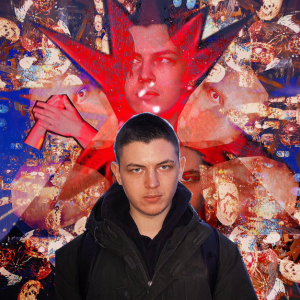
My name is Volodymyr. I’m a composer and multi-instrumentalist from Donetsk oblast. I didn’t receive much of a formal music education, only a few years of musical school saxophone class, though I had a really great mentor who taught me how to improvise, harmonize for ensemble and play a little bit of piano. Unfortunately at the time I decided to not continue with conservatory, so the rest I learned myself with some help of internet.
I started to write my own instrumentals in 2018 and full songs in 2019. There were different periods and more than 200 pieces written, but I mostly decided on my sound near the end of 2021 when I created compositions that were then on Пустота (2022) – Прогулянка у Пустоті and Відголоски Пустоти. Until 2022, I had published everything under my legal name, but then, finding it very narcissistic, I switched to using the name Музична Шкатулка, which is a nickname my family members call me.
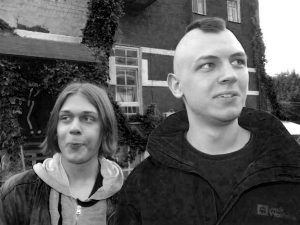
Zakhar and I, september 2025, rvrb, made by Oleksandra Akimova
What role does the project Музична Шкатулка [Muzychna Shkatulka – Music Box] play alongside your work with Gender Studies, Delayed Minds, and erythroleukoplakia?
It is quite funny how every project I participate in is connected. It all began when I moved to Kyiv in the summer of ’23. The first three days were spent at my friend’s house, where I met Mykyta Riabushev, who is an active member of ELP. He listened to some of my music and said that I should meet Misha (Emotional Anhedonia), so I did. He then listened to approximately 30 seconds of my demos through the phone earpiece and “signed” me to the label.
Thanks to my involvement with ELP, I was invited to play at Noise every Wednesday once, and then again at the May ’24, where I and Sasha (TRANCEDÆNCE) performed Dyad Dialogue, after a concert Zakhar came to me to ask if I wanted to do something together; I said yes. Later that year I was already helping Misha and Bohdan (Delayed Minds) with label management and heard that Gender Studies are searching for new members. Honestly, when I first listened to this band, I thought they sucked, but nonetheless decided to give it a try, given that Vanya (Gender Studies) really wanted a saxophonist in his band and I really wanted to do something with other musicians. As I already enjoyed playing with Zakhar in my project, I invited him to join GS as well.
One month later we were looking for a bassist, and Bohdan suggested Sonya, as she was playing with him in his band. Later in 2025, all of these guys were invited by me to play live on Spaska 13, and afterward I and Zakhar were invited to play a tour with DM. A bunch of happy incidents made us this Frankenstein monster of a band with a nearly identical cast but really different music.
Your album Події (Events) is described as a non-narrative conceptual work built around the peculiarities of your own perception. What was the original idea behind the record, and what did you hope to discover by “slicing” perception into these individual events?
My works usually start as technical ideas, from which meanings grow out over time; for example, I do not write composition about angels representing them with sound, instead I do write composition with an idea in mind to expand different instrument parts to different keys creating giant cluster chord texture, which is then can sound fitting to the name, even though the name itself has different story.
Our first jam with Zakhar birthed quite a few compositions, one of which is “Подія 5”, which was sampled later the same day from the jam recording. And exactly this composition is what triggered me to start writing this album and what gave it its name.
I often meditate non-religiously as a way to better understand myself. A lot of stuff happening can fly under the radar of our perception when our head is full with everyday tasks and worries. Meditation helps me to deal with this, and after years of meditating, I am mostly fully aware of myself and my thoughts even on a day-to-day basis. And when you’re aware of yourself, your perception can slow down so much that you are capable of examining all of your physical and psychological environment, so this is exactly what Події is. I’m not going to dive into the philosophical aspect of perception’s flow cutting because I find myself not qualified enough to talk about this, but structuralism and psychoanalysis greatly impacted the way I approached the creation of compositions for this album.
At this time, I was rewatching David Lynch’s filmography, constantly paying attention to how he and Angelo Badalamenti are approaching music and sound in their works, I borrowed some of their techniques to increase the impact my music has; to honor that inspiration I named “Подія 19”. Ангели after Angelo.
Compositions like “Подія 3”, “Подія 6”, “Подія 9”, and “Подія 11” were created using really short, slowly evolving grains of sound, which are literally slices of time being stretched. Other ones were created through looping samples or melodic lines or manipulating their pitch and playing direction to explore possibilities of sounds that otherwise would be unnoticed and hold close to zero interest for the listener. So these small sounds, like the saxophone screech on “Подія 8” or the street washing machine sound on “Подія 10”, are becoming not only a leading tone but sometimes even a whole composition. And few of the tracks were composed fully instrumentally. Here comes my love for spectralist pieces (“Подія 16”, “Подія 18”, “Подія 19”, “Подія 20”) and the repetitiveness of some post-rock bands, especially Swans (“Подія 4”, “Подія 13. Смуги, лопати”, “Подія 14”).
Also, I find it necessary to point out that this release has nothing to do with scaring the listener. Sure, it can sound inaccessible at times, and I often heard from my friends about how scary they find these compositions, yet I had zero intention to do some kind of “horror” music. Події is all about everyday life experiences and how I view them; perhaps some parts of our lives are really more terrifying than we think.
And about the non-narrative part, I was growing more and more frustrated with the tendency of music to tell something; all of my music prior to Dyad Dialogue was falling for this as well. And so I did a necessary decision and banned myself from “telling” any stories with this release.
In the liner notes you write that each composition embodies a moment stretched out in space, that each composition has a sister, and that each composition means nothing. Could you elaborate on these seemingly contradictory statements?
I guess I have already answered most of these questions above. I do not love explaining much about my music because I think it spoils listener experience, but I do love to write these esoteric notes to help one to look in the right direction and avoid being confused by the stuff that isn’t there.
The “sister” line is a cue to listen closely to similar-sounding compositions, as I made them in pairs like A1 and A2, A and A-reversed, A and A*. I might even say that this album is actually one set of 10 compositions viewed at different angles.
Each composition indeed means nothing, though it is not meaningless; it is just that these pieces are not holders of any life lesson or opinion, just sound as it is. Titles also do not hold any specific meaning; they’re serving more of a technical role of helping to navigate through the album’s tracklist.
 Події took two years to complete and incorporates older material, samples, and more recent recordings. Looking back, does the album function as a document of a particular period in your life, or is it something more abstract?
Of course it does. Події is one of my 4 Cross works, which are dedicated to the search for my “primitive.” A primitive in mathematics is the simplest object, the one that lies in the foundation of all other more complex structures, and near the end of 2022, I set up a goal to find my artistic primitive. In 2023 I decided on a symbol to represent this primitive. I put it in a lot of my visual art when wanting to point at something significant. It has a simplified shape of a Jerusalem cross but really is a cross fractal on its 2nd iteration, and in its full form it becomes an endless, ever-branching grid; I found it fitting.
In my music discography, it first appeared as a secondary element on the EP Сирий Бетон, signifying recycling of older material and rejection of perfection. But then, after the already mentioned Dyad Dialogue performance, the whole vision came together, and I decided to make a series of releases where I would reject some usual part of music until hopefully reaching a desired primitive. Next came Murmural (2024), for this release I reworked melodic patch I used in Dyad Dialogue and restricted myself from intruding into the static loop structure, only manipulating effects. With this release I declared my intention for the future and made it especially clear in the bonus track on the cassette version of Murmural; it even features the sound of winding up a music box.
While still working at Until I See, I listened to TRANCEDÆNCE’s track “Boise”, really enjoying it. I found a way to create a similar sound myself, tweaking it to my taste, and so Електрика was created. At first it was just a way to restrict myself from using melodic sounds at all, and then it started representing my growing frustration with music as a whole. And of course, at the same time I started writing Події.
Then my journey with Gender Studies began, and I was constantly busy with other projects and live sets. At the critical point I was simultaneously working on 10 different albums for МШ, including Події and Сміття, the Gender Studies album, and one special project for ELP that I hope we will successfully deliver later this year. So the whole production was really tough. I was writing and deleting pieces, reworking existing material tens of times only to find out that it still doesn’t meet my criteria. It resulted in 2025 being a year full of work and full of releases.
Somewhere around this time I decided to look into my older material in search of inspiration and forgotten ideas; this way tracks “Подія 2”, “Подія 9”, “Подія 13. Смуги, лопати”, and “Подія 18” got on to release. “Подія 18”, for example, is just a second part of a 20-minute-long piece I wrote in 2024 where the first half is the melodic loop (a theme), which then slowly changes until it becomes this ambient piece. The oldest track on the album is the funniest to me – “Подія 13. Смуги, лопати”: I wrote it in the summer of ’23 because I really didn’t like Serhii Zhadan’s poetry, but of course I put it on the album for other reasons. And about the samples, the oldest ones could be found in “Подія 7” and “Подія 15”. If I remember correctly, piano was recorded somewhere around 2018-2019 and guitar during the year 2020, and the recent one is on “Подія 14”; it is literally an excerpt of original drum recordings later used on “Сміття 1”.
On the visual side of things, the cross on every artwork becomes bigger and more apparent as I reach the end of my journey, on Події it already pushes on canvas borders as it is final coherent not yet decaying work. So yes, even though not intended, the byproduct of this album is a chronicle of my musical evolution inside one bigger journey in search of primitive.
Shortly after Події, you released Сміття (Trash), describing it as a surplus product in a state of decay and as the conclusion of a cycle of works begun in 2024. What connects these two albums, and why did you feel it was important to bring this chapter to a close?
After releasing Електрика and falling into infinite production hell, I thought that I had said too little on the previous two releases; on the other hand, two years later, after I finished Події, I thought that this is enough, perhaps even too much. So the idea for Сміття as a final release and its name came much later than when I first started working on it, about one month before its release.
The starting point for this release was one rehearsal when I and Zakhar were preparing some material for then unnamed album Корпоративна Етика (yet to be released). Being burned out already because of all the other projects I proposed to just “fuck it” and do something completely different. I put my guitar near the amp, creating really loud feedback, and started hitting drums standing at the back of the rack – Boredoms style.
The result is really raw and unbalanced basement recording with us falling out of rhythm and changing phrases faster than we get used to them while slowly losing hearing due to lack of ear protection. I loved it so much that I used it in two different lives and sampled it in a few tracks, such as “Подія 14”, but something was lacking. Later we tried to record some more of similar stuff, but it all was unsuccessful. Work on this project was eventually abandoned until I was finishing Події. I was listening to Terry Riley’s Persian Surgery Dervishes when something clicked. I opened the project with the original recording and added keys to highlight already present feelings in this music. I finished it in just two takes.
“Сміття 2” and “Сміття 3” were created in one day the same week; they are a lot less aggressive than the first one, because I finally felt relief after all these years, and it was apparent that I just can’t add anything more and not make it self-repetitive. “Сміття 3” is the last track of both the album and the cycle, featuring different field recordings with Gender Studies in Ostroh (2024), with Музична Шкатулка band in Kyiv (2025), and on tour with Delayed Minds in Praha (2026).
And I really didn’t find it necessary to wait longer until releasing Сміття, because I already have some other projects ready to be published in the next months.
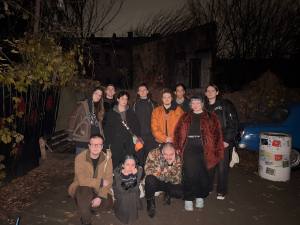
elp gathering, november 2025
You’re active in several different contexts—as a solo artist, saxophonist and keyboard player in Gender Studies, a live member of Delayed Minds, and through your involvement with erythroleukoplakia. How do these different roles influence one another, and what have you learned from moving between them?
МШ is what I think modern music lacks; similarly, Gender Studies is Vanya’s way to express that, and Delayed Minds is Bohdan’s. ELP is our collective attempt to improve musical scene in Ukraine. We all view music quite differently, but despite this, we massively influence each other through these collaborations and engage in friendly “competitions”. As said above, we are more of an organized crime group that changes its form, becoming one of bands at one given moment. We even had an idea to do a 3-hour-long concert with just ours bands where we would imperceptibly flow through different sounds while playing combined setlist of all three of our bands and changing roles and instruments.
Maybe the most valuable thing I learned with these bands and label work is that my desire to be THE artist is sometimes really inappropriate and can be harmful to what good music is. And, I guess the same can be applied to my friends when they were playing in my band. After years of full control over everything in my music, it is really hard to become just one of the members of someone else’s band and do what they see fitting, and not I. The same applies to the label, as we believe in total freedom and use horizontal structure; nothing can be done without mutual agreement. Doing stuff with other people made me a better musician and a better leader, and I’m grateful to my friends for their patience.
Ukraine has developed a remarkably active experimental, improvisational, and noise scene in recent years. From your perspective, what makes this community unique, and are there particular qualities that distinguish it from similar scenes elsewhere?
This is because it is a live reaction to stuff happening around, compared to modern American, European, and Japanese scenes, which are mostly retrospective. Our artists are not thinking about what it was like to be in a war; they are in it right now, which, of course, makes our art more aggressive and radical. There is no room for a gray zone or alternative interpretations; we see all that is happening with our own eyes. It is our closest friends who die, it is our families who suffer, and it is us who experience all of this firsthand, not through movies or books.
Perhaps the reasonable correction to my statement above is that the only retrospective aspect of our scene is the last 10+ years since the Donbas and Crimea occupation, which at the time was not influential enough to reach out to the whole population and trigger such a massive response. But in my case it all started to unravel already then in 2014, when my hometown was occupied.
Has the full-scale invasion changed the way you think about sound, improvisation, or artistic practice? Do you feel that experimental music serves a different function in wartime than it did before 2022?
I don’t think it changed my approach at all, only finely directed me towards even more raw and massive sound, as it was necessary to express myself. What really is influencing me is all the great musicians I’m now friends with.
And I don’t think that music’s (or art in general) function has changed; it’s just that it became more apparent and clear what music is to people. War does not change the ways people do things; it changes the way people view things.
Are there any Ukrainian artists, albums, performances, labels, or artistic initiatives from the past four years that you consider especially important, innovative, or representative of the current moment?
It is selfish, but I think ELP REC is the one. In my opinion, this community captures our present in its purest multi-faceted form and does things I consider impossible for others (labels, communities) to do, which is by itself – to do impossible – is corresponding to the times we live in.
What does it mean to be Ukrainian today? And if you had to explain Ukraine through a single piece of music, artwork, film, building, meal, or cultural symbol, what would you choose and why?
I think, to be Ukrainian is “to be”. I really can’t be more specific than that.
The first thing that came to my mind is a film Земля (Earth – 1930) dir. Oleksandr Dovzhenko, nearly 100 years later, we’re still existing inside its reality.
JUNE 9, 2026 – KYIV
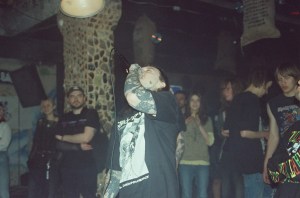
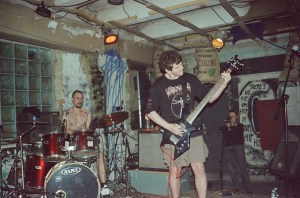
It’s a little dishonest to say that Strup emerged from the ashes of Wormitorium, despite the fact that it looks that way from label and metal-archives.com perspective. It’s more as if members of Subscum got too bored and invited guitarist of Mulyfication to create a “quick short little demo” of some primitive grindcore. After some time Wormitorium’s guitarist took the original bass player’s spot and complicated things. Overall, 2 death metal guys, 2 grindcore guys. Deathgrind. Sirko, Roma, Yegor, Taras.
What were we hoping to do differently? We all played in a number of bands before and we know how this goes (and ends). It’s not the ambition to do something differently, it’s probably this long walk of wanting to express something. In this case it can only be expressed over blast beats.
What can you tell us about the making of Abyssurge? How did you approach the songwriting and production process, and what sound were you aiming for?
Somewhere along the way it was decided to turn the “quick short little demo” into something more serious – as already mentioned, the guitarist-turned-into-bass-player – he always overcomplicates things. A lot of parts were reworked, broken, bent, some of the songs taken apart and cannibalized. It was fun. Then we recorded it, relatively pain-free, mostly diy. 70% of time we spent on the album we spent on mixing, mastering, arguing over it all and communicating with different labels. Do not love this part. Appreciate Rotted Life and Gurgling Gore who eventually released us in all 3 physical formats.
The album title Abyssurge suggests both an abyss and a violent emergence from it. What does the title mean to you, and is there a conceptual thread connecting tracks like “Absorbing Vacuum,” “Disexist,” “Plague Aura,” and “Fractal Decay”?
Don’t think deathgrind is where you explain the lyrics. It’s not about the war, at least not directly, it’s more like trying to embed certain aesthetics into words, complex dark emotions expressed in the abstract form. What else is there to talk about now?
 Death metal and grindcore have always dealt with themes of decay, extinction, and collapse. Have those themes taken on new meanings while living through wartime Ukraine?
Yes, of course, and, at the same time no, not really. With everything’s going on – you become a little desensitised but, at the same time, I wouldn’t call us nihilists. Yeah, decay, extinction and collapse, it all kinda came true. Lyrics came to life. At the same time, there’s no “I told you so.” We try to do something useful besides music, some of us do volunteering, others are related to defence technology in one way or another. I don’t think this is what is expected from metal-hell-yeah church-burning cartoonish image of a metal musician. At the same time, I wouldn’t say “it was all for show”, we know what those lyrics were talking about. It is all very weird and confusing and it’s hard to explain. We are truly fucked, that is all we know for certain.
Overall it is very sad and frightening how we all adapted to war, how normalised it is to see death and tragedy every night from air raids, how hard it is to feel anything at all now. How empty we feel.
How would you describe the current death metal and grindcore scene in Ukraine? Have you noticed a different energy at shows and in the mosh pit since 2022?
It’s sad topic really. I’m afraid, the scene has remained on the same level already for some time. There are a lot of objective reasons, air-raids, life-threatening situations that reduce your needs to essentials, musicians getting drafted. I hate when bands add it to press releases: ‘boo-hoo, we went to rehearsal under bombs’, but you can’t deny it either. What’s pleasant to see is the amount of young people both at the shows and in bands. So maybe we will have some scene after all.
We wish more people found their therapy in playing music and found energy and drive for it.
Ukraine has also developed a remarkably active noise scene in recent years. Why do you think noise and other forms of sonic extremity resonate so strongly with audiences right now?
We love noise and power electronics and their relation to extreme music, the idea of Japanese concerts where crust, grindcore, metal and harsh noise artists are playing together, without any scene division. We’re not really people to ask why – it resonates with people, that’s all. But it’s not only the noise that resonates.
 Does the role of an artist change in times of war? Is there any particular responsibility attached to making extreme music under these circumstances?
In the beginning, we were all asking ourselves this question. Now – not so much. Huge major artists are using their platform to accumulate charity donations, smaller acts just treat their artistic life and member-of-civil-society life as 2 separate roles that sometimes collaborate. We are Ukrainian band and it’s great to represent our country, for example, for American fans. But… I don’t know.
A musician’s responsibility – arrive on rehearsal on time, create music while you can. If you’re any good with the instrument, please please please continue playing.
What does it mean for you to be Ukrainian today? And if you had to explain Ukraine through a single cultural object—a book, film, album, song, dish, building, artwork, or even a meme—what would you choose and why?
Sergei Parajanov – The Color of Pomegranates.
NEW RELEASES
Alexander Stratonov ~ Rebuilding on the Edge
Rebuilding on the Edge is a documentary project examining government spending in the face of threats from russian missiles, guided bombs, and attack drones. While the Ukrainian army holds the front lines, large-scale reconstruction of schools, hospitals, and administrative buildings is underway, particularly in the de-occupied part of the Kharkiv region. Investigators from Suspilne examined facilities that had been restored with millions of public funds, only to be destroyed again by the enemy almost immediately after completion.
Was this reconstruction a vital necessity for the communities, or did it demonstrate a deliberate disregard for military risks to “spend” the budgets? The film analyses large-scale projects, such as the construction of a cancer centre costing 3 billion hryvnia and schools costing hundreds of millions, and seeks to answer the key question: do we have the right to spend colossal resources on rebuilding what may turn into ruins again tomorrow? Has the state learned to take this into account in the fifth year of a full-scale war?
Toishy Koshimi ~ Carbon Pulse
Carbon Pulse is a deep dive into the monolithic realms of hypnotic dub techno. Built on a foundation of raw concrete textures, industrial grit, and heavy, low-end frequencies, the EP explores the intersection of brutalist architecture and cyclic electronic rhythm. The title track, “Carbon Pulse,” centers around a massive, unyielding low-frequency groove. Like seismic waves moving through a dark, underground monolith, its sharp geometric modulations and gritty chord stabs ripple through an ocean of deep delay and cavernous reverb. It is a slow, powerful march through sub-bass territory, designed for shifting the air in dark, smoke-filled warehouses. Complementing the release, the B-sides strip away the excess to focus on pure, meditative repetition and micro-tonal textures. Metallic echoes decay into vast, empty spaces while a persistent, driving pulse keeps the listener locked in a state of deep, hypnotic immersion. Carbon Pulse is a stark, monochrome sonic journey—heavy, structural, and uncompromisingly deep.
Octopus Kraft ~ TAU
TAU is a sign of passage — a symbol of the unseen bridge that leads from life to whatever lies beyond it. This album is dedicated to those who could not find themselves and left us behind; to those who reached a wall and could no longer see a way forward; to those who wanted to fly but remained suspended in the void; to those who take their secrets with them and leave only questions behind. You are where all of us will one day arrive — only in the way you chose for yourselves. May this death become a celebration for you, and a loss for us.
This album was written primarily under the weight of Ivan’s tragic death, and also in memory of a good friend and the guitarist of Octopus Kraft — Andrii.
støïbrok ~ brown + greeeeeeeeeen
This EP combines old 2023 improvisation recordings with extensive use of the djembe.
Dirtbag Loris ~ Kolyskova
“Kolyskova”, that means Lullaby, is an album by Kharkiv-based lo-fi artist Dirtbag Loris, working at the intersection of bedroom pop, slowcore, ambient, and experimental folk. The material is structured as a continuous cycle of tracks, capturing thoughts and states that emerge after waking, periods of insomnia, and attempts to fall back asleep.
Ryndin ~ Terrikon Juice
@ryndin-music, whom you know from «Ghetto Donetsk» (2024), inspired by Memphis rap and childhood on Ukrainian Donbas region, created another dancefloor-killa tape «Terrikon Juice» for you. «When I hear cool lines, I immediately think how cool they can be put on a beat and create a cool track. I use samples a lot and I feel good about sampling». His music became more & more mixed genres, there are no pure styles left, hybrid sound grew: techno with elements of trance and breakbeat, electro with industrial, UK vibe in various forms, and samples from the dirty gangsta rap off course. Some classic DAW’s used a lot, like SH-101, Pro-1, TR-808, TB-303 and Juno, Diva, Pro-Q, etc. But old-school electro will always be in his heart. Modern TikTok songs will soon be forgotten by everyone, but Ryndin’s style is infinite!
некрохолод ~ Spatiotemporal Waves
A cathartic sound as a manifestation of infinity. This single is about neutrality, about perceiving the world and experience as it is. Waves of shimmering words, memories, everything that has shaped the human experience over millennia. All of this is one vast vortex, penetrating the very depths of humanity, which ultimately is humanity. This single is about the I-am, about the state of not being, of existing only as a manifestation.
The writing process for these compositions was deeply focused and meditative.
Díréadú ~ Asarlaíochta
Ulværn ~ Ecologicon
Recorded in a single jam session.
Vyr Muk ~ Mens Devastata
Emerging from the shadows of war-scarred consciousness, a new three-track EP delivers an unflinching exploration of psychological trauma, mental illness, and the lingering horrors of combat. Blending oppressive atmospheres with relentless aggression, this release is not merely music—it is an auditory manifestation of a fractured mind.
Drawing directly from themes of post-traumatic stress disorder, anxiety, and dissociation, the EP channels the internal battlefield that persists long after physical conflict ends. Each track functions as a chapter in a descent: from the echoing memory of war, through the suffocating grip of anxiety, to the complete distortion of reality itself.
Drone of War ~ Dreams
When the dream becomes tangible… some piano impromptu.
These tracks have been created by ancient soviet electronic equipment and hand-crafted modular synths, drone machines, and noise boxes.
Performed without dubbing and multitrack recording directly into an old Swiss reel-to-reel Revox via a rare Japanese console from the 90s.
100% prepared improvisations, the best of many takes have been included in this album.
старанний олег ~ а я не жаХАлася вже 4 місяці
If the Prodigy had gotten lost in the Ukrainian steppes for a few weeks, tasting all kinds of local beetroot in the process, they would have definitely recorded this album. However, in this case, it is an example of how brutal and noisy Lviv can sound, without embellishment or pathos.
Bohdan Stupak ~ Spring
As part of our digital series, Naviar Records is proud to release “Spring” by Ukrainian producer Bohdan Stupak. An immersive journey through field recordings and subtle guitar layers, where nature and the listener merge and experience the slow, relentless passing of time as one.
“Late autumn and winter of 2024 was really hard time for me, so when spring came, I decided to focus on it as a time of renewal and shedding away the past. Starting from early March and up to late May, I did a lot of field recordings in a local park to capture subtle changes that occur in nature and may be unnoticed by people who are too busy and preoccupied with their routines. Then I added some heavily processed guitar, although I tried to keep it as minimal as possible, so the nature would be the main performer.” (Bohdan Stupak)
Kevlar Snail ~ Kerger
A heavy, invulnerable snail that crawls at night between fatigue that stops the heart and terror that squeezes the breath.
Promise you will let me know ~ I think about it all the time, even in my dreams
Promise you will let me know ~ I never liked dancing
Our favourite lo-fi artist from Kharkiv is back with two albums under his Promise you will let me know alter ego. Delicate, ambient slowcore bedroom pop at its best.
DEDDOM | PAXIT ~ split
The Amsterdam-Ukrainian split of the bands DEDDOM & PAXIT is presented with two avant-garde tracks, which are always saturated with free jazz, noise and unexpected splashes of pop rock and dance music.
Mykyta Moiseiev ~ The Blessed Ones
The Blessed Ones is a documentary by Andrii Lysetskyi about Ukrainian artists facing the reality of war. Moving through ruins, fragments, drawings, burned metal, and fragile objects restored from destruction, the film asks what art can still do when the world is burning.
VIEWING ROOM
(Gianmarco Del Re)


Pingback: A Closer Listen Reviews – Avant Music News
Pingback: Музична Шкатулка [Muzychna Shkatulka] ~ Donbas Requiem | a closer listen