
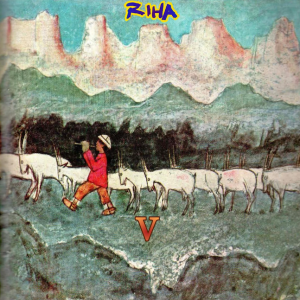
RIHA’s V is both a family portrait and a journey through the mythological landscape of Svaneti, the mountainous region of north-western Georgia that has long nourished Rati Oniani’s imagination. Conceived as the soundtrack to a forthcoming documentary about his grandfather, the sculptor, painter and illustrator Vakhtang Oniani, the album expands the ideas explored on HnH while retaining the restless curiosity that defines RIHA’s work.
If HnH was raw, energetic and openly rooted in the language of hardcore and heavy music, V is more cinematic and narrative-driven. Svan folklore, family history and personal memory form the conceptual foundation of the record, yet the music never settles into straightforward storytelling. Instead, it unfolds as a succession of vivid scenes and impressions. The liturgical grandeur of the opening “ხოჩა – Good” gives way to progressive rock excursions, jazz-inflected passages, bass-led interludes and the striking hybrid of “ამავ გუშგვეი – Amav Gushgvei (Baroque Metal),” where church organ and metal aesthetics collide without ever feeling forced.
The organ is one of the album’s defining voices. Inspired as much by Jon Lord’s Hammond-driven experiments as by the reverberant acoustics of churches, it lends the music an archaic and ceremonial quality while also pushing it toward unexpected territory. Elsewhere, pieces such as “ქორგილ – ბაბუაწვერა – Dandelion” reveal a gentler side, drifting into warm, dreamlike ambience inspired by memories of the artist’s grandfather.
What makes V compelling is its refusal to choose between opposites. The personal and the mythical, the sacred and the playful, progressive rock and Georgian folk traditions all coexist within the same musical world. At times the album seems on the verge of losing itself in its own abundance—particularly in the wonderfully disorienting “დოშდულ – Moon”—yet it never becomes directionless. Instead, it remains exploratory, imaginative and deeply human.
Like Vakhtang Oniani’s illustrations of Svan legends, V translates cultural memory into a contemporary language. Rich, sprawling and occasionally chaotic, it feels less like a carefully chiselled monument than a living archive: one that connects family history, folklore and modern experimentation into a singular artistic statement.
In the following interview conducted via Instagram vocal messages RIHA expanded on the production process for the album and the inspiration behind it.
 V is both a concept album and the soundtrack to your documentary about your grandfather, the sculptor, painter, writer, and illustrator Vakhtang Oniani. How did the process of making a film about him shape the music? Did certain compositions emerge directly from particular artworks, stories, or moments in the documentary?
Of course, the documentary and the album developed together. I was working on both during the same period, but they felt like very different experiences. At first, I wanted to make a more hardcore record, with elements of punk, heavy metal, jazz, and folk. The second project gradually became something closer to film music, which was interesting because people had often told me that my music sounded cinematic, even though I never consciously thought of it that way.
My grandfather was one of the greatest influences on my life. I was largely raised by him, and we were very close. I spent countless hours watching him paint, sculpt, and work. Even though I cannot paint myself, I often say that I paint through music. His artworks have always inspired me. When I look at them, I hear music.
I remember working on my second album, Glance Into My Visions, and dreaming about Dali, the ancient Svan goddess of the hunt. The imagery in that dream came directly from one of my grandfather’s paintings and later inspired the composition “Kingdom of Dali.” Experiences like that stayed with me.
My grandfather was the first Georgian painter and sculptor to illustrate Svan mythology in such a comprehensive way. Through this documentary and the album, I wanted to pay tribute to him and to the culture he dedicated his life to preserving. This is the first RIHA album built around a single narrative. It tells the story of a man from a remote Svan village who lived for 93 years and witnessed enormous changes. I felt that story deserved a coherent musical form.
Listening to V, I was struck by both its continuity with and departure from HnH. How do you see the relationship between these two records? What remained constant and what changed?
There is a funny story behind HnH. A friend brought me a bass guitar from America as a gift. We both loved Black Sabbath’s Heaven and Hell, and he wrote “HNH” on the instrument. At first, I didn’t want the album title to sound like Heaven and Hell, so I started thinking about what those letters could mean. When I listened back to the finished album, “Hardcore and Harmonic” felt like the perfect description.
Musically, HnH is very raw, energetic, and direct. It probably reflects my own personality more than any other RIHA album. Many of the musicians involved are people deeply connected to hardcore culture, but they also come from very different backgrounds. I have always loved those unusual combinations.
At the same time, folk music remained central. Georgian folk elements have always been part of my work. The difference with V is that the folk dimension became the conceptual foundation of the entire record. Instead of appearing in individual pieces, Svan mythology, folklore, and family history shape the album from beginning to end.
What remained constant is my belief that music begins with feeling. Technique is important, but emotion comes first. Whether it is HnH or V, I always try to express something genuine.
The church organ plays a particularly important role throughout V. What attracted you to the instrument?
One of my greatest inspirations was Jon Lord from Deep Purple. I have always loved his playing, especially the way he combined classical influences with heavy rock. His solo work, particularly pieces inspired by Bach, had a huge impact on me.
I was also fascinated by the physical sound of church organs. I remember attending Mass in St Peter’s Basilica in Rome. What struck me was the slight delay between pressing a key and hearing the sound fill the space. It felt almost supernatural. That experience stayed with me and influenced the way I approached the organ on V.
For me, the organ has an archaic quality. It combines enormous power with a sense of history. It can sound sacred, but it can also sound aggressive. I love the natural distortion that emerges from the instrument. As someone who grew up listening to heavy music, that aspect was particularly appealing.
The organ became a bridge between different influences on the album: Svan folklore, classical music, progressive rock, jazz, and metal. It helped create a sound world that felt ancient and contemporary at the same time.
Tracks such as “ამავ გუშმგეი (Baroque Metal)” combine seemingly incompatible worlds, while “Dandelion” is much more delicate and ambient. How do you approach these stylistic contrasts?
The title “ამავ გუშგვეი” [Amav Gushgvei] refers to an old inscription found near Abkhazia “აქამდე ჩვენია” that roughly means “Before this place was ours.” I was inspired by the idea of connecting something ancient with something modern.
Musically, I was influenced by both organ music and metal. One specific inspiration was the band Children of Bodom, especially the way they integrated keyboards and organ-like textures into heavy music. I wanted to bring those worlds together and create something that felt like its own strange hybrid.
“Dandelion” came from a completely different place. In Georgian, the word for dandelion literally evokes the image of a grandfather because of its white, beard-like appearance. When I saw these flowers growing in the mountains, they immediately reminded me of my grandfather. I wanted that piece to feel warm, peaceful, and intimate.
In general, I don’t consciously think about genre. Sometimes I hear melodies in dreams. Sometimes they appear while travelling on the metro or walking through a village. Music simply arrives. My imagination has always been very active, and I think I inherited that from my grandfather. I just try to translate those images and feelings into sound.
 How do you approach translating Svan myths and folklore into music? Are you preserving traditions, reinterpreting them, or creating something new?
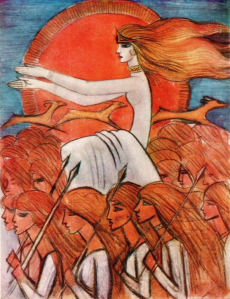
Svan folklore has been part of my life since childhood. My grandfather illustrated many of these myths and translated Svan texts. I grew up surrounded by those books, asking him questions about stories, poems, and characters. Through him I learned a great deal about Svan culture.
His illustrations had a huge impact on me. He was among the first Georgian artists to depict Svan people and mythology in a modern visual language. Looking at those paintings for years, music naturally began to emerge in my mind. I didn’t force it—it simply happened.
I was also fortunate to grow up in a Georgian folk ensemble from a very young age. I learned from extraordinary singers and musicians who represented some of the greatest traditions of Georgian folk music. Those experiences shaped me deeply.
What interests me is not preservation for its own sake. I want to reinterpret these traditions and present them in a way that younger people can connect with. I want contemporary listeners—even young Svans who may feel distant from their heritage—to discover something meaningful in these stories.
This album is deeply personal, but I also wanted it to be accessible. That’s why it combines folk music with Baroque influences, classical music, progressive rock, metal, jazz, and fusion. Ultimately, I don’t think of RIHA as experimental music. I think of it simply as RIHA: a personal language through which I can express what I feel and share these stories with others. (Gianmarco Del Re)


Pingback: A Closer Listen Reviews – Avant Music News