

Looking at the two covers side by side, one cannot help but see a geometrical similarity. To the left is what appears to be a giant fin, tapering off to the bottom; to the right is a blue stream with a large tributary. To the left, blue fish swim like missiles; to the right a series of shapes, traveling in the same direction. One cannot tell if this is all intentional or the result of playing Ouisi, but once the similarities have been seen, they cannot be unseen. One might add that the white segments of the album on the right seem to form a smile or the outline of a cup, while the triangular shapes seem sheared from the shark on the left.
In like manner, the sounds of these albums trigger the effects of pareidolia. Manja Ristić‘s Devet, available as a disc on Flung, explores the symbolism of the number nine using an architecture of field recordings and music; Manja Ristić & Mark Vernon‘s Volim Beograd, a USB drive and booklet on Kamizdat, collects found tapes and field recordings to create a collage of past lives. Devet is by nature a spiritual album; Volim Beograd is a channeling of spirits.
 “The Navagraha” refers to the nine deities and planets in Hinduism that influence human affairs. The track begins with a drone that disappears and reappears like a breath, the second time with water, imitating creation. These forces were with us at the beginning, and are with us still. The “Nine Sacred Mountains” of China, also known as the nine sacred summits, play a large role in Buddhism, an invitation to pilgrimage and communion with the divine. As the wind whips around the recording and footsteps become audible, one can imagine the laborious ascent, the striving for wisdom. Kind spirit birds offer encouragement. In the center, one can hear what sounds like a prayer wheel.
Continuing the theme, the tarot card The Hermit (#9 in the Major Arcana) symbolizes self-examination on the way to spiritual enlightenment. The sonic field is hollowed out, redolent of solitude. Ristić blows lightly on a wind instrument. Rain falls and water flows in “Nine Waters of Mictlan,” which honors the nine aquatic trials souls must face in the Aztec underworld. If only these souls had the “Nawa Sanga” (short for the Dewata Nawa Sanga) of Bali: the guardian gods of directions! Spoken aloud in English, “Dewata” also serves as a play on words. The pace is calm, turning slowly from drone to ambient.
Not everyone agrees that there are “9,999 rooms of the Forbidden City.” Estimates include 9371, 8707 and even the legendary 9999.5, but the symbolism of the legend is more important than the actual count. 9999 is the highest yang number, symbolizing the eternal, one short of perfection and thus suited for a divine emperor. In the track of the same name, one can hear the sounds of water and excavation, a hint of the ceramic, like an archeological dig. “Sedna” is not only a dwarf planet – an Earth-like “Planet Nine” in the Oort cloud – but the Arctic goddess of transformation and the sea. As the water rustles, one can imagine not only the Earth’s oceans, but a matching sea in the deep end of our solar system. “Oya,” the Yoruba goddess of wind, storms and change, continues the watery theme; after performing a sacrifice, she became the mother of nine. Finally, the “Nine Rivers of Xibalba” explores the Mayan underworld, whose trials mirror those of the Mictlan.
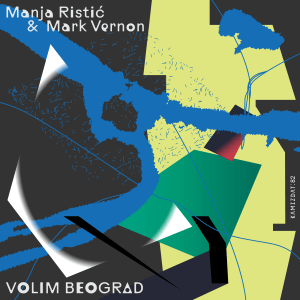 Many of the supplicants who now walk these paths may have been caught on the tapes shared by Ristić and Vernon on Volim Beograd. The album begins with a “Love Message” that is offset by the 988 subtitle – in the United States, the national suicide hotline. Side A embraces recordings of a bicycle race in Serbia circa 2003: on the surface benign, undercut by haunting drones that reflect the conditions in the country at that time. But when the yelling begins, one is grateful not to know the language: the language of bullies, ugly and angry, a fierce indictment, painful for anyone versed in the local tongue. These voices still exist and are in many places even louder and bolder today.
History is constantly being rewritten; unfortunately all too often by the victors, who do their best to erase crucial aspects of oppression and all opposing viewpoints. Ristić and Vernon’s sounds come from physical rummaging, a priceless unearthing of source material taken from dictaphones, answering machines and reel-to-reel. “Obsolete media” becomes crucial evidence. On “Napuštena pesma,” clanging bells join the sound of what may be water in a cave, a further parable. At the flea market, people sell because they have to sell, sometimes their own legacy. At other times, unbeknownst to them, they sell the last copies of people’s voices in existence. What if the song in the third minute of “Istoriju na bubanj ” is the only evidence a man had ever sung? When these sounds are lost, do the souls of those speaking disappear?
An opera singer sings; a child plays contentedly; a friendly conversation unfolds. The marketplace itself had been bombed by the Nazis, iconic architecture destroyed. Volim Beograd (I Love Belgrade) rescues sounds from the rubble like survivors, continually rewinding and replaying. One can hear both trajectories at work: peace and violence, love and hate. The knowledge of history weighs the listener down; the evidence is here, but the lessons have not been learned. Even if Side B is more benign, Side A sticks in the heart like a splinter.
The more one listens, the more one believes that these releases are meant to be played together. The covers call to each other; they invite eurekas of commonality. One recording exposes the sordid underbelly of humanity; the other recognizes its highest aspirations. There is always a choice, and each choice has a proven outcome.
The final track of Violin Beograd is a song of hope, distorted and abraded, discarded and found: a bittersweet excavation, but an encouragement nonetheless. (Richard Allen)


Pingback: A Closer Listen Reviews – Avant Music News