
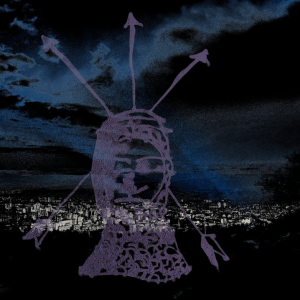
Built entirely from fragments from the Ored Recordings catalogue, Cherim’s Ğymaq reconfigures the label’s archival focus into something spectral and unstable by ways of heritage not preserved, but dissolved, stretched, and made to echo.
Working with Circassian vocal traditions, shichepshin (violin), and pkhachich (percussion), Cherim constructs an ambient language where rhythm rarely settles morphing into drones and narrative gives way to atmosphere. The opening track “Batraz” makes this clear: voices hover refracted through reverb as if heard across distance or time. On “Ashemez,” chopped and pitch-shifted samples introduce a faint rhythmic insistence, though the emphasis remains on timbre—on how sound mutates, and lingers.
What emerges is not a fusion of folk and electronics, but a dialogue between presence and absence. These are not “updates” of traditional material; they are residues. The voices of traditional singers Ramazan Daur & Kazbek Nagaroko read like an afterimage or as an aural impression persisting in the ear even after erasure, never immediately recognisable but always evocative relaying mostly on low pitch and bass frequencies.
Elsewhere, Muhamed Batit, Zaur Nagoy, Gupsa Pashtova and others surface carrying with them the weight of Circassian history — particularly the unresolved trauma that Ored’s catalogue repeatedly returns to. In this sense, Gymaq aligns with hauntological practices: the past is neither revived nor resolved, but continues to press into the present as echo.
Cherim’s detailed treatment of source material — stretching, pitching, converting to MIDI — never feels purely technical. Instead, it becomes a means of inhabiting memory. Tracks like “Hifitse” foreground texture, letting percussion and violin blur into something resembling underwater dub, while “Bgișhem” strips things back to a sparse, mountainous solitude with the faint trace of voices speaking of polyphonic counterpoint. The closing track “Jenibecre Habibere,” intrudes into The Caretaker territory playing like selected memories from a haunted ballroom with a sampled violin originating from Ored’s Bonfires and Stars Sessions, while offering glimpses of dream pop.
Through this album, Cherim offers something ancestral: a space where rituals — Jegu, Mexsimafe — persist as distant vibrations. Gymaq is not nostalgic in any simple sense. It is a yearning for home that acknowledges its own distortion, a cry — true to its title — that arrives already filtered through time, distance, and loss.
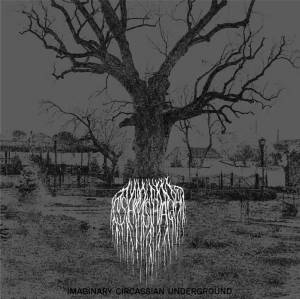
Cover photo: Tulip tree in the village of Golovinka, Lazarevsky District, Krasnodar Krai / Shapsugia. Photo by Lilit Matevosyan. Cover design: Milana Khalilova.
Released on May 21st, the annual Circassian Day of Remembrance, Shyshagh: Imaginary Circassian Underground arrives as a subtle but significant departure from the concerns that animated much of Ored Recordings’ previous catalogue. If Cherim’s Ğymaq dwelt among echoes, spectral traces, and the unresolved weight of history, Shyshagh asks what comes after remembrance. Rather than focusing on trauma itself, the compilation presents a cross-section of artists using Circassian cultural material as a starting point for new forms of expression.
The answer is deliberately eclectic. Maykop-born, Tbilisi-based Cherim moves away from the drone-hauntology and desolate ambient landscapes of Ğymaq, embracing instead a surprisingly intimate folk idiom. “Pari (Nothing)” and “Ut1ypsh (Let It Go)” are sparse indie-folk songs whose emotional directness recalls both Soviet-era singer-songwriters and the lo-fi melancholy of bands such as Low. The shift signals a different register of vulnerability.
Temir’s contributions occupy another corner of this imagined scene. Built from archival Circassian recordings and fragments of Jrpjej rehearsal tapes, “Zechir” and “Duguj” transform ethnographic material into organic, skeletal compositions where field recordings, ghostly voices, and deconstructed electronic textures coexist. These are qafe — traditional Circassian dance music — without the dancing: music that retains fragile traces of communal memory while drifting into ethereal pop and ambient collage.
The compilation’s most evocative moment arrives with Shkhafit’s “Ziguer (Something),” a collaboration between Timur Kodzoko and his son Astemir. The piece unfolds as a semi-improvised drone-folk meditation steeped into environmental sounds and centred on the shichepshin, the Circassian fiddle. It feels suspended between archaeology and speculation, evoking what the liner notes describe as “the ghosts of an unfulfilled future.” Nearby sits Zafaq’s “Chapshre Djegumre (We Heal and We Dance),” a raw black metal rehearsal recording rooted in Circassian melodic traditions while pointedly avoiding the clichés of folk metal.
What makes Shyshagh compelling is not simply its stylistic diversity but its underlying proposition. Circassian culture is often discussed through the lens of preservation, loss, and historical trauma. Here, Ored imagines something else: a living underground scene stretching from Nalchik to Paris, Tbilisi, and Göttingen, one that draws on archives and memory not to reconstruct the past but to create new futures. As another May 21st passes under increasingly restrictive conditions, Shyshagh offers a quiet act of resistance — not through commemoration alone, but through artistic evolution. (Gianmarco Del Re)


Pingback: A Closer Listen Reviews – Avant Music News