
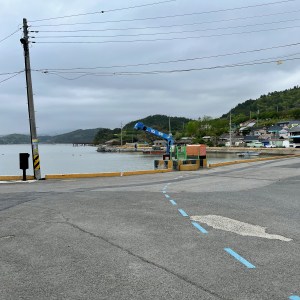
 Many ambient artists fold field recordings into their works, but seldom does an ambient artist pay so much respect to the field recordings that their work lands in that genre. Hwapo is that rare creation, its recordings captured in a South Korean fishing port and enhanced in a Stockholm residency. Wil Bolton is careful not to overwhelm the original recordings so that they retain their peaceful power.
The recording begins with the hum of machinery and the cries of morning birds. The fishing village is part of an ecologically protected region, a fragile balance conveyed by the blend of natural and mechanical sounds. As the village awakens, so does the local industry, voice by voice, net by net.
A buoy occupies the sonic space that might otherwise be filled by a church bell. In the distance a rooster crows; the day has begun. This same rooster (we assume) is front and center at the start of “Hwapo II,” crowing over the lapping of waves. According to Bolton, “the pace of everyday life is slow and locals greet each other around the modest harbour.” Their gentle conversations can be heard here, the only sadness being the preparation of octopus nets, given recent attention paid to the intelligence of said creatures. Given such knowledge, the Buchla tones may be received as an ode to the pace of the village or a bittersweet requiem for the eight-armed residents of the sea.
A final series of splashes leads to “Hwapo III,” which takes up nearly half of the album. Water splashes against the docks. Light traffic rushes by. The fisherman laugh, at ease with each other and their work. Together, these sounds form a lattice of rhythm as one sinks into the routines of the day. The music is barely audible, an onlooker careful not to intrude. A light drone unifies the sounds of scraping and loading, softening the entries of engines and motors.
In the closing piece and most musical movement, water drops land like percussion on copper hulls, while ambient tones dance over a subtle drone. The attention shifts from the sound of the harbour to the impression of the harbour. Without human sounds, one suspects that the day is ending, the nets have been put away and the creatures of the sea and the port are free until dawn: to sleep or to dance, to hunt or to mate, left to their own devices. (Richard Allen)


Pingback: Hwapo | Wil Bolton
Pingback: A Closer Listen Reviews – Avant Music News