
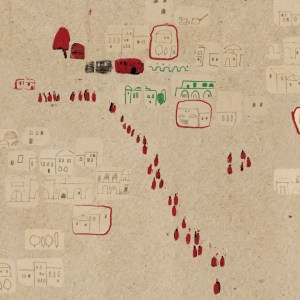
 Six months after Gaza Is the Moral Compass, Beacon Sound returns with its second in a series of vital fundraisers for Palestine. The proceeds will be split among Arab Group for the Protection of Nature, APN’s Revive Gaza Farmland, and the Palestinian Teacher Creativity Center.
We highly recommend the heartfelt liner notes for this release on Bandcamp. Here is a sample taken from MARSM’s Music for Palestine zine: “Palestine is too often encountered through rupture alone: through the image of destruction, the language of emergency, the arithmetic of death. But Palestine is not defined only by what is being destroyed. Palestine is also what continues. It continues in memory, language, inheritance, cultural practice, refusal, and the stubborn insistence on life despite every structure designed to make that life impossible.”
In short, Flowers Not Bombs is about life more than it is about death. It is about freedom more than it is about oppression. It is about resistance more than it is about destruction. The creation of art is its own life force. The music is in no way meant to sugar-coat the genocide, the occupation and the annihilation, but to heighten the horror by highlighting the beauty, the vibrancy, the irreplaceable value of what is being destroyed. A gesture of solidarity from an international lineup, the compilation may be only a drop in a bucket, but droplets can eventually become a sea.
Rebecca Foon sets the mood with the melancholic yet intense “Where the river runs free.” The strings carve a serenade from the rocks; one imagines the tears flowing into the river, overflowing its banks. The listener knows that the river flows in another time, but can still be yearned for and imagined; and as such, it remains real. Chuck Johnson‘s “Olive Flowers” adds an ambient sheen, shifting in the second half to a more restrained tone, like that of a deserted, decimated city. Two other tracks also mention flowers, referencing the album title: Ki Oni‘s “A Field of Poppies Bloom” imagines a vista undisturbed by war, bolstered by the sound of wind and waves. William Ryan Fritch‘s “Still, it bloomed in the shifting scree” recalls Ben E. King’s “Spanish Harlem,” with life defying its circumstances, rising through the cracks.
Is it premature to speak of “Healing” as the bombs are still falling? If so, what is the alternative? Sarathy Karwar (feat. Giuliano Modarelli) offers the possibility through percussion and electric guitar, gaining momentum as the piece progresses. In like manner, Thanya Iyer‘s track is titled “Free,” although no one is free; the oppressed are still oppressed, while the oppressors are chained by their own immorality. And yet still the artist dreams; not only this artist, but all artists, through the nature of artistry itself, which creates things that were not there before. Booker Stardrum‘s “Phantom Near Interlude” may include calming tones and holy percussion, but its highlight is the dawn chorus: birdsong uninterrupted by bombs.
The inclusion of dance pieces sparks a similar question: is it appropriate to dance in such times? We’ve often covered this question while writing of Ukrainian releases, concluding that not to dance would be to admit defeat. The Edna Martinez remix of Mas Aya with Lido Pimienta‘s “Vamos Pa Lante” is jubilant, like the end to war: a vision of happiness embedded in the center of the set. Nick Storring‘s “Bryn” follows, one of the artist’s finest pieces to date, packed with intense percussion, sawing strings and intricate, interwoven patterns. The intensity continues to grow throughout the track, as numerous breakdowns lead to new, exciting developments.
After this, the compilation turns more abstract and experimental, beginning with Youmna Saba‘s “Ma Bayn.” The track sounds like a walk through an irradiated zone, with dragged instruments, static surges and an encroaching drone that underlines the artist’s injured vocals. One can imagine the piece being sung amid the rubble. Racine & Rouzbey Shadpey offer “Gorselight,” a slow and howling piece that sounds as if it were recorded in a wind tunnel. When the guitar finally arrives, it contributes structure, but remains troubled, especially as it becomes tape manipulated in a distortion of its original sound. The title of Bint Mbareh “one’s own third harmonic on a rusted sewage pipe” serves a similar role, although the piece itself is played on piano. The twisting of this piece arrives at exactly 3:00 with backward-masked voices and a sense of deep disturbance. Ben Shemie contributes the album’s only English-lyric work, “I See You Too,” a message to anyone who may still be able to hear.
The final impression is left to Manara منارة (Khabat Abas / Alya Al-Sultani / Pat Thomas)‘s “Resist My People, Resist قاومهم يا شعبي قاوم (live at Cafe OTO).” Even without translation, by tone alone, anyone with a heart will feel it crumble. There is anger here, and despair, but also pleading, encouragement and resolve. There are too many emotions to remain on one. The dissonance of the piano echoes that of the region, of the messaging, of the ruined structure and stolen lives. There may be no end to this travesty; but as long as one voice speaks or one instrument plays, neither will there be an end to the resistance. (Richard Allen)


Pingback: A Closer Listen Reviews – Avant Music News