
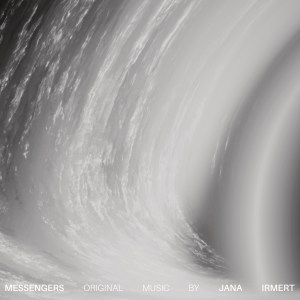
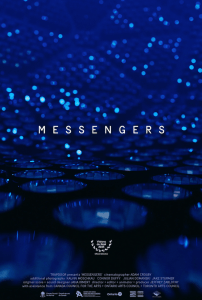
 Understanding the universe begins with listening rather than seeing. Listening to the stars as much as to our unconscious mind. This is the idea around which both Jeffrey Zablotny’s film and Jana Irmert‘s soundtrack revolve.
The documentary follows the journey of neutrinos through three subterranean observatories – SNOLAB in Canada, Super-Kamiokande in Japan and IceCube beneath the Antarctic ice. Throughout the film, the narrator repeatedly returns to acts of listening: “We are listening for a whisper.” “Listening through stone, ice and water.” The scientists descend deep beneath the Earth’s surface because, as the film explains, “the surface of the Earth is full of interference.” Only underground, protected from the overwhelming noise of cosmic rays, can they hope to detect the almost imperceptible traces left by neutrinos – those elusive “messengers” that traverse the universe largely unnoticed.
Irmert constructs a musical language that grows out of this way of listening. Pulse is reduced to slow internal breathing and harmony becomes a series of suspended resonances. Rather than directing the listener emotionally, the music encourages attentive listening. Every sustained tone and carefully sculpted silence asks us to engage with sound in much the same way the scientists engage with their detectors: patiently, waiting for meaningful signals to emerge from apparent stillness.
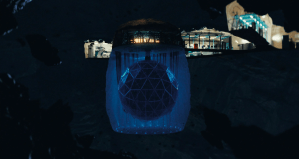
This becomes especially powerful alongside one of the film’s recurring metaphors. The architecture of the laboratories is visually stunning, particularly given that these monumental spaces are buried so deep beneath the Earth’s surface. Here, every speck of dust appears in the detectors as noise, while random particles and cosmic rays pass through them like an endless river of interference. The challenge is to distinguish the almost impossible whisper of a neutrino from this overwhelming background. Irmert’s score mirrors that process. Beneath its apparent stillness, microscopic timbral fluctuations, spectral beating and subtle harmonic transformations remain in constant motion.
The score also follows the film’s remarkable treatment of scale. Messengers moves effortlessly between forests, mountains, mines, monumental underground laboratories, microscopic animations and the vast distances travelled by neutrinos originating near black holes. Irmert achieves a similar fluidity through sound. Individual cues shift between intimate, almost bodily resonances and immense architectural spaces without resorting to conventional cinematic gestures. Long reverberations evoke underground chambers, enclosed acoustic volumes suggest the interior of the Earth itself, while slowly evolving harmonic fields seem to unfold across geological rather than human time.
The influence of Wolfgang Pauli’s psychological journey permeates both the film and the score. His fear of wasps, his dreams and his collaboration with Carl Jung are presented not as biographical curiosities but as reminders that scientific discovery often emerges from a dialogue between rational observation and the unconscious. This duality is beautifully reflected in tracks such as “A Fear of Wasps,” where moments of curiosity interrupt the soundtrack’s prevailing atmosphere of contemplation. Rather than sounding threatening, the music feels unexpectedly playful suggesting that the unconscious is not merely a source of anxiety but also of imagination. Similarly, “Hallway of Shrines” introduces a sense of wonder and of freedom, momentarily opening up the score’s otherwise austere language. These pieces soften the soundtrack’s prevailing atmosphere of contemplation, reminding us that scientific curiosity is, ultimately, a profoundly human impulse.
Throughout the album, Irmert displays an extraordinary sensitivity to spectral balance. Most of the musical energy resides in the lower and middle registers, creating a warm, dark sonic environment in which delicate upper harmonics appear only when truly needed. Hybrid timbres, hovering between analogue synthesis, processed acoustic sounds and environmental resonance, remain deliberately ambiguous. Instrumental identity gives way to the behaviour of sound itself. Like the film, the score is less interested in presenting objects than in revealing traces, resonances and relationships.
The soundtrack’s architecture follows the film’s psychological trajectory. Early cues establish enclosed interiors (“Dream Cabin”), latent anxiety (“A Fear of Wasps”) and microscopic interaction (“Subatomic Collisions”), before gradually expanding towards geological and cosmic scales in pieces such as “Sleeping, Listening to the Stars in Darkness,” “Inside the Cocoon” and “Frozen Into Ice.” The closing track, “Monuments to Our Questions,” gathers these ideas without offering resolution. Instead, it turns resonance itself into a metaphor for scientific inquiry. As the narrator observes that the underground laboratories are “monuments to our questions about the universe,” Irmert responds not with musical closure but with an extended meditation in which uncertainty becomes something to inhabit rather than overcome.
The film suggests that the deepest forms of perception occur below the surface: beneath the Earth, beneath conscious thought and beyond the interference of everyday experience. The observatories become extensions of the unconscious, places where listening itself becomes an act of discovery. In doing so, Messengers becomes a meditation on the relationship between science and imagination, and on humanity’s enduring desire to hear whispers that lie just beyond the limits of perception.

Jana Irmert
Jana Irmert was kind enough to provide further insight in the production process for Messengers.
Messengers revolves around three extraordinary scientific observatories buried deep beneath rock (SNOLAB in Canada), water (the neutrino detector in Japan) and ice (IceCube at the South Pole) — three environments through which scientists are effectively “listening” for neutrinos and other elusive cosmic phenomena.
In Time Piece, you described learning to “think how the ocean thinks,” becoming immersed within an environment rather than observing it from the outside. Did composing Messengers require a similar shift in perspective? Rather than writing music about these places, were you trying to compose through the acoustic properties of rock, water and ice, allowing each material to suggest its own mode of listening?
I think I was more looking for tonal qualities and a specific sound that would connect these observatories and that would harness their atmosphere. Although the research stations are in very different locations, the scientists are devoted to finding answers to the same questions. The fact that they are located in these extremely remote or deep underground places has to do with the specific environment that’s needed to conduct this kind of research, which is to be as far away as possible from any kind of particle “noise”.
So, while I was not so much focused on characterising the environments the observatories are embedded in, it seemed important to convey their isolation in the music. For this, I was relying on the accounts of the director, Jeff Zablotny, how it felt to be in these places. These research stations feel like space stations, and this kind of research around the detection of neutrinos is highly abstract and indeed more connected to Space than Earth. It’s also mostly work with no immediate results, it can take months and years, even decades, to be able to draw conclusions from the measurements. So that feeling of being removed from any day-to-day, possibly even from achieving research goals within a human lifetime, is also something that I had in the back of my mind.
With this, it could maybe have been an obvious choice to work with synthesizers and computer generated sounds only, but I felt I needed to tether the music to the Earth, to have it originate from something organic, which is why I chose to use a vintage electric organ as the main instrument and incorporate the sounds of its keys, wind and so on. After all, it is humans trying to figure something out, with the help of technology, of course, but the motivation is inherently human: to explore, to try to see beyond what is visible for us, and maybe also to try to understand something that defies our logic.
Having said all that, the location and natural properties of the surroundings of the observatories, were also not irrelevant. For instance, when we see the detectors buried in the ice in the research station in Antarctica, I wanted to use sounds that evoke the clarity, cold, and crystalline character of where we are. But on the whole, it was more about the underlying connection and atmosphere of these places.
One of the aspects I found most striking while listening to Messengers was the way the soundtrack continually redefines where the listener is situated. Some cues feel almost microscopic, others architectural, while later pieces seem suspended somewhere between the body and the cosmos. Yet these spaces are never created through obvious cinematic reverberation; instead they emerge through carefully balanced resonance, silence and harmonic distance.
When composing, do you consciously imagine where the listener is located within the sound? Is spatial perception something you shape as carefully as pitch, harmony or timbre?
I absolutely do think about where I am located within the sound when composing. When I make music and sound for a film, I always feel that the sound needs to come from within the film. It has to emerge out of what’s beyond the image. I never want to have the feeling of just having put a piece of music there that somehow makes the scene work. So, in this sense, the music unfolds from the spaces of the film and thus, also creates these spaces itself.
In a very concrete example, “Subatomic Collisions” is a cue where the sound, together with the image, moves from outside to inside a Neutrino detector and the acoustic space that I shaped through delays and reverb are an imagination of the acoustic space of the detector.
In other scenes, the spatial perception is more abstract and was more about how narrow or how all-encompassing the music should be. Like, when a tone that’s barely audible, buried within the sound of flowing water, starts growing into a sort of drone that feels like it’s the air that surrounds you.
Movement of sound was also a very important aspect I was concerned with. To transport the ever-changing and elusive nature of neutrinos in the music, like in “Inside the Cocoon,” there needed to be constant modulation in timbre, but also in spatial movement, the sounds shifting and passing through you like the particles do. In other places, the music needed to create a stability that would only slowly shift, to create this sense of space-time that really is timelessness, if that makes sense.
 In a 2021 interview for Located Sound, you questioned the traditional distinction between music and sound design, suggesting that the boundary between the two had become increasingly irrelevant, particularly in cinema. Messengers feels like a natural extension of that philosophy.
Many of the soundtrack’s most expressive moments emerge through spectral transformation, microscopic shifts in resonance and evolving timbral relationships rather than recognisably “musical” gestures. Having now worked on several film scores, has your understanding of the relationship between composition and sound design continued to evolve? At what point does a sound become music, or does that distinction simply cease to matter?
I think it is my love for sound – sound beyond classification – that has made this distinction quite irrelevant for me, and that still holds true. I still cherish the in-between world of sounds that are not concrete anymore and tones that are not yet melodic. Especially for the cinema, I feel there is so much potential in this ambiguity of the soundtrack. With Messengers, I was working on both music and sound design, so I could be completely oblivious to having to stay in one department and I totally embraced that. A dear colleague of mine, Nils Vogel-Bartling, worked on the more naturalistic sound design, background ambiences and sound effects, so I was really fully immersed in creating the score with whatever it needed. I think that should really be the goal – to create the sound world necessary for the specific film. Who cares what it is?
The reality of post-production often doesn’t often allow the two departments to work in a really intertwined way – and that has mostly been my experience as a composer, just because of the fact I often work on the film at a different point in time than the sound designer.
Still, I always have conversations with the sound designer where we talk about our approaches, and that has always been super positive, so in case I deliver a cue that is basically rumbles and crunchy noise, nobody feels as if I am taking away from their job.
One of the qualities I found most remarkable in Messengers is the way apparently static sounds continually reveal subtle internal activity. Sustained drones breathe through minute overtone shifts, neighbouring frequencies generate delicate beating patterns, and tiny spectral changes gradually become expressive events in themselves.
The soundtrack seems to cultivate a mode of listening based on prolonged attention rather than expectation. Is this way of organising musical time something you’ve consciously developed across works such as Time Piece and now Messengers? Do you think of patience and sustained listening as compositional materials in their own right?
This is a very interesting perspective, regarding patience and sustained listening as compositional materials. For me, however, the organising of musical time is almost purely intuitive. I try to go wherever the sounds lead me, to give them as much space and time that they need. I feel sometimes listening and making music are the few modes of being where I am truly patient. It’s something I tend to struggle with otherwise, so maybe this is a coping mechanism to keep me sane. Sound can evoke a state of just being with it, of just enjoying being immersed in it, of totally letting go of what came before and what comes next. Through listening, you become part of what you are listening to, and I mean on a physical level. The sound enters your body. And at the same time, you can become bodyless and just exist in the sound.
In Time Piece, I tried to translate the experience of listening to the ever-shifting underwater sounds of the ocean while looking at the moving waves and smelling the air, into a composition. You can basically get in and out of this composition at any time, it is more circular than following a linear progression.
In contrast to that, with a film soundtrack, you do have to work towards a certain end point, and the music usually requires a dramaturgy that helps move the narrative forward. I think in Messengers, I felt the music needed to be more reduced and clear than extremely complex and full and the pace of the film invited this sense of very patient unfolding of the music and the sounds. It was a really fascinating process, since Jeff, the director, didn’t use any layout music in the editing. It felt like this big empty space that I could move through with sound. I think this is where this soundtrack meets with other works of mine regarding cultivating sustained listening – in the possibility to create a space in which you can be and listen in a very unhurried way.

Jeffrey Zablotny
And here is what Jeffrey Zablotny, the director, had to say about the film.
One of the things I found most compelling about Messengers is that, despite being a film about particle physics, it is concerned as much with listening as with seeing. The narration speaks of “listening through stone, ice and water”, of “listening for a whisper”, and of trying to distinguish meaningful signals from overwhelming background noise. Since neutrinos themselves are almost impossible to observe directly, it feels as though you deliberately chose to build the film around acts of listening as much as visual observation.
When you began collaborating with Jana Irmert, did the two of you discuss from the outset what a soundtrack for something almost fundamentally invisible should sound like? Were the sonic and visual languages conceived together, or did they gradually find one another during the editing process?
A philosophy of listening felt close to the spirit of the observatories: there’s a quiet vigilance in how they operate continuously for years to detect the invisible. To me, listening also suggests an openness and a present quality, where the act of visual observation can sometimes be more preoccupied with ‘knowing’ and labelling. I felt a deep reverence shooting in those locations, so that approach was also a reflection of my personal experience.
The intent from the film’s conception was for the images to create a vast space for Jana’s specialty of compositions that exist inbetween music and sound design as a way to create experiences that scientific context and explanation alone couldn’t provide. In the collaboration, we were definitely honing in on a specific kind of flickering, elusive texture for the particles and playing with ways to reveal their signal in an ocean of noise, but beyond those specific devices around the invisible, I wanted her to have a great deal of freedom in finding the sound for longer compositions since their atmosphere was so central to the film’s effect. It was astonishing for me to hear those pieces come together in the surround mix, particularly in the film’s space sequence where we cross terrestrial, cosmic, and subatomic thresholds.
Editorially, the sonic language ended up shaping the rhythm and cadence of the film’s images more than the content of those images themselves – Jana had very strong instincts for where to let passages breathe longer, and where we needed to pull back.
Messengers film still
Visually, Messengers is extraordinary because it is constantly negotiating scale. The film moves effortlessly from sweeping landscapes to the monumental architecture of the observatories, then into the microscopic world through animation before returning once again to geological space. At the same time, the laboratories are never presented as isolated technological objects—they remain inseparable from the forests, mountains, rock, ice and water that surround them. Was this dialogue between landscape and architecture part of your original conception? How did you develop a visual language capable of moving between the planetary and the subatomic while maintaining such a strong sense of spatial continuity?
I think that the way urban environments are designed can disconnect us from the earth – we need consistent, tactile markers to understand our relationship to nature and to the universe. The way the film’s laboratories intersect with the natural world was something I was always drawn to in developing the film, and it required extensive research because it’s not something you can just pull up on Google Earth or find existing photographs of. Almost everything I found initially presented the projects as functional devices in a fairly limited environmental context, but to me, their enmeshment with our planet felt like such a strong statement in itself that was never really intended by its architects.
I was always looking to make subatomic and cosmic images feel flawed and real, like it was just barely possible to capture them, which I think can be more relatable to parse than some omnipotent perspective that’s free to fly around and magically depict any perspective. The visual language for ‘Messengers’ started from a previous short which depicted underground spaces that Jana had also collaborated on, ‘Sub Terra’, and it was also informed by animated films like ‘Powers of Ten’, and especially illustrated books I was fixated on as a child that had detailed cutaways of environments. Those books were always so good at consistently orienting you in an enormous world: here’s a person, here’s a truck, here’s the forest, here’s the lake. I always wondered what would happen if you kept going in either direction? Those books are about creating a sense of spatial coherence that feels safe, but I think there’s also something important about embracing the moment you feel lost and overwhelmed in scale, too. I felt my job as a filmmaker was to preserve a window of awe for as long as possible.

Messengers film still
Although there are no talking-head interviews, I was struck by how present the people working inside these observatories remain throughout the film. We see technicians descending into the mines, scientists waiting, maintaining equipment, inhabiting these extraordinary spaces, yet they never become conventional documentary subjects. Instead, they seem almost to mediate between the human scale and the immense geological and cosmological scales the film explores.
Was it important for you that the human presence remained visible throughout? In a film about particles that pass unnoticed through the Earth – and through ourselves – it felt as though the scientists themselves became another kind of messenger, quietly embodying humanity’s desire to listen to something almost beyond comprehension.
Playing with human presence was always part of the vision for the film, establishing that presence and absence at the same time. The intent was for those figures to feel fleeting, delicate, and small – I never wanted them to be conventional subjects. Physics is absolutely about expanding our understanding of the universe, but grappling with ‘not knowing’ and the nature of open-ended scientific inquiry is the most compelling part of that project to me, and positioning people in that way spatially and visually helps them read as those mediating figures in the way you’re describing. Spending time in those spaces, you really do sense humans trying to peer around the corner of their own mortality with that desire to listen to and understand things almost beyond comprehension, and there’s a peculiar fantasy and reality at the same time to me in that endeavour.
Gaining access to facilities such as SNOLAB, Super-Kamiokande and IceCube must have been an extraordinary undertaking. I’m curious about the practical realities behind the film. How long did it take to secure permission to shoot inside these observatories, and what kinds of restrictions came with that access? Were there scientific, technical or security conditions that shaped where you could film, how you could move through these environments, or even the kinds of images you were ultimately able to capture?
The three facilities were always very supportive of the film, but definitely sensitive and difficult to access – it was a long, involved process. In SNOLAB, just coordinating the long ‘cage’ shot that descends into the mine was choreographed and planned months in advance to achieve that specific perspective because the position of every individual in that elevator is so tightly controlled.
Super Kamiokande in Japan had a little front door you couldn’t leave open for more than a few seconds because you’d be letting radon leak inside the facility from the mountain rock. Because IceCube (at the South Pole) was shot in -40° conditions, we needed equipment that could reliably withstand that. I had the operators flash laminated QR codes at the cameras that would change the settings per-shot, because you can’t press buttons or operate equipment with your hands at that temperature. It meant the camera positions, sun positions, and photographic settings for every single shot in that section were blindly committed to months in advance – it was very much like a space mission in that respect. There were always constraints on the images, but ultimately the feeling needed to be protected: was this capturing the experience of what it’s like to be there?
(Gianmarco Del Re)


Pingback: A Closer Listen Reviews – Avant Music News