
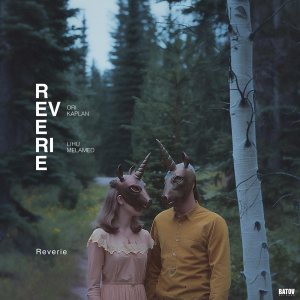
 The soulless age of the Hollywood blockbuster, rife with CGI and A.I., has left viewers nostalgic for the golden age of cinema, when a widescreen epic meant months of set building and thousands of extras, but a small, intimate picture with a compelling story could still become a runaway smash. Ori Kaplan & Lihu Melamed‘s Reverie recalls the film scores of this era, focusing on the timbres of the 1960s and 70s while unfolding like a reel of greatest themes. At various junctures, one may think of a love story, a car chase, or a desert crossing; the high drama of a western, the tension of a spy film, or even the snappy banter of a Blaxploitation flick. The cover implies a weirdness, a readiness to experiment, the courage to walk deep into a haunted glade, well aware of the danger.
While the album is offered as an LP, it would also work well as a series of 45s. The saxophone groove of opener “Merveille” is enhanced by rustic surf guitar and psychedelic flute, all nudged forward by the drums: a happy opening scene in which the early characters are introduced. One can imagine this as a double A-sided single along with “Nuna,” which is not only brassy in timbre, but in tone, confident as a Times Square pimp in the neon era. See how he struts, puffing on a cigar, not a care in the world, while the Vietnam War rages on the other side of the sea.
“The Stroll” and “Shangri-La” ease the drama down, more like Central Park on a summer day. The lovers-to-be are walking arm in arm, taking time to smell the flowers, laughing at each other’s little jokes, unaware that they will be lovers, but we know; we’ve seen the trailer. When the choir sings, it sings for them.
The title “Obelisk” recalls “2001,” but the music is more like a suede jacket with patches on the arms, a book tucked under the arm, a cappuccino in a cafe. Each piece has its own distinct vibe; one writes the scenes in one’s head as one listens. While each stems from a different (imaginary) film, all are playing at the same theatre on a glorious festival weekend. The comfort of the organic notes matches the nostalgia for 8mm film; with delight, one remembers that one has not yet seen every classic film, which means that wonders still await. Even when one has seen a classic film, one may have done so when much younger, absorbing the score without noticing it; Reverie calls attention to the evocative power of sound. The diptych “Lost Soul” and “Soul Found” brings the point home. The first begins with conversational bustle, as at the start of a screening, and a lonesome yearning; the second, a 48 second coda, operates as the end credits.
The movie is over, and we already want to see it – and hear it – again. (Richard Allen)


Pingback: A Closer Listen Reviews – Avant Music News