
 Add a viola, and the whole world changes. On Stella Maris, Pavia post-rockers Tristan de Cunha become a trio, thanks to Nicolò Vara, which moves their already orchestral sound to the realm of the majestic. Now in their tenth year, the band is still making waves, and these waves are larger than any that came before.
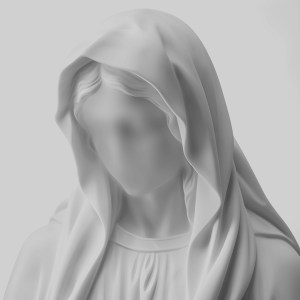
The album is inspired by the followers of Our Lady Star of the Sea (as approved by the Catholic Church). One can see Mary on the cover, shrouded in mystery, the guiding star for those at sea. Through wind and storm, perils within and perils without, her prayers and those of her supplicants guide seafarers home. This is a great theme for a post-rock suite, allowing for peaks and valleys, high drama on the open seas, and grand spiritual themes.
The album works best played as a single piece, unfolding as a suite. The opening notes are like a ship’s horn, cutting through the fog, stopping and restarting, underlining the tension. Vara enters swiftly like a tumultuous sea. The drummer adds a pulse. And then suddenly the ship pushes into gentler, ambient seas. Cymbals shimmer, the guitar refracts, the viola offers a meditation. And all this in the prelude alone! One barely notices as the piece tips into the title track, which bleeds reflection and even remorse in long, rolling tones: an early emotional highlight.
To listen is to think of three sets of parties: the sailors, possibly lost at sea; the people left behind to wonder at wait; and the third, divine party, to whom both prior sets petition. The ominous “A Tidal Wave Shall Push Them to the Light” implies two kinds of light: safety and salvation, although death may lie between. The wave never breaks, but remains a constant shadow, ignoring nature’s laws, demanding divine intervention. After this, the album enters a zone of abstraction, like the dark imaginings of a fitful sleep, the sailors unaware of their fate, tortured by nightmares.
The ship begins to steady in “Wound,” implying the wounds and thus the mercy of Christ: by his wounds we were healed. The spiritual associations are cemented in “The Veil” with the arrival of a subdued yet powerful choir. The Star of the Sea has intervened! This is the set’s high water mark, to which all builds and from which all subsides. When the strings enter, the song dives straight to the heart. In “Continuum,” the ship sets a course for home.
For a decade, guitarist Francesco Vara and drummer Luca Scotti have been sailing the high seas alone. Nicolò Vara is a steadying force, echoing the bolstering presence of the divine. The hull is now stronger, the sails more flexible, the ship more confident in the storm. (Richard Allen)


Pingback: A Closer Listen Reviews – Avant Music News