
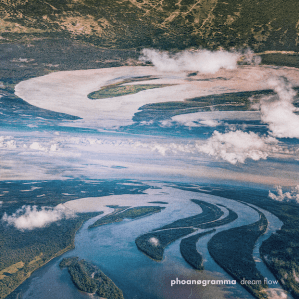
After the void on a distant sun (2023) and [limen memoriae] (with Luca Ferro, 2024), Angelo Panebianco and Matteo Mariano return as phoanøgramma with dream flow, a single long-form composition presented in six movements. Although divided into individual tracks for navigation, the work was conceived as an uninterrupted whole, with the titles reading like successive lines of a single poem. From beginning to end, the music remains in constant motion, continually altering density, and texture without ever interrupting its flow.
Panebianco establishes the broad harmonic terrain with slowly expanding drones, while Mariano introduces subtle perturbations that keep the surface in perpetual motion. “raindrops (prelude)” begins with rhythmic droplets that gradually dissolve into bubbling textures as broad circular harmonies gather around them before acquiring an insistent metallic edge. “arise in sinking feelings” darkens the atmosphere, introducing currents of unease that quietly unsettle the calm established at the outset. “fractures” opens onto an immense glacial space where deep resonances stretch into the distance while minute electronic activity continues beneath them, gradually generating a dense web of interacting signals.
The balance shifts during the second half. “where things are hollow” allows machine-like chatter and electronic circuitry to emerge with increasing clarity before they slowly sink back into the surrounding drone during “a cecasting of indices”. By the closing chapter, “the vanishing”, the droplets heard at the beginning quietly reappear, completing the album’s circular trajectory. Repetition, rotation and inversion shape the work throughout, with recurring materials returning in altered forms as though recalled from memory rather than simply repeated.
The six chapters reveal a compositional practice built on serial procedures, recurring materials and gradual transformation. Sounds return altered by context, textures migrate from foreground to background, and seemingly incidental details quietly reshape the listener’s perception of what came before. The result is an album whose continuity arises from the way each recurrence subtly modifies the whole.
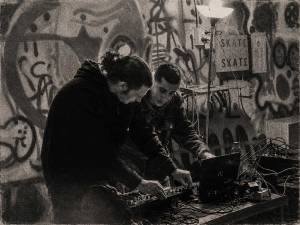 To guide us through the different undercurrents of the album, Angelo Panebianco and Matteo Mariano have agreed to answer four questions by email.
phoanøgramma’s previous releases, from the void on a distant sun to [limen memoriae] — with Luca Ferro — often seemed concerned with memory, distance, thresholds and liminal states. dream flow feels like a continuation of those interests, but also a more fluid and immersive work, unfolding almost as a single dream process rather than a collection of discrete compositions. How do you see this album in relation to your earlier collaborations, and what new territory were you trying to explore together here?
You have certainly identified one of the central intentions behind the album: the idea of fluidity and immersion.
In this sense, we see this last album as an evolution in terms of intention. Our previous works were also connected to ideas of memory, distance, thresholds and unstable spaces, but they were based on more abstract or suggested concepts. With dream flow, the concept was not only a background suggestion, but a real compositional direction: we wanted to evoke a specific condition, a circumscribed but open-ended image — the continuous transformation of perception inside a dream, in which everything moves continuously, changes shape, dissolves and reappears without clear boundaries.
Musically, we also wanted to move toward a more classically ambient/drone form. the void on a distant sun had darker moments, with a strong presence of tapes and synthesizers, while [limen memoriae] had a dimension closer to improvisation and electroacoustic interaction. For dream flow, we worked in a more programmatic way, starting from the concept itself and shaping the material accordingly. It is probably a more carefully studied work, less instinctive in its construction, even though we wanted to preserve the sense of instability and suspension that belongs to the dream state.
The title dream flow and the accompanying text suggest a work built around transformation, dissolution and the unstable logic of dreams: “fractures bloom where things are hollow” and “a recasting of indices spirals toward the vanishing.” Were these tracks shaped by specific dreams, subconscious imagery and personal experiences, or are you more interested in creating the conditions under which listeners can project their own dream narratives onto the music?
There is certainly a personal inspiration behind dream flow, coming from our own memories of dreams and dreamlike states. One example is the cover image itself, which represents an imaginary environment where sky and earth seem to exchange places. That image was suggested by a childhood dream remembered by Matteo: he was swimming in a lake, looking up at the sky, and beyond the clouds he could see mountains, almost as if he were looking down from above.
Of course, it is impossible to translate such an image directly into music. What we tried to do instead was to start from our own personal images and memories, but without turning them into a closed narrative. We wanted to create a sound environment in which the listener could enter freely, bringing their own dream memories and associations into the experience.
So the album is not meant to describe a specific dream in a literal way. It is more about creating the emotional and perceptual conditions for a dreamlike process to take place — something that can carry the listener from the beginning to the end, while leaving enough space for their own inner images to emerge.
Both of you come from slightly different backgrounds and working methods. Matteo’s recent work on albums such as Magnetic Series explored the materiality and constraints of tape manipulation, while Angelo’s solo work as Phoan often embraces intuition, spontaneity and the search for hidden sounds within sounds. How did those approaches intersect during the making of dream flow? Was the album built through careful composition, improvisation, sound design, or some combination of all three?
Having two different ways of working, and two different ways of approaching sound, was actually one of the strengths of the project. At times our methods can seem quite distant from one another, but this distance allows each of us to contribute where we feel more naturally effective.
In the case of dream flow, Angelo brought the initial structure of the work and much of the raw drone material that runs through the whole album. Matteo’s role was more connected to a later stage of manipulation and construction: taking the material generated by Angelo and working on it in a more architectural way, assembling, reshaping and refining the overall form.
So the album was born from a combination of intuition, sound design and careful composition. The intuitive element was essential in generating the first material and discovering the hidden qualities within it, but the final shape of the album came through a more deliberate process of editing, transformation and structural control. We were interested in preserving the organic nature of the original sounds, while giving them a clear long-form direction.
The album is presented as six separate tracks with a continuous mix. Listening to it feels less like moving from one composition to another than drifting through different states within the same dream. Indeed the track titles read like verses from a single poem. How did you approach shaping that long-form narrative? Were you thinking in terms of tension and release, recurring motifs, or even something closer to cinematic editing, where one scene dissolves into the next without a clear boundary?
We approached the album as a single long-form piece divided into six moments, rather than as six fully separate compositions. The track division gives the listener a possible map, but the real form of the album is the continuous flow.
In shaping that flow, we were probably closer to the idea of cinematic editing than to a traditional sequence of individual pieces. We were interested in transitions, dissolves, changes of density and perspective — the way one sound environment can slowly become another without a clear boundary. In a dream, scenes often change in this way: you do not always perceive the exact moment of transformation, but suddenly you find yourself somewhere else.
There are forms of tension and release, but not in a dramatic or narrative sense. They are more connected to perception: expansion and contraction, presence and distance, saturation and emptiness, moments of greater density followed by more suspended or rarefied passages. Some materials and gestures return, but often in altered forms, as if they were memories of something already heard rather than clearly recognizable motifs.
The choice of titles also follows this idea of a fluid dream state. Each title can be read individually, as if it framed a specific moment or image within the dream, but the titles can also be read in sequence, almost as a single poetic line that describes the entire oneiric process. In that sense, they are not simply names for separate tracks, but fragments of the same movement.
For this reason, we considered it very important to present the album as a continuous mix. This was also taken into account for the physical CD edition: the album is conceived as a single uninterrupted flow, divided into individual tracks that function more as indices of a whole than as autonomous pieces.
(Gianmarco Del Re)


Very calming into my situation today… THX
Pingback: A Closer Listen Reviews – Avant Music News