
Structura Parva — literally “small structure” — acts as both title and manifesto. Seven years after Forma, the Italian duo Filtro (Luca de Biasi and Angelo Bignamini) have moved away from long-form improvisations built from concrete sounds and electrical interference towards something more concentrated, deliberate, and architectural. Across six concise pieces, they construct miniature sonic ecosystems from the sparsest of materials, embracing self-imposed limitations as catalysts for invention.
Working with only a handful of sounds per track, Filtro adopt an approach reminiscent of Oulipo’s creative constraints, treating composition as a process of exploring the possibilities contained within a tightly defined framework. Yet the result never feels academic. The sounds themselves remain stubbornly alive: intermittent clicks, fragile drones, processed acoustic fragments and high-frequency traces evolve, misbehave and interact in ways that resist predictable looping or repetition. Rather than expanding ideas through scale, Filtro trace how small gestures ripple through space, giving the EP a sense of depth and movement.
What distinguishes Structura Parva is its refusal of sonic flattening. Every sound retains its material presence and tactile character, whether emerging from a sampler, field recordings or processed everyday objects. The duo’s attention to dynamics and spatial placement ensures that even the sparsest passages feel animated by hidden tensions. These are not static minimal compositions but living structures, constantly shifting beneath the surface.
The EP’s subtitle of sorts — “sounds for night reflections and dark disquiets” — feels apt. There is a subdued melancholy running throughout the record, but also curiosity and attentiveness. By reducing their palette and abandoning improvisation in favour of meticulous composition, Filtro have created their most focused work to date: a quietly compelling study in how much emotional weight can be carried by the smallest of structures.
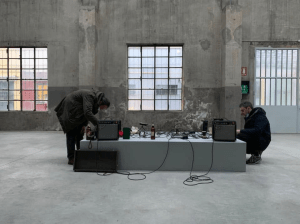 In the following interview Angelo Bignami and Luca de Biasi explain their working process.
Structura Parva feels like a significant shift from the long-form improvisation for concrete sounds and electrical interferences of Forma towards much shorter and more concentrated pieces. What led you to embrace these “small structures”? Was this reduction a deliberate aesthetic decision or the natural outcome of your evolving practice?
Luca de Biasi: After Forma, we took a long break to dedicate ourselves to our solo work, which also gave us the opportunity to reflect on what we wanted Filtro to become. The idea was to work meticulously on individual sounds, processing them and finding affinities with other sounds to shape the pieces. We set a strict limit: just two sounds each and nothing else. The biggest change for me was using a sampler, which allowed me to process sound differently than in the past and focus on individual sounds before looking at the whole picture. We also worked extensively on dynamics and the movement of sound in space. In some tracks, this remained direct, while in others we added the natural echoes of the different environments where we re-recorded the pieces.
Angelo Bignamini: It was a bit of both. It represents an evolution of our sound, moving away from what were initially uncontrolled, improvisation-based impulses toward actual composition focused on a few core elements. I believe this shift was influenced by our shared listening habits at the time, as well as a mutual desire to produce something more focused and structured.
The EP is described as reflecting a new approach to “minimal structures and small electronics.” What does “small electronics” mean for Filtro in practical and conceptual terms? Are you interested in intimacy, scale, fragility, or perhaps a different relationship between sound and space?
L: The new approach was all about working on individual sounds before the whole composition. In practice, I used a modular synthesizer consisting simply of an oscillator, a complex envelope, and a filter, constantly tweaking the sound until I achieved a satisfactory result. I did the same using very simple field recordings. As I mentioned, the choice of individual sounds, their interaction, and their interconnectivity were the core ideas behind the project.
A: It is called “small electronics” simply because the entire project is built on just a few elements—each track develops across two or three layers at most—and an extremely minimal setup. Often, we are just using everyday objects or small acoustic instruments, which we record and process using a sampler and a laptop. The core idea was to maximize the value of each individual sound and distribute it throughout the space, which inevitably transforms both its signifier and its signified.
Both of you have long been interested in sound detached from its original context and meaning. On Structura Parva, the sounds often seem stripped down to traces, gestures and subtle interactions. How do you decide when a sound has been reduced enough, and how do you prevent minimalism from becoming merely an exercise in subtraction?
L: For this latest project, each individual sound was developed separately by Angelo and me. We both worked on our own ideas without any prior agreement. After months of work, we decided it was time to meet up and listen to what we had done. Choosing which sounds to use was ultimately quite simple and quick. I don’t know how, but the work each of us had done seemed to share a common goal.
A: Honestly, I didn’t really worry about that problem. The goal was simply to find minimal structures that could convey emotional meaning—which, in a way, is a prerequisite for any kind of music. There is almost always a rhythmic element, a background texture or drone, and a melodic element. If you look past the totally hallucinated style, we aren’t actually that far off from a traditional song structure.
Angelo’s work frequently explores deterioration, tape processes and feedback, while Luca’s practice involves modular synthesis and improvisation. How has the dialogue between these approaches changed since Forma? Has the balance between improvisation and composition shifted over the years?
L: Our approach has always been improvisational. We used to meet for long sessions and then extract the sections that would become the final work. This time, it was different: we worked on the tracks individually, then discussed them and decided together which parts made sense when combined. We then re-recorded them in various environments to give them depth. We also placed great importance on the movement of sounds in space. Therefore, this latest work is much more compositional than our previous ones.
A: In this latest work, there is absolutely nothing improvised. We worked in perfect sync on the individual tracks, with each of us utilizing our own sounds and processing techniques. What united us was a shared vision to produce something simple and circular, yet containing an internal evolution driven primarily by how the individual layers intersect. Nothing was left to chance, except for the deliberate use of random modulations and stereophonic automation.
The EP is presented as “sounds for night reflections and dark disquiets.” There is a strong sense of restraint and suspended tension throughout the six tracks. Were there particular emotional states, environments or listening situations that informed the album, or do you prefer to leave such associations entirely in the hands of the listener?
L: There were certainly external factors that influenced the choice and development of the sound—not necessarily musical ones. In my case, books had a significant impact, changing my approach to life and, consequently, to music. Using a sampler also definitely allowed me to focus more on single sounds. However, I prefer not to give listeners any specific direction regarding our influences, so that their listening experience remains entirely unique and personal.
A: The way people interpret tracks is one of the most incredible wonders of music. Because of that, I prefer to let listeners filter the pieces however they choose and place them in whatever context feels right to them. Personally, I feel these sounds express themselves best in a nighttime setting, but that is by no means a strict rule.
(Gianmarco Del Re)


Pingback: A Closer Listen Reviews – Avant Music News