
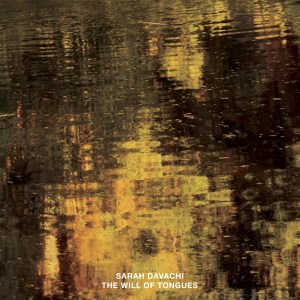
 Sarah Davachi has topped our year-end chart twice, in 2018 and 2022 ~ sonically and mathematically, this may be her year yet again. Ambitious, immersive and enveloping, The Will of Tongues seems like the natural successor to Two Sisters, despite the fact that other albums have been released in-between.
One of the reasons Davachi’s music resonates deeply with our readers and staff is that it lines up perfectly with our ethos. The new album “seeks to articulate a deep reverence for the act of listening,” Clocking in at 140 minutes, it’s neither a brief nor an easy listen, but the experience is intensely rewarding, especially on repeat plays. On first play, the surface appeal is audible: reverent organ, sumptuous strings, striving choir. On second play, the set creates a mood: active calm, heart and mind settled, the peace that passes understanding. But after this, the music turns transportive, a minor miracle one does not hear coming. At this point, the music passes through the body like blood and breath. The imagination is sparked, as if a stopgap has been unplugged. Suddenly there is access to the Divine. At this point, The Will of Tongues becomes more than the sum of its parts; it becomes a vehicle for transportation, with the suggestion of transmigration.
The first phase includes an appreciation for the technical aspects of the work. Davachi performs on historic pipe organs in three nations, and enlists the aid of various ensembles: The Sung Blood Players (Whitney Johnson, Eyvind Kang and Lucy Railton, all familiar to our site), Renaissance flute consort Phaedrus, brass ensemble Diapson and Chamber Choir Ireland. The elaborate liner notes explore the background of the recordings and the players. In these pages, one may learn all about “vertical harmony, intervallic affect, canonic structure” and more, enough to fill a doctoral thesis as one examines the architecture of the compositions. But while these may lead to appreciation and admiration, they are only the starting basis of the set.
The second phase includes the videos, as well as how one feels while watching the images. “Song of the Smile’s Fig: III. Follies” is a rare 45-length work from Davachi, five minutes of reflective choir. The video begins with a flower set against a purple sky, the camera shaking ever so slightly as the sun strikes the buds; and then a shift to evening, a black and white forest, a cabin, a foraging buck. Then the same forest in winter, candles attached to a rotating mechanism, a curtain opening and a table beckoning. Suggestion is more important here than elaboration. “Interlude V: Harmonic, for Woodwinds” is more abstract, beginning with a paint brush, setting lines and geometric shapes in deliberate motion until they become a lattice. “Canto Solo” introduces hues of cyanotype blue, a pair of cat’s eyes, a furtive hand over water and finally rapid interplay between color and black and white, Dicky Bahto’s work reminiscent of Underworld’s “Cowgirl” (Jemar Yusuf, director).
The senses have been engaged, but the third eye has not yet been unlocked. For this one needs the music, and only the music. The album begins with an interlude: “Polyphonic, for Strings,” the first brick on the path to surrender. First the mind is free to wander; soon, it begins to settle on its own images and thoughts; eventually it drifts to higher subjects and deeper understandings, dissolving the constraints of time, widening one’s attitude toward humanity, cracking open the darkness so that the light may come in. For this reason, we recommend that one view the videos as points of entry, but not watch them so often that one associates the images with the sounds.
From here, it is only a slight shift to “Canto Duo,” which swirls and flows and recedes; then “Song of the Smile’s Fig: I. Hours,” each piece revealing a different facet of the whole. The interrelated timbres of soloist and ensembles begin to produce a cumulative effect that requires time for full activation. In a spiritual sense, this is akin to the difference between a quick, rote prayer and the practice of prayer, between a church service and a spiritual retreat. In secular terms, the album imitates the runner’s high: one must push through and press on in order to enter a higher plane. Once one is fully immersed, one may begin to experience visions, or revelations, or at the very least an otherworldly calm.
The Will of Tongues uses deep intervals to prompt deep encounters. The elements accumulate like grains of sand, or the rungs on Jacob’s Ladder. Davachi’s atmospheres clear a space for the Divine to enter and to be perceived, ultimately transcending the album as album, suggesting the music as a pathway, a portal, an open door. (Richard Allen)


Pingback: A Closer Listen Reviews – Avant Music News