
 It would be easy to describe Santur & Kamancheh for Electronics as an encounter between Iranian classical instruments and electroacoustic music. Fortunately, that is not what this album is about. Rather than treating tradition and experimentation as opposing worlds, Maryam Rahmani & David Esser allow them to coexist within the same acoustic space. The santur and kamancheh are never presented as historical artefacts awaiting electronic transformation. Instead, electronics become another way of listening to them.
From the opening “Glass Tower,” one has the impression that the listener has been placed inside the instruments themselves. Contact microphones, geophones and live processing reveal vibrations that normally remain hidden: the resonance of wood, sympathetic strings, tiny mechanical noises and the physical behaviour of the instruments’ bodies. At times Esser’s electronics recede almost completely, becoming practically undetectable as they simply extend the instruments’ natural resonance, making it difficult to determine where acoustic sound ends and electronic sound begins.
This shift in perspective shapes the entire album. “Noah’s Sea Cave” explores darker, more enclosed resonances, but it also introduces one of the record’s most beautiful timbral contrasts. Rahmani’s voice radiates a quiet luminosity that seems to suspend the music from within. Set against the rough physical friction of the santur, it softens the texture without diminishing its material presence. “Copper Playground” shifts the focus towards the kamancheh, whose sustained, vocal quality becomes inseparable from processed field recordings captured in a children’s playground. Rather than functioning as background ambience, these environmental sounds become integral to the musical texture, blurring the distinction between instrument, place and electronics. “Dämmerung” becomes an exercise in gradual disappearance, with instrumental identities dissolving into sustained harmonic fields, while “Fields of Grain” strips the language back to a handful of carefully placed gestures whose expressive force depends entirely on duration and silence. The closing “Bazar of Fireflies” places Rahmani’s luminous gestures within one of the album’s richest electronic environments. Her flickering sonorities continually emerge from a shifting electronic haze, preserving the intimacy of the acoustic instruments even as the electronics become increasingly present.
One of the record’s greatest strengths is that it never exoticises its materials. The Persian modal language remains present throughout, but it is never presented as a marker of cultural difference. Equally, the electronics avoid the familiar rhetoric of technological innovation. Both become part of the same musical vocabulary. The dialogue between Rahmani’s santur, kamancheh and voice, and Esser’s electroacoustic practice feels natural, not because their differences disappear, but because each continually reshapes the other’s way of listening.
That sense of discovery extends to the album’s construction. Much of the material originated through improvisation before being carefully assembled in the studio into more composed forms. One can hear both processes throughout the record. The music retains the openness and unpredictability of spontaneous performance, yet every track displays a strong sense of formal balance. Nothing feels accidental, even when individual gestures seem to emerge almost by chance. Rather than altering the identity of the instruments, Rahmani and Esser invite us to hear them from a different perspective.
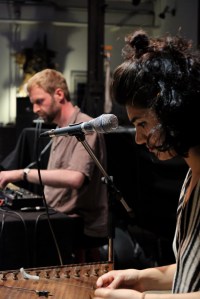
photo by Yuulia Vlaskina
To find out more about the production process we reached out directly to Maryam Rahmani & David Esser.
Santur & Kamancheh for Electronics places two instruments deeply associated with Iranian classical music into a very different sonic environment of contact microphones, geophones, field recordings, and live electronic processing. Rather than presenting tradition and experimentation as opposites, the album seems to allow them to coexist within the same acoustic space.
How did the project begin, and at what point did you realise that the Santur and Kamancheh could be transformed in these ways without losing their cultural and emotional identity?
Maryam & David: We met 2025 at a concert in Berlin’s Km28 over a Beer and decided to get together for a music session. What began with sharing a meal, memories, and stories naturally evolved into making music.
From the very beginning, we encouraged each other to experiment freely with the instruments, without explaining or instructing one another on how to play them. Instead, we allowed the music itself to become our conversation. By listening closely and responding intuitively, we communicated through sound rather than words.
The electronic elements were never intended as mere decoration or an addition to the music. They were an essential part of the dialogue, expanding the instruments’ voices and deepening the interaction between us.
What became clear quite early in the process was that the identity of the Santur and Kamancheh did not disappear through transformation. Their cultural and emotional presence remained because it was carried by the way they were played, listened to, and responded to. The electronics did not replace that identity-they revealed other dimensions of it.
The use of contact microphones and geophones reveals aspects of the instruments that listeners would rarely hear—the vibrations of wood, strings, bodies, and even the surrounding space. Pieces such as “Glass Tower” and “Copper Playground” often feel as though we are listening from inside the instruments rather than outside them. What drew you to these recording techniques, and did hearing the instruments at such a microscopic level change your relationship to them as performers and listeners?
Maryam & David: We wanted to change the perspective from which these instruments are usually perceived. Normally, they are heard from a certain distance, but with this album we wanted to place the listener much closer-to move inside the instruments themselves. We wanted to explore their essence without completely distorting them, keeping their character alive while allowing it to be modulated in different ways. In that sense, the instruments became an object of listening, almost like acoustic spaces in themselves.
Maryam: Through this way of microphoning, I heard completely different sounds coming from my own instruments. That changed the way I played and responded. Every gesture became different because I was reacting to details that I had never been able to hear before.
David: I was fascinated by revealing sonic qualities that are usually considered non-musical-the vibrations of the wood, the body of the instrument, and all the hidden resonances. Ironically, this made me think about sound itself in a much more musical way. Listening at such a microscopic level changed my relationship to the instruments because they became places to explore rather than simply instruments to record.
The liner notes describe the album as emerging from experiences of migration, linguistic displacement, and cultural translation, suggesting that sound can carry meanings that language sometimes cannot. Maryam, as an Iranian musician living in Australia, and David, working in Berlin with a strong interest in place and listening, did you find yourselves approaching these themes differently? How did your respective experiences of geography, language, and belonging shape the dialogue between the acoustic instruments and the electronic processing?
David: For me, the perception of sound is always connected to memory. In my field recording practice, I search for hidden vibrations within structures and environments. Working with Santur and Kamancheh extended this way of listening into a musical context. The instruments gradually became resonant bodies rather than fixed musical objects. What interested me was not changing their identity, but uncovering layers that usually remain unheard, allowing them to be experienced from a different perspective.
Maryam: For me, it often felt like hearing my own reflection through a different world. There were moments when I found myself trying to sound closer to the musical language that felt familiar to me, and other moments when I almost disappeared into this new sonic environment. Over time, I stopped thinking of those experiences as opposites. Instead, I became interested in being fully present with my surroundings while still holding onto my own voice.
That shaped the way I approached the dialogue between the Santur and the electronics. I wasn’t trying to preserve one identity or transform into another, but to let both worlds affect each other. The electronics didn’t feel like something separate from the acoustic instrument; they became another space for listening, responding, and discovering how my musical language could exist in a new context without losing where it comes from.
A significant part of the material developed through live performance and improvisation, particularly during the 2025 concert at Kühlspot Social Club in Berlin. Tracks such as “Noah’s Sea Cave,” “Fields of Grain,” and “Bazar of Fireflies” feel suspended between composition, memory, and spontaneous discovery. How much of the album emerged from structured ideas and how much from trusting the moment? And do you see this project as the beginning of an ongoing collaboration that may further explore the intersection of Iranian musical traditions, sound art, and electroacoustic experimentation?
Maryam & David: All of the music developed through improvisation. We often began with simple sonic ideas, particular recording techniques, or a shared atmosphere rather than fixed compositions. Later in the Studios we combine all the Recordings into a more composed Form. The live performances, especially in Berlin, became an important space for discovering how the acoustic instruments and electronics could respond to one another in real time. Many moments that ended up on the album could never have been planned-they emerged simply through attentive listening, trust, and a willingness to follow the music wherever it led.
A key aspect of this project was creating music that opens a dialogue between tradition and experimentation. We are interested in how we, as human beings, distinguish between tradition and modernity, and in the roles that technology and culture play within this relationship. Rather than reinforcing these oppositions, we wanted to explore their points of connection and reveal the creative potential that exists between them.
We definitely see this collaboration as an ongoing artistic dialogue. For our next project, abandoned sites of infrastructural use from the totalitarian rule of the German Nazi regime -sites which were later also utilised by the GDR-have been chosen for recordings. These places are fascinating in that they can now be used for their acoustic qualities as instruments themselves by singing within them and ‘playing with them’, thereby alienating them from their original purpose. Of particular interest is engaging with what remains of totalitarian regimes – not necessarily sites of destruction and oppression, but sites of everyday, critical infrastructure that were an essential component in the maintenance of these systems.
(Gianmarco Del Re)


Pingback: A Closer Listen Reviews – Avant Music News