
 One of my hobbyhorses I love to beat—likely familiar to longtime readers—is that percussionists often make the most interesting composers: Steve Reich, Egisto Macchi, Iannis Xenakis, Edgar Varése, John Cage, Lou Harrison, Karlheinz Stockhausen, Art Blakey, Max Roach, Paul Motian, Jack DeJohnette, Milford Graves, Susie Ibarra, Valentina Magaletti… I could go on and on. Rhythm is one of the ways we structure time, and in this percussionists seem to think differently about the architecture of music in unique ways. Attack, resonance, and duration dominate their vocabulary, while pitch and harmony are often less centered.
It was Steve Reich who first inspired this intuition in me, but I first articulated it as such when I learned that Sasu Ripatti (best known as Vladislav Delay) was trained as a drummer. As he explained to Fifteen Questions,
I started at the age of 5 with classical percussion and drums, jazz later on, death metal in between. I switched from sticks to electronic equipment and music production at about the age of 20, in ’96, and released my first productions in ’97.
The off-kilter rhythms of Vladislav Delay are rooted in part in jazz, and even the relatively dance friendly music of Luomo, Ripatti’s deep house project (see 2000’s beloved masterpiece Vocalcity), makes more sense in this light. But this influence seemed to be a formative one, the roots, rather than a window into Ripatti’s creative process. As Vladislav Delay, Ripatti is granted the freedom to pursue whatever, while Luomo operates within the form of a relatively codified dance music genre of microhouse. Ripatti has occasionally wheeled out other monikers to pursue other directions, for instance footwork and juke through his Ripatti series, and later happy hardcore as Ripatti Deluxe on his newly minted Rajaton imprint (see 2022’s Speed Demon).
There’s something surprisingly captivating about much of this later, frenetic, high-tempo work, although in truth it often makes me feel much too anxious for the era we’ve been living in. But even when a particular record or style doesn’t land with me, it still reveals something about the artist that helps unlock aspects of his other records. Like the Blues, innovation isn’t occurring on the level of form but of expression. Having the contrast of the free form persona allows us to better hear the artist’s style manifest from the limited gestures available within the conventions of other genres.
It was the release of Whistleblower (2007) that transformed me into a committed fan, with earlier records including Multila (2000), Anima (2001), and The Four Quarters (2005) becoming some of my favorite records of all time. But it was Tummaa (2009) that changed how I thought about Ripatti’s process. Ripatti and his partner AGF had left Berlin, relocating their family to a remote Finnish island in the Baltic Sea, where they still live, and Tummaa feels like a rebirth worthy of this change. That record features Lucio Capece on bass clarinet and soprano sax and Craig Armstrong on Rhodes piano, with Ripatti playing percussion and shaping the results as a producer and composer. For whatever reason, Tummaa seems to get lost in the (admittedly excellent and crowded) discography, but I’ve increasingly come to see it as a missing link between classic VD records and the ensembles he would later work with.
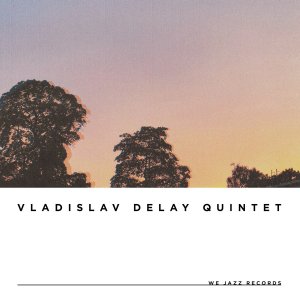
Sasu Ripatti has been quietly releasing new VD and Luomo material since late last year, and in May 2026 released the surprisingly acoustic vd5 on Finland’s We Jazz label. In our spring preview earlier this year, Richard wrote that “Vladislav Delay is now a quintet.” In fact, we had heard a preview in 2020 in the form of a live video, but unless you were a subscriber (or there for the live show at Teatro do Bairro Alto in Lisbon), this probably went under the radar. That Bandcamp subscriber exclusive also noted that “there will be an album eventually with the group,” and that time has finally arrived.
Fifteen years earlier, Vladislav Delay had already become the Vladislav Delay Quartet, consisting of Derek Shirley on acoustic bass, Lucio Capece on reeds and effects, Mika Vainio on electronics and live processing, and Delay on drums and percussion and postproduction. I love the physicality and ambiguous electroacoustic timbres of this record, and had hoped for more (perhaps even a live set at Mutek), but of course, the tragic death of Mika Vainio in 2017 put an end to that. And Vainio is impossible to replace, so expanding further into a quintet is a logical move.
In addition to the returning Derek Shirley and Lucio Capece, Ripatti is joined by Maria Bertel on trombone, and frequent collaborator Max Loderbauer, who played Buchla on the 2020 recording and perhaps most surprisingly here contributes piano. Ripatti and Loderbauer rounded out the Moritz von Oswald Trio, who I vaguely recall seeing at Mutek in 2010(?), but I was much more blown away by a bill that included Delay, Tim Hecker, Ben Frost, and CM von Hausswolff. I mean, come on! I was discovering the Basic Channel and Rhythm and Sound catalogues at this point, but the Trio never resonated as deeply with me.
Even if I rarely revisit the Trio records, I did appreciate seeing Ripatti in the context of a live band, playing acoustic instruments with analog effects, strongly signaling a gesturality that is harder to perceive in his electronic works. While those trio records never quite grabbed me, they clearly cemented Ripatti and Loderbauer’s rapport. Shortly after the release of the Quartet record, Ripatti and Loderbauer left von Oswald’s trio (they both appear on 2012’s Fetch), and the two would continue to work together as Heisenberg. Some years later, Ripatti emerged from a quiet period, contributing percussion and electronics to Nils Petter Molvær’s aptly titled Nordub (2018), which also involved Eivind Aarset on guitar and Sly & Robbie holding down the rhythm section.
A very nice project, but a bit restrained, perhaps, clearly aimed for bourgeois audiences in refined theatres rather than dank basements and hazy bedrooms. The experience must have been a dream for Ripatti, however, who would later fly to Kingston to further collaborate with the reggae legends, sessions that resulted in 500-Push-Up (2020), distilling the group dynamic to raw rhythm section excursions. (Both Sly and Robbie, too, have sadly passed on in the years since.)
Delay continues stubbornly chasing his own vision. Sasu Ripatti is never one to get too comfortable, preferring to take the more difficult road, reinventing himself time and again. Perhaps this is what has led him to so many collaborations. In addition to those ensembles previously mentioned, we should mention records with his partner Antye Greie as AGF / Delay and RyJ, Sensate Focus with Mark Fell, and most recently ZWAARD, with Antipop MC Beans. But as much as I love a good duo, there is something magical about an ensemble.
On vd5, Ripatti trades the brittle and dystopian electronics of the late Mika Vainio for the warm, impressionistic touch of Max Loderbauer’s piano and Maria Bertel’s trombone, playing off Capece’s woodwinds and Derek Shirley’s bass. Recorded at Berlin’s Candybomber by Ingo Krauss, mixed by Ripatti himself, and mastered by Juho Luukkainen, the album marks a fundamental shift in the group’s center of gravity. Where the Quartet record felt like a clenched mechanical fist—a thicket of vibrating reeds, deep bass, and corroded signal—the Quintet opens into a more porous breathing space. The Quartet was slow, abrasive, and texturally heavy; the 2020 live take on this material trafficked in similar drone textures and feedback while searching for their own identity. But vd5 is a different animal.
At forty-five minutes, the ten tracks are simply titled with numbers—though not in sequence. The album opens with “two” before moving to “twelve” and “nineteen,” while the closing track is, fittingly, “three,” hinting at a larger suite from which these pieces were selected. Despite this fragmented taxonomy, vd5 is unmistakably a Delay record; the space still feels meticulously sculpted, the silence carefully hewn, but the palette is overwhelmingly acoustic and warmly resonant. This is a mature, generous iteration of his vision, and arguably his most immediately rewarding ensemble work since Vainio’s passing.
The album unfurls slowly. Opener “two” establishes the core tensions: Loderbauer’s piano offers harmonic anchor rather than abstraction, while the acoustic sighs from Capece’s sax and Shirley’s bass are met with Bertel’s molten trombone. Ripatti’s own kit work is characteristically fractured, ghosting around the pulse rather than driving it, less of a timekeeper and more of a textural instigator. Elsewhere, “nine” foregrounds horn harmonies and deep bass, ranking among the darkest cuts on the record. Midway through, the group locks into a loping, almost meditative groove on “thirteen” that recalls not the dub-like spacing of Tummaa but an acoustic version of the 2010s VD records for Raster-Noton, with their uneven kick patterns and warbling melodies. “Fifteen” comes closest to the plodding dissonance of the Quartet, making it the most foreboding and insistent track here, yet strangely also one of the most “jazz”-sounding, beginning in gloom before resolving into something almost uplifting. Closer “three” picks up where the opener left off, dissolving into sustained, sinister drones, the musicians’ breath overwhelmed by noise.
Is it “jazz”? Who cares. Ripatti isn’t just programming rhythms; he’s composing with attack, resonance, and silence through a living ensemble. And it’s the largely acoustic, real-time interplay of that ensemble that elevates vd5, making it a must-hear record for fans of Vladislav Delay. If rhythm is how we structure time, then vd5 finds Ripatti carving out a temporality that feels less like a loop and more like a tide; it’s a testament to a lifelong percussionist’s ear for the life that exists strictly between the beats. (Joseph Sannicandro)


Pingback: A Closer Listen Reviews – Avant Music News