
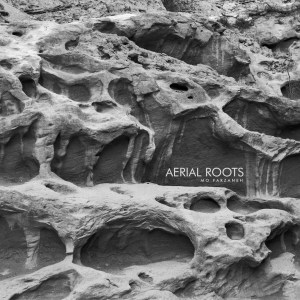
There are places that become so closely associated with geopolitics that it is easy to forget they are still inhabited landscapes, with their own geology, ecosystems and daily rhythms. Qeshm Island, in the Strait of Hormuz, Iran, is one such place. On Aerial Roots, Mo Farzaneh turns his attention to the island itself, drawing on field recordings made across its coastlines, villages, mountains and Hara mangrove forests. Wind, birds, water and traces of human activity are woven into electronics that grow directly from the environments he encountered. As Farzaneh explains in our interview, repeated visits taught him to recognise structures already present in the soundscape: changes in density across day and night, shifting winds and, above all, the tides, whose cycles repeat without ever producing exactly the same configuration.
“Tabl” opens with wind carrying faint evidence of human presence through crackling environmental noise and birdsong, while sweeping shifts in pitch from a rising and falling wail give the piece a ghostly atmosphere. “Doulab” becomes more languid, bringing water and birds into sharper focus as an incantatory, revolving figure recalls the doulab, the traditional water wheel from which the piece takes its name. Circularity becomes still more pronounced on “Distant Memories”, where the movement of waves is translated into electronic material. Farzaneh describes the sea as an image of memory: each wave replaces the previous one while the underlying rhythm persists. The thirteen-minute “Aerial Roots” pushes this exchange further, playing with resonance until the natural ecosystem begins to resemble a negative imprint of its synthesised counterpart; towards the end, the environmental sounds gradually reclaim the foreground. “Sandstone Canyon”, meanwhile, introduces sharper sonic peaks and greater dynamic variation.
The title catches something essential about Farzaneh’s method. Roots normally imply attachment to a particular ground; these roots have become airborne. His field recordings retain evidence of actual places and events, while percussive elements carry traces of particular practices, yet both can be detached, transformed and recomposed. Farzaneh noticed how Qeshm’s acoustic environment changes near piers and other centres of human activity, where species audible in quieter areas disappear beneath the noise of boats, while human sounds themselves can become strangely disembodied.
Having moved to Qeshm after years in Tehran, he approaches the island as a stranger learning how to listen, deliberately resisting the temptation to interpret the lives he encounters. The album never turns these concerns into an environmental manifesto. Instead, vulnerability is embedded in its shifting cycles, where repetition always contains small changes and nothing remains sonically fixed. As Farzaneh writes of the Hara mangroves, this is “an ecosystem whose cycles have repeated here for thousands of years, now seeming more fragile than ever.”
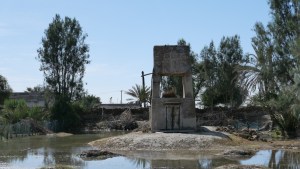
photo by Mo Farzaneh
To find out more about the location and the recording process we asked Mo Farzaneh a few questions.
Aerial Roots grew out of recordings made across Qeshm Island, from the Hara mangrove forests and coastline to mountains and villages, and you describe field recording less as collecting material than as a way of “spending time with a place”. Listening to the album, birds, water, wind and other environmental sounds often seem to determine the music’s rhythm and structure rather than simply provide atmosphere.
How much did the environments themselves teach you how to compose? Were there moments when you found yourself following patterns already present in water, birdsong or wind rather than imposing a musical structure upon them?
Yes, a lot. At the beginning of my field recording work, it was mostly the sound events themselves that caught my attention. But gradually I stopped thinking only about collecting raw material. I kept going back to the same places at different times, and I started noticing how the sound environment changed with the weather or with human activity. Those repeated visits made the place itself show me its rhythms and patterns. The way the density of sound shifted throughout the day and night was already a kind of musical structure. I just listened to it and tried to keep that structure in the composition.
The electronic parts are basically my emotional and inner response to those patterns more like a conversation between the sounds of the place and my own reaction as someone who was there listening.
I should also say that after years of living in Tehran, moving to Qeshm felt completely different. The unfamiliarity of that listening environment changed the way I hear things, and that shift still feels valuable to me.
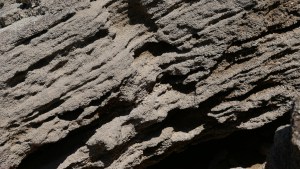
photo by Mo Farzaneh
Your photographs repeatedly move between very large landscapes and extremely close observations of surfaces: eroded rock, cracked earth, tidal patterns in sand, mangrove roots, weathered walls. There is something similar in the music, where a recognisable environment can suddenly seem to dissolve into microscopic textures, drones and electronic detail.
When you were photographing, recording and composing on Qeshm, did these different ways of looking and listening begin to influence one another? And do you see the photographs as documentation of the places behind Aerial Roots, or as another part of the same artistic work?
Yes, I had already started photographing on the island before I began recording sound. Looking through the camera helped the direction of the project become clearer. Gradually I noticed that photography was affecting the sound sources I chose, and the other way around working on the sounds pushed me to take more photos, and more
varied ones. Sometimes looking at a place through the camera while listening to it at the same time also changed how I structured the pieces or processed the sounds.
Making this album and connecting with the place through these different ways made me want to share the other things I had collected too. That’s why I see the photographs as part of the work itself, not just documentation. They’re both telling the same experience, just from different angles.
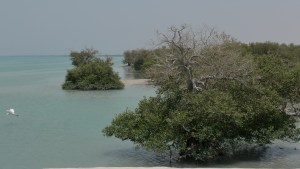
photo by Mo Farzaneh
In your notes on the Hara mangroves, you describe an extraordinarily organised daily sound cycle: birds and other creatures gradually becoming more active, frogs joining the soundscape, crickets occupying the night, and the first bird at dawn effectively marking another transition.
You also describe the ecosystem as having repeated these cycles for thousands of years while now appearing “more fragile than ever”. There is a comparable tension in Aerial Roots between repetition and constant small change. Did those ecological cycles provide a model for the album’s sense of musical time, and how consciously did the environmental vulnerability of Qeshm enter the work?
Yes, but it was more a matter of gradually becoming aware of it. Because I was recording in the forest at different times of day and night, I started paying closer attention to how the environment was changing. I slowly noticed a recurring cycle things would repeat, but they were always slightly different. Even now, whenever I go back to those
recordings, I hear something new.
The changes weren’t just about day and night. The tides played a big role too. The activity of the creatures in the forest seemed to move with the tide, constantly shifting the sound. Places that at first seemed completely still were actually changing all the time.
The wind direction could change several times in a day, the light would move across the water, and a bird I heard from one direction in the morning might come from somewhere else in the afternoon. Even something as repetitive as the daily cycle of the forest took on a slightly different shape each time.
This gave me a strong sense of the tension between stability and constant small change a pattern that repeats without ever being exactly the same. That quality became something I paid attention to while working on the album. I tried to keep a similar feeling in the structure of the pieces.
I was also constantly aware of how vulnerable Qeshm’s natural environment is in the face of human presence. The more I moved around the island, the clearer this became. Many of the quieter places, simply because they were further from busier areas, had a completely different sonic character. There were bird sounds you simply don’t hear near the piers, where the noise and activity of boats made the environment very different. That contrast stayed with me throughout the process.
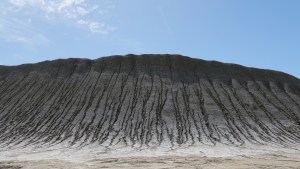
photo by Mo Farzaneh
Memory seems to occupy an important place in Aerial Roots, most explicitly in the title “Distant Memories.” Field recording might initially appear to be an act of preservation — fixing a particular place and moment in time — yet your electronic processing allows those recordings to move away from their original form and acquire new associations.
How do you understand the relationship between remembering and transforming in your work? Are you interested in preserving something of Qeshm as you experienced it, or in allowing those memories to change and acquire a new life through composition?
Being part of this process made me think more about my relationship with places. No recording can fully represent a place. It can only capture one layer of the experience of being there tied to that specific day and time. What remains is a kind of sonic memory, and that memory keeps changing.
When I enter an unfamiliar place, I usually slow down and listen before trying to understand what I’m hearing. Sound leaves more room for imagination than a fixed visual image. I start to experience the space less as something solid and more as something alive and constantly shifting.
Listening to something unstable and fleeting feels closely connected to memory for me. A sound happens, disappears, and becomes part of what I remember. When I return to it later, I’m not necessarily hearing the same thing anymore. The recording is still there, but my relationship to it has changed.
This became especially clear while working on “Distant Memories.” I took the continuous sound of the sea and worked with it in a way that keeps the underlying rhythm of the waves, but never lets any single wave stay for long. As one wave arrives, it gradually replaces the previous one, and then it too fades as the next one takes its place. In a way, the piece became an image of how memory works for me: something arrives, stays for a moment, and is slowly replaced. We don’t necessarily lose the memory completely, but its original form becomes more distant each time. The sea felt like a continuous memory the rhythm remains, but the individual waves are always temporary. That’s probably what interested me about it in the first place.
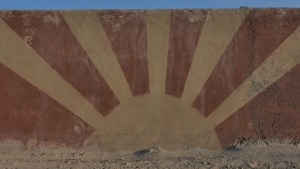
photo by Mo Farzaneh
Qeshm is not only an extraordinary natural environment but an island with a remarkably layered human history: inhabited since prehistoric times, shaped by successive empires and occupations, and for centuries positioned along maritime routes connecting Iran with India, China and East Africa. Your notes, however, approach the island at a much more intimate scale — people talking between houses, fishermen working on their nets, a goatherd calling in the morning, children cycling through a village, or someone inviting you into their home and offering you dates.
What is your own personal relationship with Qeshm, and how much did you want Aerial Roots to engage not only with its landscapes and ecosystems but with the lives, histories and cultural memory of the people who inhabit them?
My personal relationship with Qeshm is that of a stranger who’s gradually getting to know a place. Maybe that distance is why things that feel ordinary and everyday to the people who live there still feel fresh and worth noticing to me. That sense of newness is what made me want to listen to them and record them.
As I spent time going around different villages and parts of the island, I started to sense something of the island’s history and collective memory in the rhythms of everyday life, rather than in its buildings or official stories. The way people adapt to the climate and their environment, and the kind of resilience in how they live, really stood out. The closer I listened, the harder it became to draw a clear line between the natural and human soundscapes of the island.
For me, people’s lives were just as much a part of Qeshm’s soundscape as the mangroves or the sea. Since I was a stranger myself, still learning how to listen to this place and the people in it, I preferred not to explain or interpret their lives. I just let their presence stay part of my experience of the island. Maybe that’s why what I saw and heard found its way more into the sounds I chose and the overall atmosphere of the album than into talking about it directly.
(Gianmarco Del Re)


Pingback: A Closer Listen Reviews – Avant Music News