
 From dub to industrial and Tanzania to Thailand, from an untitled album by an unnamed artist to a turntable album without records, our Electronic Music Preview has it all! This adventurous slate is bound to appeal to the mind as well as to the body. Site favorites such as Jónsi and Andy Bell appear in surprising categories, while newcomers make their play for the big time. One thing is sure: the dance floors won’t be empty this season.
We’re halfway through our Fall Music Preview, with much more to come; our largest installment is set to appear tomorrow!
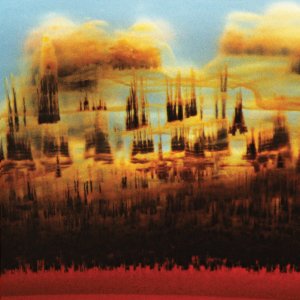
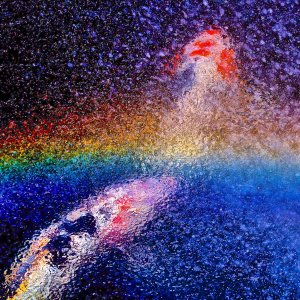
Our cover image comes from Petrels’ Infangthief, covered below.
 Bonobo is the biggest name on fall’s electronic slate. Fans won’t have long to wait, as Distance in Static is released on September 11. As with previous efforts, the album offers a mix of vocal and instrumental cuts, the bonus being that the vocal tracks are in English, Urdu and Japanese. We’re enamored with lead cut “Drift,” and expect mainstream success (Ninja Tune). The same (safe) prophecy holds true for Chrome Sparks‘s Ball of Light, especially as the producer has roped in Khalid and Jónsi for lead single Sleeper. The languid opener is not representative of the album as a whole; for a more accurate representation, spin the club-friendly title track and then “Pleasure” (Chrome Sounds/AWAL, September 11). Nathan Fake is back, and it didn’t even take that long! The Caldera EP is a follow-up to Evaporator and the Hypercube EP from February and May (InFiné, October 23).
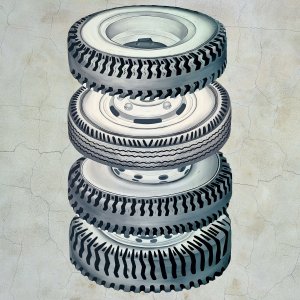
 Bibio & Dorian Concept are releasing the expressive Answers, their first collaborate album after years of friendship. The timbres are warm and inviting, perfect for autumn (Warp, October 16). It’s only fair that we mention The Avalanches, though we’re not yet sure if the album is primarily vocal or instrumental; the sample-based Since I Met You is still one of our all-time favorite albums, and we’d love the same to be true for No Bad Memories, out October 16 and preceded by Can’t Get Over Losing You. Another sample-based artist, Odd Nosdam, is releasing a “love letter to the vinyl format.” On Patrol is packed with slow beats, obscure loops, and enthralling grooves: a crate digger’s delight. Bonus points for the cool cover art, seen right (Alien Transistor, October 23).
 Is it acid? Is it jazz? Is it ambience? Is it hardcore? Yes ~ Semiratruth‘s S!M is all of these things and more, hopping genres like low fences in a wide field. A lot of ground is covered in twenty-two tracks, not one longer than 3:04 (Sooper, September 25). Space Afrika‘s Quiet Storm is a study in contrasts: featuring segments of ambience, electronics, opera, hip-hop and modern composition. The support cast is massive, each guest contributing a different aspect of a greater story. A spiritual thread runs through the recording, lifting it to a higher level (Dais, September 25).
The snails seen on Carmen Villain‘s Memoira are purposeful; the album is one of “deceleration,” with trumpet, clarinet, flute, piano and strings, all filtered through sluggish beats and dub timbres (Smalltown Supersound, September 4). Post Dub Cities is the new concept album from Adriano Zanni, who wanders an unpopulated landscape and finds it rich in sound. The accompanying photos makes it seem less science fiction than recent history (Bronson Recordings, October 2). Soaked in crackle and reverb, Oblique‘s Ghost Dubs is an exercise in tension and mood. Opening single “Low Times” comes with a series of alternate mixes (Pressure, September 25).
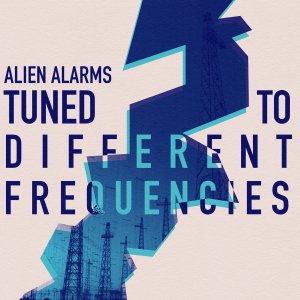 Alien Alarms are Tuned to Different Frequencies. The album investigates a wealth of tonalities, uses creative composition to address the modern malaise of distraction. “The machine is much, but it is not everything” (PATCHWORKS, October 2). พังและแพง splits the difference between ambient and electronic on หัดขับรถ, whose title means “Learning to Drive.” The Thai producer calls the sound “dance music for introverts” (September 4). James Gorczyca also straddles the line between genres, adding a bit of modern composition on Weights of this world., whose aural presence is accompanied by a “visual world” (September 2). Les Brown‘s The One After That is the concluding part of a loose trilogy. Punchy rhythms accompany kind patterns, with a slightly cinematic lean (September 22). According to Short Span, it was “important to have Eden Aurelius‘s Entre Nous out for summer.” Close enough, as the album shimmers like the low angle of the ever-sinking sun. The further south one lives, the greater the impact will be (September 17). Supporting our theory that 2026 is The Year of Blue, Emily A. Sprague offers Cyano, drenched in blue synth and voice. There are various ways to procure the bonus tracks, including 7″ and Japanese CD; a limited edition RISO booklet is also available (RVNG Intl., October 2). Belbury Poly returns with his ninth album, Sorcery, a set of nostalgic sci-fi synth, referencing the golden 80s of sight and sound (September 25). Those who miss disco will be enamored with Narcoba‘s Pechersk. The title track could be mistaken for an instrumental by the Pet Shop Boys (Nisantashi, October 2). Loula Yorke seems always to be in a positive mood, and the upbeat nature of her personality shines through her music. Starling Sessons is filled to the gills with synth and exudes a playful tone (Truxalis, September 4).
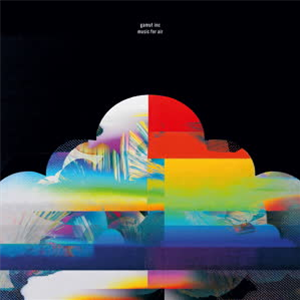 Here’s something we didn’t expect: Infangthief and Outfangthief, a pair of interlocking albums from old fave Petrels. The drone remains intact, while the beats come hard and fast, reflecting the time spent revisiting and remixing. (Denovali, October 16). Church meets club on Music for Air, as the duo of Gamut Inc uses computer-controlled pipe organ to produce sounds more suited to Saturday night than to Sunday morning. We hold out hope that this music might find its way into a forward-thinking worship service (Karlrecords, October 16).
Ride bassist Andy Bell joins harp and synthesizer duo Masal for Common Primitives, a lovely album whose rock tones set it apart from others in this article. The moods shift from placid to encouraging, often within single pieces, as new aspects of the music are turned toward the light (Sonic Cathedral, October 9). Names On Tapes offers Ayin, which celebrates the Jewish concept of “absence as potential,” the seat of creation. Clarinet, guitar and electronics emerge from the void (September 4). Then from nothing we travel to NOWHERE, found “between movement and stillness,” as PHILMS explores the liminal spaces like “That Uninspiring Beige Building” (November 17).
Slow and steady wins the race. Never rising above 121 BPMs, Philipp de Castro‘s Morferna is a lesson in restraint. “Oximoro” even includes a sound like that of a tea kettle, waiting to boil (Fala Nocturna, September 18). Peter Gall‘s Drum Seeds allows the percussion to take center stage, enhanced by synth and keys, producing a sound somewhere between jazz and electronic, with a trance-like veneer (Compost, September 4). Vintage drum machines, live drumming from Valentina Magaletti and sporadic punk-energy vocals make Holy Tongue‘s Basilikum an exciting experience. Lead single “Coca” might fit into an adventurous goth set (AD 93, October 4). One might expect to find Future Sounds of Jazz, Volume 16 in another department, but while the series honors jazz, it falls firmly into the electronic category and features exclusive tracks (Compost, September 18).
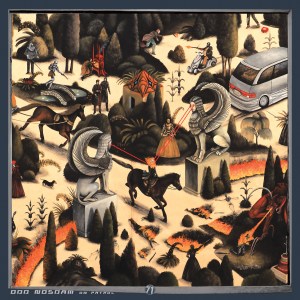
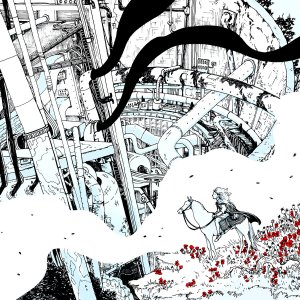 opo collects seven years of experiments on 666ridims (2020-2026), using unconventional rhythms, infusing the music with a pan-cultural flavor (Meakusma, September 3). Don’t be fooled by the opening track; Max Kutner‘s The Illustrated Interior veers from rock to glitch to percolation to prog. Infused with a sci-fi sheen, the album sounds as literary as its title (September 16). Sporting a wild cover by Kat Williams Illustrations (shown left), Ørdop Wolkenscheidt‘s concept album Stallmeister Rittich vs. the Machine takes as its starting point the 18th century lost and found poem “The Ballad of Stallmeister Rittich,” and builds a narrative around the hero’s journey: music unfolding like a narrative in verse (October 9). The slightly scary House with a Curse arrives with a silent film video and a sense of fun, the Halloween love child of Andrew Waslylk and Tommy Perman. There’s a haunted story in these grooves, perfect for the midnight hour (Clay Pipe Music, October 16). We’re digging the video for “Plastic Minds / Elastic Machines,” from Jeremiah Chiu‘s Edge Conditions; the frames flash with the percussion, and the presentation is a breath of fresh air (International Anthem, October 9).
With “eight prepared turntables, four mixers, no records, six hands,” Institut für Feinmotorik is an outlier. Öd (meaning “barren” or “boring”) is anything but; these are the sounds our turntables hide from us, brought out of the shadows and into the light (Faitiche, October 9). J. Juva‘s loop-based Unclocked uses techniques invented by Steve Reich to set patterns against each other in a miasma of sound. Don’t expect an ambient record; the album is packed with beats and patterns, angular at times yet still suited for adventurous club floors (September 25). Slaylor Moon makes angular, unconventional machine music, “pushing keys, buttons, pads, or wheels.” Crisis Make Up! heads in unexpected directions, but is never random (Maple Death, October 9).
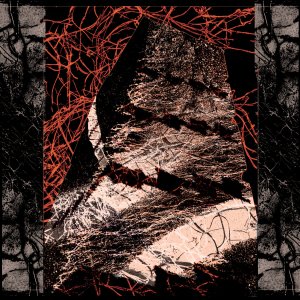 The post-industrial sound of DIKDӔDØR has evolved over time, and now includes drum machines and a power mixer. Their sound continues to be bleak and uncompromising, but now ~ perhaps ironically ~ one can dance to it. The Entertainer is released September 9 on Edelfaul. Also in this vein, A Tomb Full of Stars walks a post-apocalyptic landscape, decorating it with echoed words and the sounds of forgotten melodies, rescued from the ash. 1:When the Reflection Passes is released on Varia September 22. Fresh from Birdsong (made with birds only), Megafauna returns with an immersive, industrial, self-titled album. Voidscan appears on one track, lending the project to an even darker hue (Syrup Moose, September 25). While the music is informed by tragedy, Anthony Baldino‘s CONVEYER bleeds dramatic tension, offering not healing but catharsis, scoring the pain beat by devastating beat (BL_K Noise, September 18). After 17 years, Lauren Bousfield (Nero’s Day at Disneyland) returns to claim her throne. After influencing many splattercore sci-fi IDM artists, she hasn’t lost a step. The Grand Reopening EP drops October 16, preceded by the Mormon-sampling single ØBabylon. Beautifully harsh sounds decorate Cenizas 1era Parte, a broken beats and bass set from Lima’s XR1S, with an industrial sheen (nodo, September 10).
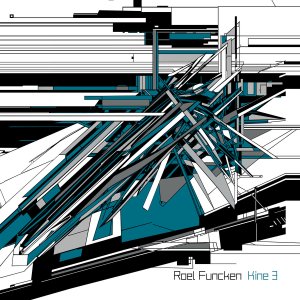 The fact that deep glens opened for Autechre last year opens a window into the artist’s sound. carver is intricate and melodic, while defying expectations of where the beats might land next (September 17). The beats are generous on Roel Funcken‘s Kine 3, spanning the length of a double CD. In an unusual confluence, the artist will be opening for Autechre this year. As the title implies, this is the continuation of a series that gets better with each installment (EC Underground, September 4). Machine Records is the perfect landing place for Foel, whose IDM rhythms are mysterious and dark, a reflection of difficult experiences. Gwasagaru means “scatter-disperse,” which is exactly what these beats do while dancing around a melodic core (September 4).
 The clever unknown-untitled offers the double 12″ uu05 on September 18, with information revealed a week later. This way, the house-techno rhythms can be appreciated on their own, with wild speculation as to their origins. While the spelling is different from the epic poem and film, “odissiy,” the closing track on maxolydian‘s altre galassie, is meant to score the end of a journey: one that spans the galaxies and ends up safe at home (September 1). Uplift (Butterfly) is the first taste of Tom VR‘s Don’t Know How Fast I’m Moving Until I Hit Something, an upbeat set inspired by the story of koi ascending waterfalls to become dragons (Heart Somersault, September 9).
Never far from our consciousness is Subsist & Faith Disciplines, who already has a trio of releases lined up for fall. First out of the gate is Not Charlie‘s Inconformista, a seemingly oxymoronic “reflective dance floor album” that somehow accomplishes the feat (September 4). Fleet offers Percussions from Space, although one should not be able to hear said percussion while in space (September 25). Sci-fi dance floors will be enamored by Cathopsis‘ Solythode, a voyage into the outer limits of the universe (Component, September 4). JØHRN offers frigid techno on Miles of Silence Between Us, using music as a metaphor for relationships (October 16). Steady, pulsing techno dominates Oscar Mulero‘s Between Two Worlds, the 199th release from Semantica paving the way for a landmark celebration (September 25).
 The consistently surprising Nyege Nyege Tapes returns with Jay Mitta‘s rapid-fire Kazi Kwanza, which showcases the vivid sound of the Tanzanian underground. Get ready to sweat it out, as the BPMs approach 200 on multiple occasions (September 4). The BPMs of Silvan Strauss may not be quite as fast, but they are still hyperactive; SPRINTING also boasts an international cast, primed to bring the producer’s vision to full fruition (Kabul Fire, September 4). We are really looking forward to fabric presents Max Cooper. The tracklisting blends old favorites with exclusives, along with some surprising entries. Ólafur Arnalds, Future Sound of London, Lusine and a Roly Porter remix of a Cooper track all share space in this upbeat mix (fabric, October 2).
Richard Allen

