
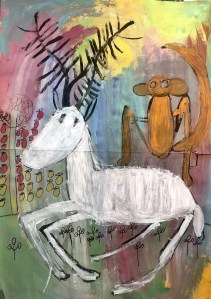
Artwork by Natasha at Aza Nizi Maza
And we are back after the summer break with a new episode of UFN. I wish Ukraine could have had a bit of a break as well, but far from it. Ballistic missile attacks have only intensified, while Kramatorsk and Slovyansk increasingly resemble ghost towns.
This month we introduce several new voices to the UFN universe, including Aircraft, whom I had the pleasure of meeting in Berlin back in June; Bey O Bey from Kyiv, praising the level of organisation in smaller cities such as Khmelnytskyi and Vinnytsia; TRANCEDÆNCE, referencing the work of Mark Fisher; and Соня Хедекель [Sofiia Khedekel], who is starting to forget what life was like before the full-scale invasion in Kharkiv. Furthermore, Roksana Smirnova and Misha Kalinin imagine the moment after the war ends in Tallinn, and Forma Formanta, in Kyiv, discusses freedom.
We are also very pleased to reconnect with old friends Bohdan Stupak, Fedir Tkachov and Lu Joyce, as well as the Sumy-based label Bondeni through Kateryna Pavlovska, all talking to us about their new releases.
There’s a big crop of new music, including a double fundraisier by Side-Line Magazine and releases by Alexander Stratonov, Alla Zagaykevych, Ambiotik, Corn Wave, Cryptic Chorus, Decorodi, Doctor Bugg, Horizon Resonances, Khladna Landscape, Kotra, Mootney, Motorpig, Neroba, Oleksii Podat, Peshka, Piriinka, Regina Collage, Ross Khmil, Sasha Chemerov & Hidden Element, Tetiana Khoroshun, v4w.enko, Valentin Silvestrov, ХЖВИ, Ніщо, Vøvk, КАТ, Serhii Litinskyi, DJ POPS and 58918012.
In the mix section, we have new sets by Vlad Fisun, Bogdan Zaiets, Ecce Lizard, Reshat and Khrystyna Kirik.
In the viewing room, we have videos by Natalia Tsupryk, Ignea, Vera Logdanidi and Zavoloka, alongside a new documentary by Suspilne about Ukrainian children being adopted in Italy under the guise of the international principle of “the best interests of the child”. We also feature a DJ set by Ro_Ma 4E (Roman Cherkas), a veteran who took up DJing thanks to EnterDJ and performed at one of the Czech Republic’s most popular festivals, Colours of Ostrava, back in July. And to finish proceedings, a set by Vlad Fisun.
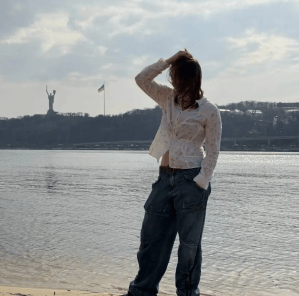
Daryna
But first, this month’s Resonance FM podcast features Daryna, a 16-year-old girl from Kharkiv, talking about the art studio Aza Nizi Maza, founded by Mykola Kolomyets in 2012 and working creatively with children with disabilities and those on the autism spectrum. The studio has continued to operate throughout the full-scale invasion, becoming both a haven for creativity and a reference point for foreign journalists seeking to understand life in Kharkiv. During our conversation, we discussed the studio’s ethos, the language issue, and what everyday life is like for schoolchildren in Kharkiv, where classes are now conducted online and students meet physically once a week, with only a limited number actually attending in person.
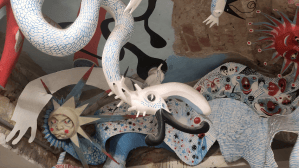
Aza Nizi Maza Studio
Tracklist:
- headachee – хедейк
- Соня Хедекель – Унісон
- SadSvit – Той, хто пісню грав
- REGINA COLLAGE – Горизонт
- ХЖВИ – Они все
- nearr – Календар
- СТРУКТУРА ЩАСТЯ – Лесбіянство (не) модно
- Zhadan, Ojra, Kiritchenko – Чорнотроп
- Dirtbag Loris – Праска
JULY 21, 2026 – BERLIN
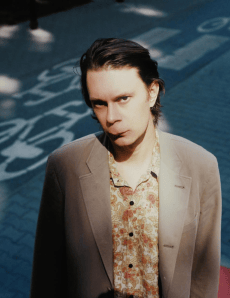
photo by @yaroslavstorchak
Your latest album, Тигролови, marks a return to singing entirely in Ukrainian, and even its visual identity draws on the work of the celebrated Ukrainian folk artist Mariya Prymachenko, whose paintings have become powerful cultural symbols in recent years.
Before discussing the record itself, could you introduce yourself to our readers and tell us about your musical background? What led you to start making music as Aircraft, and why did returning to the Ukrainian language—and to these distinctly Ukrainian visual and cultural references—feel important for this album?
Hi, I started Aircraft 15 years ago as a side lo-fi project which eventually grew up to what it is now. My background was mainly grunge then garage-punk music, I played in several bands, including Buzzmonster, Martiansdoitbetter, The Dontpaniks. I just fell in love with delays in reverbs at some point and switched to more postpunk sound.
Ukrainian was always big for me, I was listening mainly to Ukrainian or Western music. And before pro-russian dictator Yanukovich – Ukrainian was very big in underground. For example in 2008-2010 we were singing mainly Ukrainian. Then russia took it from us, pouring billions in propaganda of russian culture. Before Ukrainian was developing quite rapidly.
So now it is a third renesanse on my memory of Ukrainian language – 90’s then 2000s then 2014-now. So as an artist i feel responsibility to work with Ukrainian audience, also exporting our culture, and cultural code abroad.
Your lyrics often rely on deceptively simple images—night, forests, birds, wire, winter—that gradually accumulate emotional weight without ever becoming overtly symbolic. “Мавĸа” (Mavka) draws on Ukrainian folklore while remaining firmly grounded in the emotional reality of the present, while “Люди” (People) and “Зона” (The Zone) evoke displacement through remarkably economical language. How do songs usually begin for you? Do they emerge first from words, melodies, or atmospheres?
I think from memories, by actualising them we create future and hope. That what my music is about.
The album repeatedly returns to the idea of waiting. In “Гаю Час” (Killing Time), waiting becomes almost a state of existence, while “Навĸоло Ніч” (Night All Around) transforms the night into a space where time seems suspended altogether. These songs avoid political slogans, yet the war is present in every silence and every hesitation. Was it important for you to write about the psychological consequences of war rather than documenting events directly?
I don’t agree that it doesn’t have political slogans, I say, “I will never forgive the world when the war is over”. Which means the passiveness of western politicians, often loyal to russia, fossil fuels dependancy instead of protection etc. Tons of hypocrisy. That is quite political I think.
What does it mean for you to be Ukrainian and if you had to pick a film, novel, artwork, building, dish, song, album, and meme that best represents Ukraine for you at present what would you choose?
Emm. I don’t like this question. I would rather answer what does it mean to be a Ukrainian artist. It is picking the hardest themes to work with. Developing fast, by accepting harsh reality as it is. Struggling being “too authentic” in the standartized and refined European industry. A lot of distributors, streaming platforms and music businesses in general still recognise the post soviet map as one environment, which is ridiculous, since it hasn’t existed for 40 years. Which smells like chauvinism to me. All in all I think there is still quite a lot of that in Europe.
As a Ukrainian and a Ukrainian artist I faced it a lot. And we now pay for our recognition a very high price. However, I always see bright lights of hope here and there, and your project is one of them. So thank you!
AUGUST 12, 2026 – KYIV
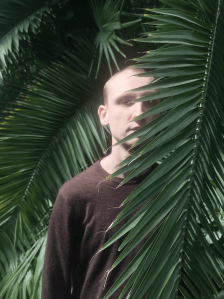
Hi Bohdan, when we spoke back in 2024, you said that the full-scale invasion had made you realise you needed “a stronger voice” for your story to be heard, and much of your work at the time—war.datapoints, Voices of War, “air raid siren is over”—dealt quite directly with the sonic reality of war. Since then, book of sorrow and a place in memories seem to turn inward, towards beauty, memory, loss and contemplation.
What has changed for you over these two years, both personally and as an artist? Is this retreat from explicitly war-related material a consequence of the fatigue you describe in the notes to book of sorrow, or does it represent a more fundamental change in what you now want music to do?
Surely, there is fatigue present. Nobody expected that the war would drag on for more than 4 years. And one cannot stay constantly alert for such a long time. But also, a lot of things happened in my personal life. Getting to know loss, grief. And the art was always a great therapeutic way to process such strong feelings.
But most importantly, although now I’m dealing with more “neutral” subjects, people from other countries still ask me about what it is like being a Ukrainian nowadays and ask me a lot about life in Ukraine. So I guess, working with such universal topics still allows me to raise the voice I dreamed of, although in softer ways.
Back then, circumstances had forced you to leave your guitar in Kyiv, and you told me that you hoped eventually to bring organic sounds back into your music. book of sorrow almost feels like the fulfilment of that wish: the entire record was made from a single guitar, processed until it can resemble horns, strings or an ensemble, while drawing on Baroque harmony and the European classical tradition. Why did you impose this restriction on yourself, particularly after working so extensively with SuperCollider, algorithms, field recordings and data?
It is not like I imposed the restriction. It’s rather that I was so mesmerised with the sound that I got, that I felt that nothing else was needed! Of course, with “a place in memories”, I had to move further and incorporate this type of sound into my entire system of program-generated textures.
And did rediscovering the guitar change the way you thought about composition?
I wouldn’t say that it was a dramatic change, but rather a gradual process that happened over the years. With my first project “fractions” I explored the entire sonic field with the means of numbers. But when “grammars” arrived, I felt I had to find the link between beauty and the algorithm. So now, when I have a guitar at my disposal, I have another powerful instrument I can augment the algorithm with.
There is an interesting progression from book of sorrow to a place in memories. On the former you write about seeking beauty as nourishment during a period of exhaustion, although war inevitably remains present beneath the music; on the latter, memory itself becomes the subject, beginning with your recollection of the Black Sea in 2017 and the recognition that an occupied part of Ukraine now exists for you less as a geographical place than as “a certain point in the past”. How do you distinguish memory from nostalgia here?
It’s a great word “nostalgia”. I think it was the missing word that would neatly describe the music when I was writing one-sheet for it. And I think it’s great that this is nostalgia, not just memory, as listeners seek emotion, not the documentality.
When a place still exists physically but has become inaccessible through occupation, does remembering it alter the meaning of both place and time?
It is a hard question. On the one hand, the place would be special anyways because of that special time we had there, which we can never bring back. But on the other hand, I feel bitterness every time I think that those places are not only physically inaccessible now but also plundered (like Askania Nova natural reserve).
In 2024 you spoke about how quickly the human mind can adapt to almost anything, to the point that war can acquire the texture of ordinary life; you also chose Vasyl Stefanyk’s The Stone Cross as the work that best represented Ukraine for you, partly because of its protagonist’s relationship to the land and the labour invested in it. a place in memories returns repeatedly to landscape—“endless fields”, “horizon”, “orchards”, “mist”, “old porch”, “rings on the water”, “fireflies”—but now landscape seems inseparable from absence. Has your idea of home, land and what it means to be Ukrainian changed since our previous conversation?
Not at all. The paradox is that although the land is a focal point of the “Stone cross”, it is far less landscape-centered than “a place in memories”. In the book, the land is rather a medium that bears the fruit of a person’s hard labor. In modern-day interpretation, it could be anything that represents that hard, relentless labor to make something out of this life. For instance, a bottle of olive oil. There was an anecdote back in the early days of full-scale invasion, that russians who marauded houses in Bucha found a bottle of olive oil, and as they had never seen it before, they decided that this was some sort of fancy liquor, and attempted to drink it!
They didn’t consider applying their work to improve their lives and afford better nutrition, but instead they chose to travel almost half of the globe to ruin other people’s lives instead. Ukrainians are the opposite of it, which can be seen not only in powerful gestures, but also in small, cozy, convenient things.
And after more than four years of full-scale war, are you still able to imagine these places in the future, rather than primarily remembering them in the past?
Sure. From time to time, I think of those sunlit fields, bus stations in small towns, buildings of agricultural factories standing tall across the steppe, cozy villages, and of course sea. I can definitely envision my wife and me traveling there again, but this time together with our son. Although, as memorising those places now is rather nostalgia than memory, visions of such a future are rather a dream than a plan.
AUGUST 12, 2026 – ODESA
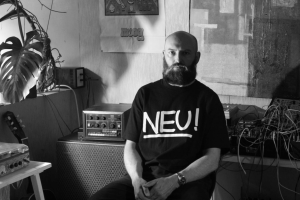
Looking at your recent records together, there seems to be a clear evolution rather than a sudden change of direction. Mastermind, made from recordings dating from 2022–24, remains largely rooted in ambient, drone and electroacoustic texture; Symbols of Escapism begins introducing more defined beats and moves between ambient, IDM and techno; and now Amphibia commits much more fully to dub techno. Do you hear these three records as stages in the same process? What gradually drew you from the freer, more textural music of Mastermind towards rhythm, repetition and eventually the dub structures of Amphibia?
As for the evolution , it’s more in certain techniques and details. I didn’t plan to make a specifically dub techno album with Amphibia; it’s a random selection of tracks that share a common theme of water and something from a different realm of presence. That’s probably where the similarity with dub techno reference points lies. Although there is a micro sauna and ambient in the track “Expo.” I think it’s inspired by the works of Romeo Poirier. As for the last three albums and their connection, they’re more like three different mes that live in an agreement with each other. Many of Gurdjieff’s “I”s come to mind, but this is a different multiplicity. I would call it a multiplicity of vectors.
When we first spoke in 2022, you said that tuning was “the heart of a track”, while other pieces could emerge from the detailed treatment of random sound events. I wonder how that approach translates into Amphibia, where tracks such as “Omni Dub”, “Orchid Dub” and “Dolphine” seem much more concerned with pulse, repeated chords, bass and delay. When constructing these pieces, what now comes first: tuning and atmosphere, as it did in your earlier work, or rhythm and the manipulation of space?
Yes, that’s absolutely right. In Amphibia, the basis is rhythmic structures, because the amphibian doesn’t lie on the bottom for long; it’s always wandering somewhere, wandering strangely. But I’ve been a real fan of the Chain Reaction label for the last year, and I even started collecting their vinyl records, even though I don’t have a turntable lol. perhaps subconsciously this began to influence the sound.
It also seems significant that Amphibia has appeared on Insectorama. Back in 2022, before you were making explicitly dub-oriented records, you already mentioned the “constant support from the dub producers community”. How did your relationship with Insectorama and Markus Masuhr develop, and why did the label feel like the right destination for this particular record? Masuhr also mastered Amphibia and created its artwork—how much did that exchange contribute to the final identity of the album?
Strangely enough, dub has become my ally, even though I’d previously ignored the genre and avoided it. I discovered the work of the Insectorama label by chance, but I remember listening to their releases all night over a bottle of wine and being struck by how interesting the label was, so I wanted to send them a demo. I also like their artwork and limited edition discs. Markus Masuhr also did a very good job mastering the tracks and writing the descriptions. He created a whole legend for the album.
In 2022 you told me that you no longer wanted to look at the Black Sea because it had become “the sea that is at war”; when I met you in Odesa in 2024, you were rehearsing with Rudnic Ore at More Music Club. What is life in Odesa like for you now, and what has changed since those encounters? There is an intriguing progression here too: Symbols of Escapism already suggests the desire to move elsewhere mentally, while Amphibia is saturated with water, from its title and “Dolphine” to its imagery of pressure waves, liquid galaxies and cosmic oceans. Is there a connection between this imagined aquatic space and your changing relationship with the actual sea surrounding Odesa—and, more broadly, has living through these years changed what you now want music to provide: documentation, escape, abstraction, or something else?
Odesa remains my friend and a place of creative enthusiasm. The Black Sea remains a living entity with an ancient spirit. I always communicate with it. Amphibia is an even more distant place—more precisely, a creature that leads to deeper places, and they are imbued with love, despite the strangeness of some of the compositions. If Symbols of Escapism was an escape, then Amphibia is a born essence and ally that, through dub waves, leads to metaphysical depths—to oneself.
AUGUST 14, 2026 – KYIV
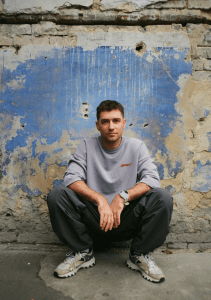
I’m Sashko Bey. Bey is actually my surname, and at first my nickname “bey o bey” seemed a bit funny to me, but over time it turned into something I’m known by. I like it, and everyone likes it, so I’m happy with it. I live in Kyiv, but I was born in Donetsk region — I moved here because of the war, back in 2014.
Since childhood I’ve listened to a huge amount of music. For me, listening was almost like an analysis, a real pleasure — I was always more interested in listening to music, figuring out the artist, the genres they work in, and so on, than watching a film, and that’s stayed with me to this day.
As for my musical background: my friends and I used to organize parties, and that’s where I played my first DJ set, sometime around 2017–2018. Then in 2019 I joined a school called Kultura Zvuka to learn how to play vinyl, under a teacher named Rustam. Fun fact — over the past few years we’ve actually played four b2b sets together, and it was incredible every time. My friend Denys, with whom I later founded Terms of Groove, also signed up for that vinyl course — I joined him, and it turned out to be a great decision, because from that point on I fell in love with music on records. I think I’ve been collecting vinyl since around 2019.
As for what first drew me to electronic music and vinyl, and how my approach as a DJ took shape — I was already playing music and buying tracks before the vinyl course, mostly house, tech house, minimal. Back then I was really into Romanian minimal, and that's actually what I started my record collection with — Denys and I played a lot of Romanian minimal together. Even now, so many years later, I still put those records on and enjoy them; they still sound great.
As for how my approach as a DJ developed — I think I looked a lot at other people, how they did things, and tried to do what was being done in Kyiv at the time. There was always this internal tug-of-war between what was happening around me and what I actually liked myself, and I’d look for some kind of compromise. It’s only now that I’ve reached the point where I play what I want, and I don’t care what anyone else thinks. I collected records, and they were completely all over the place: I started with Romanian minimal, but then I picked up ambient, some house-leaning stuff, broken beat, and more.
Gradually I realized I didn’t want to limit myself in any way — I wanted to play everything I wanted to play. I wouldn’t say my sets were ever especially one-note — I always tried to keep them varied. A lot changed when I discovered Discogs and started spending hours there every day. It’s like a door opening onto a collection of millions of records from different years and genres — you can dig and dig endlessly. After that discovery I started playing mostly older music. These days it’s roughly a mix of 80% old and 20% new, more or less. Of course I still buy new releases too.
As for being one of the founders of Terms of Groove and now a resident at Brukxt, and how my musical identity has changed — at first, together with the guys, we founded Terms of Groove in a format built mostly around house-adjacent genres: house, tech house, minimal, progressive. I always loved broken music and collected a lot of it, but I’d only sprinkle it into house sets here and there. At some point I decided to try playing a set made up entirely of broken records, since I’d accumulated so many of them at home. It turned out to be a fully broken set. It was great, something completely new for me. Over time I got noticed and was invited to become a resident at Brukxt club — and I dove even deeper into broken music from there.
As for how my identity changed — a lot of broken records got added to my usual house collection, sometimes even darker ones, sometimes just really driving, high-energy ones. And overall my performances changed too, in the sense that when you’re playing broken music, it’s active, and you just want to jump around behind the decks 😉
And honestly, in recent years I don’t limit myself at all anymore — not by genre, not by tempo, not by era.
I play what I want and how I want, and that’s the whole fun of it 😉
Looking back at 2025, you described it as an especially productive year, with performances across Kyiv and other Ukrainian cities. You’ve played at venues such as Brukxt, Closer, Keller, Abo Records, Brave! Factory, and also in Kharkiv at Some People. How would you describe the character of Kyiv’s electronic music scene today, and how does it compare with Kharkiv or other cities you’ve played in? Despite the war, does each city still retain its own musical identity?
Yes — over New Year’s I sat down and looked at how many shows I’d played in 2025, and I was genuinely shocked. I traveled to a lot of cities across the country, and it was a great experience. It really was a productive year — I was playing almost every week, and I gave up a lot of other things to make that happen. But it was worth it.
As for how I’d describe Kyiv’s electronic scene today, and how it compares to Kharkiv or other cities I’ve played in — Kyiv’s scene is, without question, a level above the others, first and foremost in scale. In terms of quality it also wins out almost everywhere. For example, I love that in Kyiv, wherever you walk into on a Friday, there’s good music playing, and very often the place is packed — that’s a genuinely great sign. There are a lot of really good DJs in Kyiv; it feels like every second person collects records.
The competition is fierce, but it’s inspiring, and overall it’s a great thing. I want to highlight Kharkiv — the guys there built Some People, and they’ve also brought the Kultura Zvuka approach into a club format; there's another club as well, and overall the electronic music culture in Kharkiv is moving in a really good direction. I genuinely loved playing there.
I also want to say again — I was genuinely struck by the level of organization, the level of everything, in the smaller cities like Khmelnytskyi and Vinnytsia. Of course the communities there are much smaller, and it takes an enormous amount of work to get people to understand what this culture is really about. I’m grateful to the people building that scene there — without them, none of what exists now would exist. The problem I see in other cities is that there’s no money, not enough people, and it’s very hard to grow it.
As for whether each city still retains its own musical identity despite the war — I think it’s even harder for the smaller cities: places and parties like that exist on much shakier ground there.
Since the full-scale invasion, Ukraine’s electronic music community has continued to grow in remarkable ways. From your perspective, how has the scene changed over the past three years? Has the role of DJs, promoters, and clubs evolved, and what gives you optimism about where Ukrainian electronic music is heading?
Before the war I wasn’t that integrated into this electronic community, so my perspective can really only speak to how things look now — specifically from a DJ’s point of view.
What I can say is that there are a lot of DJs now, and to get noticed you need to stand out musically somehow, stand out visually somehow, or have good connections so you get booked somewhere and get seen there. There are actually a lot of really good DJs who struggle to promote themselves — they’ve built incredible music collections but rarely get to play, because that takes a promoter. Overall we now have a huge number of DJs of our own.
Promoters and clubs, of course, have it very hard during the war, because there are shellings, and it happens that Saturday is a day of mourning right when you have foreign artists booked, or a big party you’ve spent months preparing for — and it all gets cancelled. The war keeps making its own adjustments. But I’m honestly amazed that despite all these circumstances, you sometimes walk into a party and just lose yourself in it completely — it’s like a different world. It’s incredible that during the war there’s a place you can go where everything is always good. That’s genuinely amazing.
What gives me optimism about where Ukrainian electronic music is heading — when I play music and see people smiling, enjoying it, and then someone comes up afterward and tells me it was great, that gives me a good mood and the motivation to keep going.
As a multi-genre selector, your sets move freely across styles, eras, and tempos rather than staying within a single genre. What do you look for when building a set? Is there a narrative or emotional arc you’re trying to create, or do you prefer to let the crowd and the records themselves shape the journey?
First and foremost, I start from the venue where I’m playing. Second is the slot — what time it is. Then a kind of picture forms in my head of roughly what I could play at that time, and after that I just go about my day, walking around, and a thought pops into my head: “maybe this record”; — and if I have it, I add it to a list of records that would be fun to play in that slot. By a few days before the show you’ve got a big list of records, and you just sit down, go through them, and throw them in the bag. And something good usually comes out of that — that’s roughly how it works.
I never buy records for a specific set — I buy records regardless of circumstances, just all the time. When I need to pull something together for a specific show, I simply pick from my collection.
As for an emotional arc — in about 90% of cases it’s some kind of positive emotion. I want my music to bring out positivity in people, smiles, a certain simplicity. I’m not one of those DJs who plays super, super deep music — at least that’s how I see myself; someone else might see it differently.
Looking back over the past four years, are there any Ukrainian electronic — or indeed any Ukrainian — albums that you feel have captured the experience of the full-scale invasion or contemporary life in Ukraine in a particularly meaningful way? What makes those records stand out to you?
One of the first things that comes to mind is the work of Si Process. I’ve seen him play live several times, including a solo show, and discovering his music during the war has been a real highlight for me.
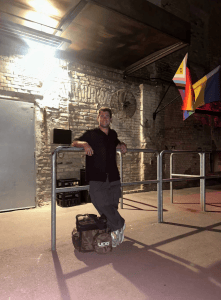 Finally, what does it mean to be Ukrainian today? And if you had to introduce someone unfamiliar with Ukraine through a single film, artwork, meme, traditional dish, song, building or monument, and album, what would you choose — and why?
Being Ukrainian today means trying to live and enjoy life despite a huge number of obstacles and a huge number of hard moments, while still holding on to your identity and taking comfort in the fact that the people around you are the same as you — Ukrainians who understand you without needing to finish a sentence.
If it’s about a song, or where to send someone to listen to Ukrainian music — I’d point to the YouTube channel in.rec_kyiv, which records sets by Ukrainian DJs. If you don’t know what to listen to, you can just open it and dive in — there are sets recorded in some really cool locations, like a vinyl fair or a clothing store.
As for a film — two recent ones stood out to me: the documentary Okean Elzy: Stormwatch (Океан Ельзи: Спостереження Шторму;), and the film about Nazariy Yaremchuk, Yaremchuk: The Incomparable World of Beauty; (Яремчук: Незрівнянний світ краси).
And there’s also a great book — A History of Ukrainian Rave; (Історія українського рейву) published by Book-ye — I’d recommend it.
AUGUST 17, 2026 – DNIPRO
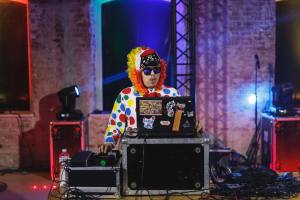
Live at the Construction Festival
Hi Oleksandr, thank you for joining us. Let’s jump right into it. Your debut, 0ne, was built from first-take improvisations with no post-production, and you described the act of making it as a trance in which the creator briefly becomes united with the creation. How did you arrive at this way of working, and what was your musical background before TRANCEDÆNCE? Has improvisation remained central to the project, or has your relationship with composition changed since then?
Before TRANCEDÆNCE I was mainly focused on my first project, Cynpym. I’d always dreamed of making music, and under that alias I released whatever I felt confident enough to put my name behind. I was still learning FL Studio and had no real plan — mostly hip-hop beats and my own rapping, sometimes vaporwave and even krautrock. A real shift came when I started writing music with the structure of more rave-oriented genres. I was under the heavy influence of the Odesa underground club scene at the time, which gave me a completely different sense of how music could be experienced — the idea of “speakers/acoustics as an instrument,” working with crisp frequencies and timbres.I’d never really listened to much EDM before I started clubbing and got exposed to big sound systems. Before that, I wrote music with more of a rock/pop logic; shifting my focus from compositional structure toward short, repetitive loops that still sound interesting made me appreciate my own music far more, and audiences responded to it too with better feedback and more streams.
The project was growing and I started getting some fanbase and developing my own style. From young years I was really into experimental music, so I kept trying to make my music unconventional – sampling avant garde artists, utilizing polyrhythms, building my own kicks out of tom-toms. One of the things I tried was jamming and modulating a sound, then releasing the recording itself as the finished song instead of writing a composition step by step. That later became the whole method behind TRANCEDÆNCE. Originally TRANCEDÆNCE was meant to be an alter ego — it first appeared on a track called Twins where I introduced it as a mysterious collaborator; I even talked to people online in character, with its own name and backstory (the illusion didn’t survive long though — I got caught using the name while playing Minecraft with friends).
I’d originally intended TRANCEDÆNCE to sound closer to post-trance / SoundCloud-core / nightcore, scenes I’d gotten into after COVID, chasing something more spiritual and hauntological — but it didn’t fit the way I was used to making music. Then, in one sessionі, I’ve started just modulating the shit out of a short synth loop on one of the new VST and decided to just record it. The process of turning the knobs felt almost ritualistic. When I listened back, the recording had everything I’d been chasing for months, so I recorded a couple more sessions the same way and put them up on SoundCloud the same day, this time under TRANCEDÆNCE. I was genuinely surprised by the results — for the first time, I felt I’d made something complete that represented my own ideas and emotions. I realized it belonged to a completely different discourse than what I’d been aiming for — much closer to noise music and avant-garde practice than anything else. Less than a week after making music this way for the first time, I asked to perform at a local experimental-arts event, sent demos to Ereh Saw, who was organizing it, and got approved. Only two weeks separated the first time I tried free improvisation from my first-ever live performance — and it went well: I improvised alongside a performance artist who was wrapping her naked body in adhesive tape. The audience loved it, and the feedback told me I was on the right track.
While recording 0ne I was completely absorbed in this new method — I wanted to demonstrate its possibilities, find its limits, and understand what it meant.I didn’t know yet that it would become the core of the whole project. In some ways it still hasn’t changed: my most recent album, Dnipro City Guardian, is structurally identical to my debut — one synth, one short loop, notes that never change through the track, no post-production beyond mastering, one channel. But where 0ne dwells inside the method itself, almost like an essay film, DCG just utilizes it as an instrument to tell about many different themes and concepts.
Free improvisation is still the core medium for TRANCEDÆNCE, though my lens has shifted a lot since the debut. I don’t always limit myself to one channel anymore — I recently wrote a piece for an octophonic installation where each speaker carried the signal from a different synth I was modulating live. But it’s still trance at heart: I pick patches that feel interesting, give them one or two notes, loop them, hit record, and start modulating. Some of those presets I could work with forever and get a different result every time, but I always prefer to release the first take — it keeps the raw energy and the surprise of discovering where a sound can go. This philosophy works amazingly for live performances – most of the time I just need to choose a patch that has a lot of potential to mutate in interesting ways. it’s never about rehearsal, always about reading the room and getting into a flow state where I steer the sound toward a story I don’t fully know myself until I’m in it. Some projects have more anchors — compositional, conceptual, dramaturgical — but the core stays the same: a MIDI loop and my hands on the synth’s parameters.
Time seems to have been an important idea in your work from the beginning. The text accompanying Trip Reserved rejects linear time in favour of a “reservoir” in which past and future events coexist, while later records increasingly seem occupied by memory, spectres and particular places. How has your understanding of time changed since you made Trip Reserved in 2021, especially after the full-scale invasion?
I believe what changed is not my overall understanding and feeling of time, which I find quite transpersonal, but my focus about that. I still feel myself quite dissociated from time and often I find myself in situations where I am able to feel and understand myself and what is happening around me only in retrospect, or to make choices that would only make sense in a context I’ll get in a future, so nothing much changed there. But my attention now goes toward therapy, humanism, and political action within that same configuration of time. I believe a lot of people today experience the stress of living in a time in its totalitarian manifestation and it’s important to do something about it, to fight for emancipation of time. Capitalism and authoritarianism don’t only make time unbearable — they do the same to our bodies, relations with nature, language, geography and many other basic aspects of our living life – and different people carry different parts of that weight as trauma.
Mark Fisher wrote about some of this in Acid Communism, the book he never finished — we only have the introduction, because he took his own life before writing the rest. He argued that we have the capacity to imagine and use time in far more creative ways than capitalism allows. But when the political, economic, and psychological situation gets as bad as it has for so many people — especially in Ukraine — there’s very little room left to play with time, because so many people are simply fighting to survive. When things are this hard, I think the most important thing is to help each other: to remind each other that our dreams are still real, and to feel empathy for other people’s struggles even when we’re luckier or more successful ourselves.
So when I work with memory, hauntology, and time now, I try to hold onto that. I don’t want the work to turn cynical or apathetic — I want it to open a dialogue, to let listeners find some hope in it, to remind people that a lot of us carry a similar kind of trauma around time. I’d rather not treat that with irony; I’d rather use it as a reference point for what we build next — as a reminder that time can still become beautiful.
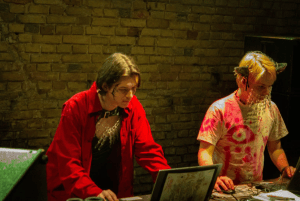
at нойзщосереди with Музична Шкатулка (left)
You recorded “Monad” at Noise Every Wednesday (нойзщосереди) at Otel’ in Kyiv in January 2024. What was that series like from the inside, and what did it mean to have a regular space devoted to noise and experimental music in wartime Kyiv? At a time when people were already surrounded by the unwanted noise of sirens, drones, explosions and generators, did gathering to make and listen to noise acquire a significance beyond simply having somewhere to perform?
“Monad” came from one of two performances I did at Noise Every Wednesday (НЩ) — my debut in the capital, and later a collaboration with Музична Шкатулка. Both are still among the best performances of my career. I found the series quite early and fell in love with the concept immediately — I’d been to noise events in Odesa and Dnipro before and always found them the most interesting to watch as an audience member, so the idea of experiencing that regularly in Kyiv was exciting. I got in touch, sent some material, they liked it, and we booked a date almost immediately. Communication was straightforward and open from the start, and every time I dealt with the team I got the sense that the people running it were motivated, genuinely passionate about what they were doing, and honest and friendly with the artists.
It was also impressive on a purely organizational level. Soundchecks were fast and painless, the lighting and visuals were excellent, the sound and monitoring were spectacular, and the tech rider was met in full — if something was missing, they’d always find a solution to make the performance feel complete. As an artist in Ukraine you’re pretty much guaranteed at least one small crisis at venues of a much bigger scale, so having everything taken care of by a project that screamed DIY was genuinely inspiring to say the least.
The philosophy of the series helped as much as the organization. Every artist — whether it was their first time on stage or they were a veteran of the scene — got the same level of attention. That’s one of the most beautiful things about НЩ: at almost every show there’d be someone playing their first-ever set alongside “legends” of the Ukrainian underground. At my first performance there, Timur Dzhafarov (aka John Object) publicly premiered his new project, Група Б. At the time I saw Timur as one of the most important musicians in Ukraine, so being able to talk to him and get his feedback was both an honor and a real opportunity. НЩ felt like a place built on non-hierarchy and solidarity, where your status didn’t matter and people from different backgrounds were treated as equals.
The other thing that stood out was how liberating it felt that the audience had almost no fixed expectations. It felt like you were allowed to do anything, as long as it wasn’t boring — which meant nobody was anxious about “failing.” It gave artists a green light to try things they’d always wanted to attempt but never had a safe space for. I never did anything especially extreme there myself, but just knowing I could was already freeing as an artist. I once talked about this with Vadym Oliinykov, one of the people behind the project, and he told me something like: “It’d be great if you did something crazy — but keep in mind we don’t have an age restriction, so if you decide to get naked in front of people, we won’t be able to help you with the cops if someone reports it.” Honestly, that’s about the best mindset I can imagine for experimental music.
Often the genre tags on the poster mattered more than the artist’s name — you’d go just to hear someone play a harsh noise wall or a lowercase set. For that reason, I think НЩ will end up being important as an archive of Ukrainian musical avant-garde on its own. It was open to everyone, and I think a lot of artists who are, or will become, culturally significant had their start or a key moment there. I’d like to think it will eventually mean as much to Ukrainian underground music as Novaya Scena does now, but that will take time — and it’s a shame that not every show was filmed before НЩ got its own YouTube channel, because I think each of those performances will matter for anyone researching Ukrainian post-war experimental music in the future.
I never lived in Kyiv while НЩ was running, so I can’t claim to have seen the whole picture, especially once the events started getting more attention. But it made me want to move there — I wanted to help however I could, and I was told I’d be welcome to keep developing my project within it. I was invited a couple more times before the series ended and couldn’t make it, mostly because I was sure it would just keep going. I hope the community finds a way to self-organize and continue what НЩ started, and the values it brought into the Ukrainian post-war underground. There are still radical music events happening in Kyiv, but none of them feel quite as inclusive. I still hope for some kind of resurgence — the ideas behind НЩ worked perfectly from 2023 to 2025, and I think they’d still work now. But it’s worth remembering it wasn’t just good timing or the underground zeitgeist after the full-scale invasion — Vadym, Kseniia, Misha, and Pavlo worked incredibly hard to make it happen.
Your recent work invites a hauntological reading: Dnipro City Guardian contains a track called “Haunt of Kaminya”, while your music repeatedly returns to spectres, loops, memory and distorted temporalities. Mark Fisher famously associated hauntology with futures that were once imagined but never arrived. Does that idea make sense in Ukraine, where an anticipated future was not simply “lost” through cultural stagnation but violently interrupted by invasion? And is there a danger of aestheticising very real ghosts and absences when talking about Ukrainian culture in hauntological terms?
I see hauntology less as a fixed thematic or aesthetic lens and more as a genuinely modern discipline that’s still being worked out — which means it can develop in a lot of directions. Interest in working with memory is growing right now, Fisher’s ideas included, and inevitably some of that will romanticize trauma while some of it goes cynical. That kind of recuperation happens to most good ideas eventually, so it’s a risk I try to stay aware of.
I don’t think the idea only makes sense in Ukraine now — I think the war has accelerated it to an extreme speed, which means we suddenly have a lot of new material and new angles to work with. Fisher’s original focus was roughly about the decay of the welfare state and the rise of neoliberalism; the Ukrainian context gives us something more anti-colonial and less Euro-centered.
You’re right that a lot of what we’ve lost here comes from actual, literal destruction and violence, not slow decay. Until recently, Ukrainian hauntology was mostly about things that had already been haunted for a long time — the Soviet past, the annexation of Crimea. Now people are experiencing these spectres of time at a much faster pace. One day your commute to work is ordinary; the next day it’s changed forever because a building along the route was hit overnight. It’s not only about the horror of that — you start asking smaller, stranger questions too: what will replace this? why was it even here? how do we want to remember this place — do we even want to? what does it mean that I miss this past?
A lot of people are already nostalgic for the first months of the war, the first blackouts. There’s a growing pull toward more conventional hauntological gestures — artists sampling Ukrainian pop from the 2000s, grieving lost national futures against the futures Russia tried to promise us instead. Stalker 2 is a good example of how the discourse has shifted since the invasion — the relationship to lost futures there is much more contradictory and tangled than the classic version, closer to how I think Ukrainian collective memory actually works now. We can’t separate ourselves from these missing meanings — not just ideas about a better past or future, but ideas about what being Ukrainian even is. We still need to fight for our present and build a future, but these lost futures and broken pasts have become part of the cultural fabric for a lot of Ukrainians, so I think there’s real, useful work to do with them — using older hauntological tools and building new ones.
My own practice has become more centered on hauntology over the last couple of years — “Missing Sounds” among other pieces — and I think I get closer to something meaningful when I try new mediums and methods rather than just sampling or referencing symbols that trigger nostalgia. I’m also finding new ways of noticing my own hauntological code — ghosts I didn’t know I was carrying — in landscape, architecture, sound, local communities, time itself, food, language, products. want those new perspectives to actually do something — to build more promising, more emancipated versions of reality, not just describe the loss.
Administration, recorded across 2023, reduces its accompanying text to two words—“drug / politics”—and titles its pieces “Blackout”, “Boise” and “Brothel”. Then Dnipro City Guardian gives us “Taking a Dump at Biennale Restroom”, “DCCC” and “Haunt of Kaminya”. There seems to be a mixture of seriousness, absurdity and private mythology running through these titles. How autobiographical is TRANCEDÆNCE, and how much are you constructing a fictional world around experiences that actually happened?
That’s something I think about myself a lot as of recently. I’ve been doing more institutional artist practices and started signing my works with my real name Oleksandr Suprun more frequently, and I’ve realized I can use both names — TRANCEDÆNCE and my real name — more or less interchangeably, depending on what the work needs. From the start of the project I saw TRANCEDÆNCE as whatever musical or sound work I do inside contemporary art and institutional avant-garde music.
I still construct and work on the overall artist identity and design of this project to build some cohesive artistic statement. But I see TRANCEDÆNCE as less autobiographical or focused on narrative world-building and much more about conceptual depth and the listener’s own subjective reading — emotional states, psychological associations, that kind of thing. I try to keep things as abstract, vague, and surreal as I can; what a track title looks and sounds like as a combination of letters, or what colors go on the artwork, usually matters more to me than sending any specific message.
That said, I can see the project moving toward more worldbuilding or a more unified narrative in specific works, even if that’s not really the focus. With Dnipro City Guardian the album got more personal and specific than anything before it — I wanted to say something about my hometown and its local identity, and for the first time in my career I felt genuinely connected to that. It was a shift for me as much as for the music. I want TRANCEDÆNCE to be open to such dynamics and only be limited to this electroacoustic improvisation praxis I was talking about earlier.
The mythos side of things — private mythology, world-building, a constructed persona — is something I work with much more directly under my other alias, Cynpym, which I use for my blog, more conventional music, poetry, graphic work, and my main social presence. I try to keep the two as genuinely separate mindsets and workflows. It’s honestly a challenge right now: TRANCEDÆNCE ended up giving me a functional method and became the direction my career moved in, while Cynpym — which I think of as my main persona, the one I show people most often — has been hard to turn into a complete, larger project. I want to get back to it, because I think it can express things TRANCEDÆNCE simply can’t, but figuring out how to bring what I’ve learned from TRANCEDÆNCE into it, without collapsing the distinction between the two, is an ongoing problem. It might sound like an overly formal thing to worry about, but for me it’s a genuinely interesting one to solve.

Photo by Anna Chaika courtesy of Artsvit Gallery
Where are you currently based, and how has displacement—or, if you have remained in Ukraine, the transformation of everyday life there—affected the way you make and hear music? More broadly, what does identifying yourself as a Ukrainian artist mean to you now? Is “Ukrainian” primarily a cultural identity, a political position, a lived experience, or something that inevitably enters the sound itself?
When the full-scale invasion started I moved back from Odesa to Dnipro, where I still live. For the first months it was mostly about getting all shit together – finding a new job, moving to a new place, making new connections. I didn’t really start thinking about my career again until I went to some of the first post-invasion gigs, some of which I was invited to perform at in late 2022. It was a really strange and transactional period – I see that the community wanted to continue functioning on the same logic and principles as it was before the war, not yet knowing how exactly the scene should transform. I had no idea either – but performing, and reminding myself I was still a musician, mattered a lot. With that mindset I released my second album …&2, which tried to capture that odd, liminal year. I’m not especially proud of it sonically, but I’m glad I made it — it kept me moving forward through a context that had changed completely since February 2022.
Time passed and it became more obvious that initial enthusiasm for creating musical events in a pre-war fashion was fading away, at least in Dnipro. The cultural space felt colder and emptier as the first blackouts and Shahed attacks started. I stopped thinking seriously about music for a while — it felt impossible to fit back into the scene without some kind of reinvention. That changed when I went to Kyiv for a 20ft Radio event where Oleksii Podat was playing alongside other experimental and radical artists. Watching a crowd vibe to something that loud and harsh made me think that if I got back into music, there’d actually be an audience for it. That pushed me to put together my first real portfolio, get my old material onto streaming, and start applying to open calls — which eventually led to me being included on the ШЩЦ3 VA compilation, which was a huge deal for me as it got a lot of publications and I admired this label long before making experimental music myself.
From there I started more new projects, met more local artists, worked with more Ukrainian art organizations, and did my first residencies. Becoming a direct participant in the Ukrainian underground scene, rather than an outside observer of it, was the biggest change in how I make music. I used to think of my work as representing more global subcultures and networks; now I keep in mind that I represent my local context too, and it’s basically impossible to separate my solo work from the Ukrainian people I’ve collaborated with. Whatever I pick up from elsewhere, I try to bring back and share with the local community as a priority. That’s not always simple — sometimes the local focus feels imposed by institutions, and the community itself keeps shifting and radicalizing politically — but caring about how my work resonates here, and about making something that matters to these specific people, has pushed me to try new mediums, work with new themes, and be more sincere as an artist.
As for “Ukrainian” as a label — I think it’s an ongoing process of figuring out what we can be and do, not a fixed or essentialist thing, and I’m wary of romanticizing it. It’s an active practice, where we constantly adapt as a community for the sake of our own survival. It’s a lived experience people gain from cultural code, passport, language, land, contribution to community, etc. A lot of people carry “ukrainity” in different amounts, and for some it grows large enough to shape their whole way of living. Right now, being Ukrainian often means direct action and direct connection — we tend to self-organize without waiting for guidance from above. Turning “Ukrainian” into that kind of flexible, dispersed network, using whatever tools we have, is what we’re doing right now so that we can’t be crushed.
Your earlier work repeatedly imagines the future: 0ne refers to technological singularity and “Coming of Age”, while Trip Reserved describes events acquiring meanings only later in life. Are you still able to think about the future in those terms? After more than four years of full-scale war, is imagining a future an artistic necessity, a luxury, an act of resistance—or something that has become almost impossible?
I touched on part of this already — to summarize, I still find Mark Fisher’s Acid Communism and Capitalist Realism the most useful frame for thinking about the future, and I’m genuinely glad to see him getting more popular with younger audiences. It’s almost impossible to picture a realistic, positive future right now, but letting yourself start dreaming again feels like the necessary first step toward one.
I can’t talk about the future without acknowledging how much has changed over the last few years — new technology, the political climate of USA-China and their world influence, COVID. Since the full-scale invasion, accelerationism feels like the most relevant frame to me globally. Even inside Ukraine, the new shape of drone warfare wasn’t something anyone expected, and its effect on our society and culture is hard to overstate. How we resist, how our trauma is shaped, how we fight and understand this war — all of that is being formed by new technology and new media. The faster we understand how it’s changing us, the better we adapt and the better we do strategically.
The accelerationist view can be genuinely frightening given what a lot of theorists predict — especially with the current Trump administration having real roots in Dark Enlightenment thinking. It’s a fact that the tech sector today is largely controlled by people with no real interest in solving the world’s problems or improving people’s lives, and yet the technology keeps developing at full speed regardless. Most political parties, most of the public, even a lot of artists, underestimate or ignore this, while authoritarian regimes are already putting it to use.
As an artist I feel a responsibility to engage with this, especially from a Ukrainian angle. I see Ukraine as a place where the future is actively unfolding — not just in terms of which weapons and technologies get used in this war, but in how the war and its outcome will reshape how we understand colonialism, imperialism, and globalism in a world with mass-deployed AI. Ukrainians have been living in that mode for a long time already: we’ve had some of the fastest, cheapest, least censored internet around; most of our schools and universities never fully left remote learning after COVID; we’ve gotten so used to working through blackouts that it’s less disruptive than people might expect. That’s how this society ended up more technologically acknowledged than a lot of much wealthier countries, under some of the worst possible conditions — which I find genuinely inspiring.
I think younger Ukrainians are even better positioned to use technology culturally, and if we want to theorize seriously about a better future, we need to pay attention to what they’re actually doing, feeling, and thinking. I doubt many of them care much about experimental or contemporary art in the white-cube highbrow form that still dominates the field. A lot of art mediums and music genres are going to lose relevance fast if we don’t reshape them for younger artists who grew up with technology from birth — otherwise they’ll just go to virtual platforms instead. The same goes for “new money”: IT workers, e-scammers, crypto traders have real potential to become the next Ukrainian elite, so it’s worth starting that conversation now if we want Ukrainian art to have a future worth building. Honestly, these days I see more potential in Instagram Reels brainrot memes than in most institutional art projects, which too often feel technophobic and commodified — not exactly the right configuration for building something better.
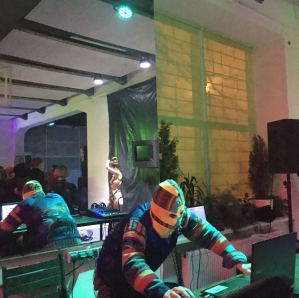
From debut performance in Odesa
Finally, rather than asking you to define Ukraine, could you build a small portrait of the country as it exists for you right now: what book, film, artwork, monument or building, dish, meme, album and individual song best represent contemporary Ukraine—and why?
I would choose ‘тсн’ by kissesfromeldar – but honestly, any of their recent releases would be a great fit. That music gives me the most hope about where Ukrainian music is going, and it represents Ukraine the way I want it represented: sincere, vulnerable, queer-coded, post-ironic, cutting-edge, visionary, self-referential, anti-institutional, and still respectful of its roots. I see how this music would be enjoyed equally by Ukrainians and foreigners. I think Ukrainians and foreign listeners can enjoy it equally, for different reasons — for us it’s full of context and references only we’d fully catch, while for people outside Ukraine it just sounds fresh, with very few real equivalents elsewhere. Those are the same qualities I’ve always valued in Svitlana Nianio’s music. kissesfromeldar isn’t based in Ukraine but performs around Europe, which also matters to me — having artists who matter equally to people who stayed and people who left because of the war feels important at a moment when those two groups keep drifting further apart.
SEPTEMBER 2, 2026 – KHARKIV
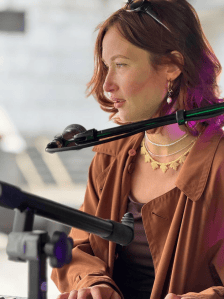
Hi Sofiia, could you tell us about your musical background and how Соня Хедекель [Sofiia Khedekel] began as a project? What music were you listening to when you first started writing and recording, and how did you arrive at the combination of intimate vocals, dream-pop atmosphere and much denser guitar textures that characterises songs such as “Незупинно” and “Unison”?
When I was a child, I studied at a music school for a few years, but eventually chose visual art instead. I had been writing music for a long time, mostly for myself – as a kind of personal diary. Gradually, I started sharing it publicly. I wouldn’t really call myself a “project” in the traditional sense: I don’t have a strategy or a team. I just honestly do what I feel an inner impulse to do.
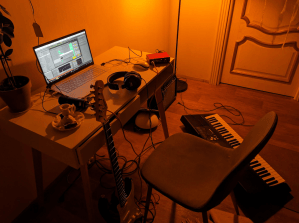
I started performing solo at local events in Kharkiv in 2025. But I always wanted a fuller sound, not just the format of keys and vocals. I have a fairly clear feeling of what I want to express, so it is important for me to control most of the process myself. This motivated me to learn guitar, music software and gradually build a small home setup for recording.
I don’t connect myself to any particular genre and I don’t have very clear references. But obviously, what I listen to influences me: shoegaze, dream-pop, underground and lo-fi aesthetics.
In my own sound, I care about a feeling of real human presence, melancholic haze and the texture I create by layering vocals and guitars. I’m glad you noticed this in your question. I work with music as an emotional space and I’m not really interested in making a quick impression – it’s more important to me that the sound pulls you in and exists as a certain state.
If I am not mistaken, you live in Kharkiv, a city that has experienced more than four years of war and remains under frequent attack. How has living there changed since 2022, both personally and as a musician? Is it possible to adapt to that degree of uncertainty, and what are the particular difficulties of trying to write, record, perform and maintain an ordinary cultural life in Kharkiv at the moment?
Yes, I live in Kharkiv. Sometimes it is difficult for me to answer the question “how has life changed”, because I feel like I’m starting to forget what life was like before the full-scale invasion, and that scares me. But of course, reality has a strong influence both on the topics I work with and on my approach to creativity in general. In some way, it may be a way for me to process and understand my own emotions and experiences.
I have also become much less afraid of imperfection. It feels like, after everything that has happened, it is harder to scare me with things that used to make me feel vulnerable.
There is quite a friendly music community in Kharkiv – we try to support each other. At the same time, it is quite small, as many people have left, so it can be difficult to find venues and people with whom you can create something together and move in the same direction.
Of course, reality also affects the technical side of making music. For example, I recorded “Незупинно” during a period of severe power cuts after russian attacks. During the day I would go to a café to work, and in the evening, while I had a few hours of electricity at home, I would charge my laptop and record music in Ableton until the battery ran out. I did this sitting in the kitchen by candlelight. I think one day I will remember that period as something surreal.
While writing the answer to this question, I remembered how I used to wait for the explosions to stop before starting to record vocals. At the time, I didn’t even think much about it. Now I realize how abnormal our reality has become.
There is an interesting tension between your two recent singles. In “Незупинно” you describe the desire for an “emotional escape from reality” while remaining anxiously attached to it; in “Unison”, home becomes something you can find through trust and mutual understanding with another person. The city itself becomes almost weightless as everything seems to dissolve around the two people. Are these songs connected for you? Has your understanding of what “home” means changed through the experience of living in Kharkiv during the war?
Yes, these songs are definitely connected – for me, they are two stages of how I am processing everything that is happening.
“Незупинно” is probably about accepting that sometimes I simply can’t cope. In Ukrainian society, it can feel shameful to talk about this, because there will always be someone whose situation is much worse. Through this song, I wanted to get rid of that feeling of shame and give myself permission to talk about my own pain. About the desire to get rid of it, at least for a while. At that time, I started having thoughts about emigration, which I still sometimes come back to and which makes me feel sad. These thoughts also made me realize how much I value sincere things about my home, and how lost I might feel without it. It’s strange to love your home and still sometimes want to escape from it.
“Унісон”, on the other hand, was written out of a desire to cultivate something in opposition to pain and destruction – something humanistic, something I really value. I feel that these are the things that keep me going now: the people close to me, understanding and sincere communication between us.
After writing this song, I even allowed myself to fall in love, because I started trying not to run away from emotions – neither the bad ones or the good ones.
So yes, both songs are about home for me. About two opposite feelings I have towards it at the same time: I love it with all my heart, but sometimes I also feel deeply tired and hopeless. Maybe home has stopped being just a specific place for me. It is both the pain connected to it and, at the same time, something tender, meaningful, and deeply personal.
Your lyrics rarely describe current events directly, yet exhaustion, fear, disappearing traces, confused calendars, sleeplessness and the hope for a quiet night inevitably acquire particular meanings in contemporary Ukraine. Do you consciously leave that space open for the listener? Do you ever feel a responsibility as a Ukrainian artist to address the war explicitly, or can writing about intimacy, abstraction, anxiety and everyday life itself be a way of documenting what it feels like to live through this period?
My lyrics are quite abstract because I naturally tend to think in images. And yes, this is my way of documenting my own experience, emotions and states rather than specific events.
In general, creativity is more of a monologue for me than a way to communicate something to the outside world. But of course, I’m happy to find people who connect with what I do.
I don’t feel a particular responsibility to speak about the war directly, because music is almost the only space where I can let go of any external responsibility and simply be honest with myself. I think journalists and reporters are the ones who directly document the war. While I document what it feels like to live in my reality, where many other parts of life exist alongside the war.
 If you had to build a small cultural portrait of Ukraine as it feels to you right now, what would you choose as one book, one film, one song, one album, one play, one artwork, one dish, one building, one monument and one meme — and why those particular choices?
This question is difficult for me to answer because I feel like some time must pass before I can look at all of this from the outside. Right now, I still don’t fully understand what Ukraine is today or how I could describe it through specific cultural images. It feels like such a broad and complicated topic.
Maybe a few years ago I could have given a more specific answer. But during this time, I have changed, my perception of what is happening has changed, and, as a result, my perception of Ukraine has changed too. So for now, I am still looking for these answers for myself. At the same time, I increasingly feel how unhealthy and distorted our idea of what is “normal” is becoming, while society itself is becoming traumatized. A lot of my attention is focused on this now, and it hurts me.
But Ukraine is not only about the war and its consequences. It is also about its authenticity, mentality, landscapes, smells, people, and many other things that are difficult to fit into a single portrait. Maybe that is why I’m not ready yet to choose just one symbol for each of these categories.
SEPTEMBER 4, 2026 – SUMY
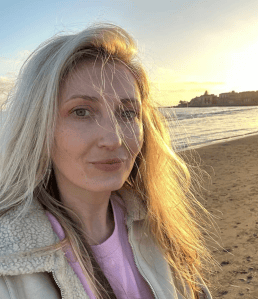
Having previously covered the Sumy-based label Bondeni, Pavlovska is a familiar name to readers of UFN. Her first solo release provides the perfect opportunity to reconnect.
Hi Kateryna, “Veselo” is your first solo single after your work as the vocalist of ZzuppamanN and Tvaryny. Why did this particular song feel like the right moment to step forward under your own name? Does beginning a solo project give you a different kind of freedom—or responsibility—in terms of what you want to say and how personally you can say it?
We decided to start with “Veselo” because this song opens my upcoming EP Vidpustka, setting the state of mind and atmosphere that makes you want to escape as quickly as possible to the warm waves of the sea, delicious food, and wine. The EP is closed, by the way, by the recently released song “Crete”. As for what will be between these two songs, we’ll keep that a secret for now. It’s also hard to say at this point exactly when the album will be finished and released.
Actually, a little earlier I had already released the song “Jack” together with Tvaryny, where I wrote most of the lyrics and melodies, and on the song “Animal Instinct” I was a co-writer of the lyrics, which is why you can see the “feat.” credit with my name there.
The thing is, there is no strict division of roles regarding the label’s projects at Bondeni. Yes, Tvaryny is Ihor Kostyk’s brainchild, ZzuppamanN is entirely under the control of Hryhorii Vashchenkov, Art Sopin is self-explanatory from the name, which is an abbreviated first and last name, while the notorious blogger CHUV is slowly but surely saving up for a studio to record his already legendary nine or ten albums. But at the same time, we really are primarily a community of musician friends who are always ready to help each other bring creative ideas to life.
That’s why I sometimes write things for Tvaryny and help Hryhorii with his madness in ZzuppamanN, while Ihor Kostyk and CHUV have taken on the role of producing the project named after me. I don’t feel any overwhelming responsibility because everything I sing about is the reality that I and my friends live in. So, at the same time, I feel completely free.
“Veselo” grew out of the news that another friend had been killed, yet the response was not a lament but a profanity-laced, almost absurdly cheerful song—the idea of laughing so as not to cry. After four and a half years of full-scale war, has humour become increasingly important as a way of processing what is happening around you? And what has changed most profoundly in the way you experience everyday life since February 2022?
Yes, in terms of its meaning, “Veselo” is more of a personal song for Ihor, about his losses, although all of us have experienced loss. That’s why he even sings it together with me. And “Crete” is basically a kind of nostalgia for his vacation during the COVID-19 era, which you can see in the video for the song. But I completely share the emotions and thoughts he put into these songs, so singing about all of this felt completely natural to me.
Both songs also contain that very specific kind of humor that has allowed all of us to keep living and creating over the past few years. In fact, the entire label’s creative output is permeated with it, because the creation of most of our songs starts with some kind of inside joke. It’s just done more directly here than, for example, in Tvaryny or Art Sopin. Yes, I’m talking about profanity and distinctly Ukrainian swearing.
There was actually a rather sweet moment with “Veselo” when the guys somewhat awkwardly asked whether I was comfortable singing lyrics like that. Apparently, they had forgotten that I had already recited an absolutely catastrophic amount of swearing in ZzuppamanN’s manifesto “Idoly”. After that, everything else seems like child’s play.
As for changes in the way I perceive everyday life, I can say just one thing: you start appreciating your family, friends, and creativity more and more, because without them, getting through this kind of “everyday life” is incredibly difficult.
SEPTEMBER 5, 2026 – CHERNIHIV
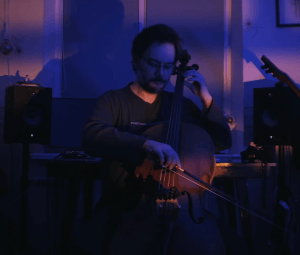
Hi Fedir, it’s been a while! When we spoke back in September 2022, you described improvisation as fundamental to the way you make music, something you partly inherited from your father, and said that the full-scale invasion had given you an urgency to leave behind a substantial body of work. Four years later, Uncut Jams is built from relatively spontaneous synthesizer explorations, while your new Legacy Series is deliberately returning to older recordings that might otherwise have remained unheard.
Has your relationship with improvisation and with your own musical archive changed during those four years?
A lot of water has flown since 2022. My core way of working “create a beautiful sound and try to improvise some beautiful music with it” hasn’t changed. But within that I feel like I had a lot of growth, even if that’s not something I can quantify or explain with words. I still feel the urgency to leave behind more music, both newly made and oldies. That’s the best I can offer the world, and at this point my life doesn’t have much meaning outside of that.
And what made the 2016 cello improvisation “Warnings” feel particularly relevant to release in 2026, when you now hear in it “warnings from the past” about events you could not then have imagined?
I’ve been making music for many years, but I only started releasing it more or less seriously in 2022. “Warnings” used to be a nameless file that surprised me every time I would dive into my older recordings and projects. It has that weird mix of urgency and mourning. It was a perfect choice to start my “Legacy Series”, because it’s a cello recording, which was the instrument that really lured me into the world of music making, and it was strong enough to stand on its own as a single. Not every release needs a story, but I find that humans seem to better connect with music that way, and I came up with a story of It being a misunderstood and ignored warning about the future invasion and darkness it brought with it.
There was nothing particularly relevant to release it in 2026, other than a feeling it was time to do so, and to finally give way for other neglected music I have in store.
Uncut Jams is interesting because you explicitly say you weren’t trying to demonstrate your abilities or construct a major conceptual statement—you were playing with instruments, having fun and sometimes using music as a refuge from pain. Yet you also say that removing those expectations led you towards compositional structures and sounds that you might normally have rejected as too excessive or complex.
Has “not overthinking” become an increasingly important part of your practice?
I don’t overthink some things and badly overthink others. For example, I like live-recorded improvisations because it condenses the aspects of composition and production into this singular realtime process, and by the end of the performance you either got it or not. It’s quite an honest way of making music. Even if I use modern technology to do that, I still have only two hands and a certain level of musical ability. At the same time, I have a relatively conceptual album project that I’ve been dragging for years, refining the concept, changing the name, adding and removing music. Just a couple of weeks ago I recorded a piece that feels like a fitting last track for it, but I’m having a hard time to apply the “no overthinking” mindset and workflow to the rest of it, as some compositions are either too complex or carry too much pain. It’s a heavy album, hopefully I have enough time to finish it.
Ultimately, I treat live-recorded and produced music as two separate sonic art forms. I really love both, and I just had a new release, spiritually similar to Uncut Jams, but focused on acoustic cello improvisations.
Listening back to pieces such as “Captains’ Quarters”, “Cyber Jungle”, “Daily Triumphs” and “Everything Ends Eventually”, can you hear circumstances from late 2025 entering the music despite your decision not to make the album explicitly about them?
Life events and experiences inevitably inform and even bleed into my creative work, that’s a fact. With some compositions it’s quite subtle or almost non-existent, with others it gets very personal. Honestly, I wouldn’t want it any other way. In the age of so called AI and everything becoming increasingly more fake, at least I can say “Based on real events” haha)
Back in 2022 you mentioned your cousin Danny as someone who had supported your music long before you were really sharing it publicly and who helped expand your musical tastes. Now that relationship has resurfaced as Thrasher Grace, but the three pieces on the album actually document an earlier period when you had limited equipment, slow computers and much less technical experience: Daniil’s voice becomes the raw material of “Mindstorm”, his eBow guitar generates “Uncertain Times”, and “Meadow” comes from an improvisation involving guitar, a smartphone used as a MIDI keyboard and a Korg controller.
Why did you decide to preserve and release these recordings rather than remake them with the resources and experience you have now?
“Legacy Series” is about honouring and presenting the older works as they are. I slightly remastered the audio to hopefully provide a better listening experience, but I really respect the music that I did in the past and I wouldn’t release it if that wasn’t the case. On top of that, I don’t really care about remakes. But reworking old material into something completely new is always interesting, like treating a track as a sample pack to build a new sonic narrative, which I explore sometimes. Maybe I’ll need another series of releases for that kind of thing.
And does Thrasher Grace represent an archival project celebrating your shared musical past, or has rediscovering this material made you and Daniil want to create something new together?
I feel I can say for both of us that properly releasing this music definitely inspired us to make something new. There’s no knowing what future Thrasher Grace might sound like, but we have plenty of instruments at our disposal, and we both have grown exponentially as musicians over the years, even if in considerably different dimensions. It’s only about us getting serious and doing the work.
When we last spoke, you had only recently returned to Chernihiv after being displaced during the siege, and you described not knowing when you left in March 2022 whether you would ever see your home or family again.
More than four years into the full-scale invasion, what is everyday life in Chernihiv like now, and how has your relationship with the city changed since that experience?
It’s quite surreal to say this, but in retrospect that time right after the 2022 siege was quite blissful, there was a lot more hope in the air. For a few months back then life has seemed to return to a version of normal. I was also quite happy in my personal life, I was in love and probably was loved back. I’m almost nostalgic about it.
Things only went downhill from there, but also a lot more nuance and depth about the war and the world has been revealed. These days the city is almost constantly in the air raid mode, and the density and success rate of the attacks seems to be increasing. It’s not a safe place to be. Upcoming winter will most likely be quite bleak, to put it mildly. But regardless if we’ll have water and heat or not, I have enough battery-powered devices to keep creating, at least for a while.
In 2022 you were still able to speak about gratitude, remaining functional and building a future for yourself as an artist.
Are you still able to think about the future in those terms today, and has living in Chernihiv throughout these intervening years changed what you want music — and your life as a musician — to be?
It’s hard to choose an appropriate lens for this question, but maybe a few different truths can coexist. It’s not all doom and gloom, after all I was able to keep myself in one piece so far, and even in 2026 I consider myself to be blessed in many ways. But I’m 36 now, and I realise that the likelihood of me seeing 40 is quite low. I try to keep a positive outlook on life, but I live a day at the time, and any kind of future planning feels naive and futile. Considering the current trajectory of events, my best hope is making music a little while longer without any big dreams or expectations. At the same time, I appreciate my life’s story for what it is and has been so far, a really nice ride.
2026 was quite a fruitful year for me in terms of releasing music and streaming live performances, and I hope to keep and ramp up the pace going forward.
Cello Drones brings you back to the instrument that, as you write, “lured” you into music more than half your life ago. The cello remains very recognisable throughout the six pieces, even as looping allows individual gestures to accumulate into drones and increasingly layered textures.
What drew you back to the instrument in this particular way after years of working with synthesizers and electronics? And has your experience with electronic music changed the way you now approach the cello—particularly your sense of duration, repetition and the possibilities contained in the sustained sound of a bowed string?
In a way it’s a return to the roots. My acoustic cello journey was interrupted in 2017, when I had a soundtrack project that allowed me to purchase an electric cello, which was a long dream coming true. My acoustic cello was a very cheap soviet factory made instrument, while my NS Design electric is very high-quality in terms of craftsmanship, ergonomics and playability, and overall plug-n-play experience. Shortly after this new purchase my acoustic cello fell apart (maybe out of jealousy?), the back separated from the sides and it became unplayable, and I just accepted that. For years I’ve been trying to change the sound of the electric cello into acoustic with different reverbs, impulse responses of an acoustic cello body, eq, but it was never the same. Then somewhere in summer-autumn of 2024 I decided to have my acoustic cello fixed, and everything clicked into place – both of them became two sides of the same phenomenon, similarly how electric and acoustic guitars perfectly coexist today and there’s no point in trying to convert one into another. The sounds of acoustic and electric cello actually complement each other really well.
What drew me back was the sound and the physicality of the experience. I really missed the texture and variety of sonic colours and having to work it, to extract the sounds out of this mysterious wooden box with strings. I still love synths and modular and software, but you have to do a lot of work to make a really emotive synth sound, and with cello you just grab it and play away.
I’m certain that years of producing electronic music serve me well now with cello. It’s quite a lo-fi sound, but despite the low quality of the instrument, my self-taught skill level and very close miking technique, I have the ability to make it somewhat pleasant, and to build sonic worlds for other people to connect with on a deeper level, even if initially I make them for myself.
SEPTMBER 10, 2026 – TALLIN
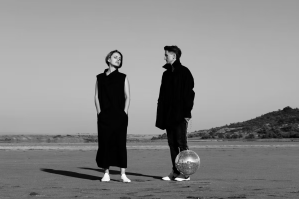 Roksana Smirnova and Misha Kalinin
You have been working together as a Duo for more than ten years, but you came to it from quite different musical backgrounds: Roksana through classical music and jazz, and Misha through jazz, rock, electronics and experimental music. How did each of you arrive at music in the first place, and how has your musical relationship changed over those ten years? Do you still recognise which ideas belong to one of you, or has the duo developed a language that exists somewhere between the two?
Roksana: Music has been part of my life since early childhood and, in a sense, was already woven into my family. My mother and great-aunt played the piano, and my great-grandmother played the violin. I vividly remember my father calling me when I was six and asking, “Would you like to go to music school?” I immediately said yes. It was not a decision my parents made for me—it was my first independent choice connected with music.
That was the beginning of my musical journey: first music school, then jazz piano at a music college in Odesa, followed by classical piano at the conservatory. Both traditions played an essential role in shaping me as a musician. In jazz, I have always been drawn to improvisation, freedom, energy, and groove; in classical music, to the richness of form, refinement, and precision. The combination of these qualities has largely shaped my own musical language.
Over more than ten years, Misha and I have come a very long way creatively. We did come from different musical worlds, but we have always shared a very similar instinctive understanding of music. Of course, we each bring our own ideas, and at first we can usually recognise where a particular idea came from. But once our ideas meet, they stop existing separately and give rise to something else. I think this is how the language of our duo emerged: it draws on different styles and musical traditions, yet ultimately becomes something new that belongs to both of us.
Misha: Yes, our backgrounds are different, although jazz was the common foundation for both of us in the beginning. From there, our paths developed in different directions and we each absorbed very different musical influences. In the end, that diversity has enriched our shared musical language enormously and brought many more colours into it.
Over more than ten years of working together, a language of the duo has formed that now exists in its own right. It continues to transform and evolve, but it definitely has its own recognisable characteristics, colours and ways of interacting that feel specific to us. At this point, what matters most is not where an individual idea originated, but what it becomes inside that shared language.
Silent Dialogues is conceived almost as a life cycle, beginning with “Inmost Dialogues” and “First Light”, passing through “Night”, “Windsong”, “Time” and “Shadows and Light”, and ending with “Memories”. At the same time, improvisation is fundamental to the way you play together. How much of that larger trajectory existed before you began recording, and how do you reconcile a clearly conceived dramatic arc with the unpredictability of improvisation? What also changed when the Laulasmaa String Quartet entered the music for the final three pieces?
Roksana: The music for this album took its final shape during our two-month residency at the Arvo Pärt Centre in Estonia, where we had come specifically to record it. We arrived with a number of musical ideas that still needed to be developed into finished pieces, but as the process unfolded, it became clear what truly belonged on the album, what did not fit within its world, and where entirely new material needed to be created. For example, three pieces: “Time,” “When the War Is Over” and “Memories,” were written entirely during our time there.
The idea of the album as a unified cycle also emerged through the process itself. We did not conceive this dramatic arc in advance—the music gradually began to find its own sequence and reveal the album’s internal logic.
We do not see a carefully shaped dramatic structure and improvisation as opposites. Each composition has its own form and emotional direction, but within that framework we deliberately leave space for improvisation. It brings vitality, spontaneity, and the sense that something is being created in the here and now. In this way, the overall trajectory remains intact, while the music itself stays alive.
Bringing the Laulasmaa String Quartet into the final three pieces significantly expanded the album’s sonic palette. Our musical language remained the same, but the quartet added greater depth, dimension, and new emotional colours. The strings became not simply a background or an additional layer, but another voice in the music dialogue.
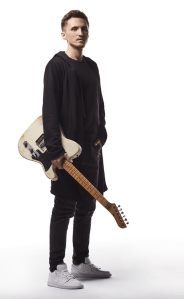
Misha Kalinin
Misha: In earlier years, we tended to work with a larger proportion of written material and perhaps less improvisation. Over time, one of our intentions became to find the right balance between composed music and improvisation – enough structure to shape a piece, but enough openness for every performance to retain flow, freedom and the presence of the actual moment.
The larger dramatic trajectory of the album gave us a frame, while improvisation allowed the music inside that frame to remain alive and unpredictable. For us, these two things are not opposites; they can strengthen each other.
The Laulasmaa String Quartet enriched the sound in exactly the way we had hoped. We have always loved the colour of a string quartet and wanted to bring that dimension into the project. It also helped us expand the palette of the life cycle we were tracing throughout the album. In the final three pieces, the quartet adds another layer of depth, scale and emotional colour, and we are very happy with how naturally it became part of the duo’s sound.
Since the beginning of the full-scale invasion, Ukrainian artists have had to work in circumstances in which their nationality and the war can become almost unavoidable contexts through which their work is perceived. Do you think Ukrainian artists have any responsibility to address what is happening, or should there be complete freedom not to do so? Looking back over the past four and a half years, are there particular works of music, literature, film, visual art or theatre that you feel have captured some aspect of the experience of this war in a significant way?
Roksana: From my own experience, and from what I see in the work of my Ukrainian colleagues, I do not think this is primarily a question of duty or conscious choice. I do not mean that artists have an external obligation to address the war, but rather that it becomes part of their internal creative process.
A musician, artist or writer absorbs the reality around them through their own emotions and experiences, and then reflects it in their work. This is how art comes into being. It is therefore difficult to imagine a Ukrainian artist living through this reality whose work would remain completely untouched by it.
At the same time, everyone expresses this experience differently. We all perceive life in our own way, so the war can appear in art in many forms – sometimes directly and explicitly, and sometimes through atmosphere, imagery or emotional tone.
Over the past four and a half years, an enormous amount of music, literature, film, theatre, visual art and photography has emerged in response to the war. It is genuinely difficult for me to single out particular works, because there are so many of them and each one reflects a different aspect of this experience.
Misha: The war has affected both our lives and our work very deeply. For us personally, it became a responsibility to speak about what was happening and to help bring the reality of the war to people outside Ukraine. At the same time, we were very grateful for every opportunity to represent Ukrainian culture through our duo and through our other creative projects across Europe. One important part of that work has been performing our original scores for Ukrainian silent cinema at film festivals in different countries of the European Union and in the United Kingdom.
I would not single out one particular work created during the war. What has struck me more is what I have seen happening across the work of many of my colleagues. Again and again, people have gone deeper into their artistic language and revealed something new in themselves. The experience of the war has become an extremely powerful catalyst, bringing different colours, greater intensity and another level of depth into their work. In that sense, it has affected cultural figures both inside Ukraine and those now living abroad.
The final section of the album contains “Peace Prelude” and “Postludia When The War Is Over”, titles that inevitably acquire particular weight coming from two Ukrainian musicians during the full-scale invasion. Could you tell us what lies behind these two compositions, and especially the decision to imagine a musical postlude to the war while the war itself is still continuing? Has the meaning of these pieces changed for you since you wrote them?
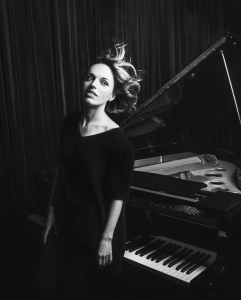
Roksana Smirnova
Roksana: “Peace Prelude” was inspired by the first major winter blackout in Ukraine. I remained in constant contact with my family and was deeply worried about them, because the conditions were extremely difficult. Winter days are very short, and many people were living almost entirely in darkness, without heating or even the ability to cook.
What struck me most, however, was the way people responded to the situation. They did not lose heart or give up. They remained strong and continued to believe in a better future – in the light at the end of this dark tunnel. This is the hope that “Peace Prelude” expresses: hope for light in both the literal and, above all, the metaphorical sense — the belief that light will inevitably follow darkness.
“Postludia When The War Is Over” grew out of an attempt to imagine what we will feel when the war finally ends. What will we feel when the explosions and gunfire fall silent, when we look at our scorched land and realise that it is truly over? Will we celebrate and dance, will we cry, will we begin to reconsider our lives — or will we experience all of these emotions at once?
This postlude is therefore not simply an image of victory or a celebratory finale. It is an attempt to hear, in advance, the silence that will follow the war and to imagine the full complexity of emotions that moment will bring.
Misha: Both pieces are directly connected to the war. ‘Peace Prelude’ was written by Roksana for string orchestra during a very difficult period when Ukraine was experiencing blackouts. The piece reflects a longing for peace and, at the same time, a belief that sooner or later peace will come – a peace that can bring healing, calm and restoration.
“Postludia When The War Is Over” is more contemplative. It imagines the moment after the war has ended. It is almost a narrative from the perspective of an observer who is looking back at everything that has happened – the hardship, the losses, the destruction – from a point at which the war is finally over.
For me, it is a kind of silent contemplation of that experience, but at its centre there is also a deep hope and belief that, with time, wounds can heal.
To imagine such a postlude while the war is still continuing is, in itself, a way of looking beyond the present moment and holding on to the possibility of an ending, of peace and of healing. The titles inevitably acquire even more weight as the war continues, but the essential meaning of these pieces for me remains connected to that hope.
You are both Ukrainian musicians who have spent significant periods living and working elsewhere — including Shanghai and now Berlin. After everything that has happened since 2022, what does being Ukrainian mean to each of you today? Has living outside the country altered your relationship with Ukraine, its culture and your own sense of belonging?
Roksana: I think living abroad has actually made us feel our connection to Ukrainian culture more strongly, especially when we lived in Shanghai. When you live in a very different culture, you begin to feel your own roots much more clearly. A good example is “Whispers” from our first album. The piece has a very clear Ukrainian melodic character, but we did not plan this at all – it appeared naturally and spontaneously. It was interesting to see how our own culture came through in our music while we were living so far away from it.
Of course, living in other countries also brings new colours and influences into our lives and our music. But our own cultural background remains the foundation. Other influences can become part of it, but the feeling of belonging to Ukrainian culture always stays with us.
Misha: Since 2022, my relationship with Ukraine and its culture has become much deeper. The war became a catalyst that pushed us to go further into our own roots and to rediscover Ukrainian culture with even greater attention – its music, its cinema and its broader artistic heritage.
Living outside the country has not weakened that connection. In many ways, it has made me more conscious of it. For me, being Ukrainian today means carrying a much stronger awareness of where I come from, of the culture that formed me, and of the value of those roots. The experience of these years has expanded and deepened that sense of belonging.
If you were asked to assemble a small cultural portrait of Ukraine as it feels to you right now, what would each of you choose as one book, one film, one song, one album, one play, one artwork, one dish, one building, one monument and one meme? They don’t have to be canonical choices: I’m interested in what that particular combination might reveal about the Ukraine you carry with you today.
Roksana: I find it difficult to think in terms of individual books, films or works of art, because any specific choice would feel too limiting. For me, Ukraine is something I experience through its nature, sounds and smells, through the way people speak, and through the taste of its wonderful fruit and vegetables. I grew up by the sea, so my image of Ukraine includes both the sound of the sea and the steppe, as well as the smell of dry grass and sun-warmed earth in summer.
I do not think any single work of art could fully capture this image. So if I were to create a cultural portrait of Ukraine, it would not be a list of ten specific things, but rather a mosaic of sounds, scents, flavours, landscapes and memories.
Misha: It is genuinely difficult for me to reduce Ukraine to one choice in every category. Because we are from Odesa, so many of my strongest associations are naturally connected with the city. Rather than force a list of ten cultural references, I would choose two things that feel immediate and essential to me right now.
The dish would be Ukrainian borshch. The building would be the Odesa Opera House. They are very different symbols, but together they connect something deeply everyday and familiar with the cultural memory and beauty of the city I come from.
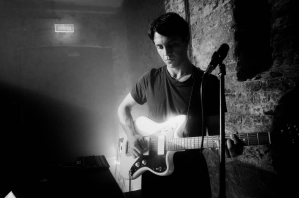
NEW RELEASES
v4w.enko ~ Internal Rhythms
There are constant rhythms and poly-rhythmic structures are used in connection with raw synthesis and harmonic frequencies.
Melodic abstractions, sometimes dramatic, melancholic and often surrealistic meditative and energetic soundscapes are bringing perception to abstract space travel in between of sound compositions
Generative aesthetic to synthesis raw procedural sound lines connected with sound design approach in stitching layers of sound carefully by using attentive state of mind.
Eight compositions are prepared as rare keys to various abstract dimensions to visit them one by one.
58918012 ~ Summer Twenty-six
Hello! Do you know what day it is? It’s my birthday. Today I turn 41. I have no fucking idea how it happened to me. Inside, I feel like I am 25 or 30 at the most. But let’s be honest, who gives a shit? We are all getting old eventually, from the cradle to eternity. I am not sad about it. I’m rather indifferent. Anyway, I have a good tradition — to release a new album on my birthday. So, here we are again!
The only thing I can say about this one is that it’s way lighter, softer, and much more melodic than the previous one. I just took all the things that happened during this summer (not much, to be honest) and packed them into the sound. At the end of the day, all these things will become blurry screenshots in my memory. This is the way to save them. Enjoy.
ХЖВИ ~ Пусть так и будет
ХЖВИ is also the new alias of a kellersynth artist we have covered and interviewed before. On Пусть так и будет, he pushes the bright, accelerated rave language of their previous album Ешки into considerably darker territory. The happy-hardcore and nu-rave rush remains, but the major change is the arrival of the voice: where the previous album was largely instrumental, these six compact tracks are driven by lyrics preoccupied with death, fear, violence, disappearance and the desire to escape or dissolve altogether.
Horizon Resonances ~ Residual Artifacts [TE0267]
Horizon Resonances is back with a gentle, summery, hazy EP. Four spacious tracks of beats and ambient fuzziness.
Alexander Stratonov ~ “Protected from the Homeland” Original Documentary Soundtrack
“Protected from the Homeland” is a deeply personal and haunting score written for Suspilne’s latest investigative documentary. Reflecting the film’s focus on the legal isolation and loss of national identity faced by Ukrainian children within the Italian judicial system, the music carries a distinct European, neoclassical weight. Built as a hybrid mosaic, the score frames these complex emotions by weaving a melancholic chamber string ensemble and intimate solo piano together with heavy orchestral percussion and deep, pulsating electronic basslines. It shifts fluidly between moments of quiet, unresolved tension and sweeping, dramatic climaxes.
Ambiotik ~ Cat Cafe
Cat Cafe is a new full-length album that transforms everyday tranquility into an immersive sonic experience. Inspired by the comforting atmosphere of relaxing time and the purring of a cat where time seems to stand still for calmness and comfort, the record blends ambient, sound-healing, and atmospheric electronic textures into a collection of compositions that invite listeners to pause, breathe, and simply exist in relief.
Evgeny Gromov ~ Valentin Silvestrov. Moments of Silvertones
When Russia’s full-scale invasion forced Valentin Silvestrov to leave Kyiv in 2022 at the age of 85, pianist, researcher and curator Evgeny Gromov felt a new urgency to document the composer’s work. Moments of Silvertones, released through the Kyiv Dispatch label founded that same year, spans Silvestrov’s career from the modernist experiments of the 1960s to the lyrical Moments, Bagatelles and Postludium of later decades. For Gromov, the project also addresses a significant gap: much of Silvestrov’s piano music exists in scores but lacks an established performance tradition. “If this is not played now, systematically, insistently,” he argues, “it will remain absent.”
The two discs trace a profound shift in Silvestrov’s musical language while revealing continuities beneath it. Early pieces such as Five Pieces, Triad, Elegy and Piano Sonata No. 2 move through astringent modernism, unstable harmonies, extended techniques and sudden eruptions of colour, while already displaying the attention to microstructure that Gromov hears in the later works. The second disc turns towards Silvestrov’s ideas of “meta-music”, postlude and memory: spare, lyrical pieces shaped by resonance, decay and silence rather than conventional development. Heard against the circumstances of war, their apparent simplicity acquires particular force. As Gromov puts it, music becomes “a space of attention, of concentration, even of consolation”.
Kotra ~ Rust
Torn spider under the fried dome,
Melting his wires into the voice coil.
The intent and the meaning,
Raw forces, twin states.
Peshka ~ Fatebreak / Raw Void
While I’m trying to figure out how to fill a God-sized hole in my soul, I decided to release a few more tracks from a past version of myself.
Alla Zagaykevych ~ Vyshyvanyi
“Kyiv. Summer. War. War, war – endless war. Glissando of sirens tearing the air. They are the loudest now. Unless the great Lavra bell is louder than them. Every morning at nine o’clock it fills the city with its powerful, pure voice like the sea. But the sirens return. Insidiously. At night and during the day. In the morning at dawn. The cruel, unnatural sound of war arrhythmia.
I can tell the story of our time with lines from the opera “Vyshyvanyi”, with the lyrics of its heroes. “This war has been going on for too long to only think about it” – sings the Girl in a duet with Vyshyvanyi… “we must build while there is still a chance… especially since who knows how long this war will last” – and these are the nervous answers of Colonel Bolbochan.
While working on the opera “in pre-war times” (the opera was written in 2019 and staged in October 2021 at the Kharkiv Opera Theater), I was, of course, exclusively concerned with artistic challenges. How to convey the special nerve of Serhiy Zhadan’s poetry through “operatic” means? How to combine the “hero’s expression” with almost adolescent naked sensuality in the part of Vyshyvanyi? How to build a musical dramaturgy around mainly of wartime events… After all, all the events in the opera are somehow connected with the war – the Great (First World War), the liberation struggles of Ukraine for independence. Even the most tender scene with cadets from the youth of Wilhelm von Habsburg is a metaphorical “premonition” of war – the expectations of a cold and terrible winter. After all, how to convey the feeling of a layered consciousness, the “fragility of reality” in the opera, because the main character constantly travels between worlds in his delusions during interrogations in the Lukyanivka prison…
The musical language of the opera is consciously saturated with elements of the “fragile” aesthetics initiated by Berg and Schoenberg. A variety of vocal forms, including combinations of modern academic extended techniques and folk vocals, a wide palette of orchestral sonoristic means, including spectral techniques, and finally electroacoustic sounds and electronic processing of the orchestra and voices in real time, are components that ensured the continuous “variability” of the musical language, the rapid change of the opera’s tebro-texture.
“About war”, about struggle, about love, beauty, about our dreams, our no less complex and fragile reality, I seem to continue to speak in the language of “Vyshyvanyi”… Among the sirens. In a half-sleep. Therefore – loudly. Therefore – tenderly.”
– Alla Zagaykevych, Kyiv, 2026
Mootney ~ What Happened To The Music
David Mootney, hailing from the outskirts of Ukraine’s capital, has always sought to blur the boundaries between genres, bringing a rebellious spirit and an uncompromising philosophy to his craft. The aesthetics of the “dirty Kyiv electro” tradition have remained a defining thread throughout his work. But the only constant is change, and the music evolves alongside us.
What Happened To The Music? is both a personal reflection and a question directed outward. Where do we go from here? How do we confront the consequences of endless consumption?
Expanding on ideas introduced in his previous Mystictrax release, Mootney takes a radically different approach. Instead of aiming to overwhelm or shock, he chooses subtlety, drawing the listener in rather than demanding attention. Built around extensive vinyl sampling, the EP blends euphoric, mystical and faintly delirious melodies with fractured electro rhythms.
Across three original tracks, Mootney explores the outer edges of electro, while a heavyweight remix from PROGRAMM_LDN co-founder D3U5E adds an extra dose of raw energy to close the release.
Piriinka ~ Помітки
Помітки is a mini-album of seven notes in which I searched for the diversity of life through music for five years. Here I leave intersections from dreamy to painful questions related to self-knowledge and growing up.
Tetiana Khoroshun ~ Yalos
Yalos—γιαλος, meaning “shore” in Greek—is a collection of electroacoustic works by Tetiana Khoroshun that explores Ukraine’s landscapes in relation to water.
The journey begins with the Chongar salt flats and the piece *Crimean Titan*—a 2018 recording of crossing the illegal border with Crimea, combined with a chance audio recording, which together form a performative, documentary noise piece.
The journey continues with the piece *Madrigal*—an octaphonic ensemble ritual marking the return of the Sukha Moskovka River to its natural course, navigating the vast scale of the sound processes at the Zaporizhstal plant and entering into a complex relationship of coexistence, resistance, and memory with the industrial landscape.
The third part—LJ—immerses the listener in the waters of the Black Sea. Here, the sea appears not as a backdrop or a symbol of tranquility, but as a living and dangerous force capable of simultaneously holding, moving, and destroying: “Just like in …, basically, if you don’t know how to swim, it can simply destroy you—it’ll just grab you and throw you against the seabed, because not everyone knows how to swim there…”
Khladna Landscape ~ Lichtgestalten
A cathartic sound as a manifestation of infinity. This single is about neutrality, about perceiving the world and experience as it is. Waves of shimmering words, memories, everything that has shaped the human experience over millennia. All of this is one vast vortex, penetrating the very depths of humanity, which ultimately is humanity. This single is about the I-am, about the state of not being, of existing only as a manifestation.
Regina Collage ~ Horizont
Ukrainian artist Regina Collage’s new album ‘Horizont’ is a personal and honest document of rebuilding a life and creative voice in Bristol. The record holds space for themes of burnout, quiet shame, tenderness and the courage of staying emotionally open when the world feels unstable.
Feeling carries the songs forward. Across bedroom recordings and borrowed studios, Regina moves between cloudy dissonance and stark minimal arrangements built around bass, fragments of guitar, and an exposed voice.
The album takes its name from the Ukrainian word for “horizon,” that unreachable line where sky meets earth. For Regina, the horizon became a quiet metaphor for living with distance and uncertainty. Inspired by one of her collage artworks showing a figure lying in grass and staring toward that far line, the title track reflects a feeling of moving toward something that never quite comes closer.
“It is important for me to speak about Ukraine and remind people that the war has not ended,” Regina says. “Some of my friends are fighting and some are still making music. They were musicians before the invasion and everything changed for them. My hometown Kharkiv is under constant attack. My parents are there. Even if it is not always in the news, it is happening every day. I also want to represent our underground music culture. I love the music from Ukraine and the people making it.”
ROSS KHMIL ~ KAILAS SUNRISE
live recorded outsider power trance music
originaly released as a mix for examine-archive platform
Sasha Chemerov & Hidden Element ~ Все Це Колись Мине [All This Will Pass Someday]
The release becomes a quintessential reflection of contemporary surrealism, where uplifting, life-affirming music collides with stark social realist poetry, creating a powerful contrast between hope and the reality of the present.
In addition to the original version, the release also includes an instrumental version and a live recording from Hidden Element’s performance at Brave!Factory Festival 2026.
Various Artists 1 ~ The Freya Files
A Darkwave Compilation in Support of Ukraine
She rides into battle cloaked in dusk and gold.
The Freya Files (and its brother release The Odin Files) was never meant to be an easy release. As part of a 37-track project, the compilation faced legal obstacles, political pressure we never expected to encounter in 2026, failed hard drives, lost files, production delays, and repeated setbacks that threatened to stop it from ever reaching the public.
It survived because the reason behind it mattered more to us than the obstacles.
Rooted in the darkwave, electro, EBM, and industrial underground, The Freya Files brings together female artists whose music moves between beauty and defiance, grief and determination, restraint and force. Each track stands on its own, but every contribution serves the same purpose: supporting Ukraine in its fight for sovereignty, dignity, and survival.
The release became a testament to resilience. Every recovered recording, rebuilt session, resolved dispute, and refusal to give in became part of its history.
Freya, goddess of war and love and chooser of the fallen, represents those who carry sorrow without allowing it to silence them. These artists transform that sorrow into sound: fierce, radiant, synthetic, and unbroken.
Proceeds will support humanitarian and frontline aid efforts in Ukraine.
🜁 For the mourners.
🜂 For the mothers.
🜃 For those who dance among the ruins
an honest fox ~ The Weight Of Empty Cities Part III: Horizon
Volodymyr Tkachov ~ Soundscapes
“Soundscapes” Part 1-5 were recorded at home studio in 2001.Equipment used for recording is
– Jolana Special (electric guitar)
– kids toys
– MD-57 microphone
– Vega 122c tape recorder
– bathroom sink, shower and some bathroom accesories.
Note on the hidden part of the cassette booklet says
“To my patient family”
Cryptic Chorus ~ And the wheels of war keep creaking
This album was recorded in the pauses between combat missions in a real war. That’s why it took so long to record. This album is somewhat different from my previous works — on it, I tried to express more of my emotions and personal experiences. I hope you enjoy it.
corn wave ~ elephant entertainment
Reissue of the 2023 release with updated cover art and bonus tracks.
Decorodi ~ Topography
Ніщо ~ Каркоза [СТУС-079]
The second album by the band ніщо [nіshcho / nothing], which, as it unfolds, tells the story of a man who is given a second chance at life after committing suicide. He tries to readjust to the realities of the modern world. His attempts prove futile, and in his isolation he gradually loses his mind, becoming convinced that all the horrors of the world around him are manifestations of an emerging new world order. He calls it Каркоза [Carcosa].
In the end, his delusions turn out to be real…
Neroba ~ Pechersk
Neroba is not a person. Neroba is the name left behind after the person disappears. People in Ukraine say, “This one is a Neroba,” or “This was done by Neroba” — нероба, literally a slacker, a lazy man. Nobody remembers meeting him.
Some say he was responsible for early LAN fileshares in Obolon that no longer exist. Others say Neroba is a local demon inhabiting underpasses, relay cabinets and service corridors beneath the city.
Our protagonist, Neroba, was part of Da Sintezatoros!, a duo from the young Kyiv electronic scene of the 90s and among the first groups to introduce experimental techno in independent Ukraine. Later, producing music for TV ads and commercial jingles, and tracks for Ukrainian pop and independent artists, Neroba slowly accumulated a catalogue of works where his name wasn’t prominent.
The music on this album was created in his bedroom studio between 2010 and 2020. A blend of boogie, funk, house and disco – 12-bit drums programmed on his beloved Casio RZ-1, alongside the usual suspects: a Roland JV-1080 and a Yamaha DX7, a couple of drum machines and a cheap early-90s Boss SE-50 stereo effects unit. Neroba’s small synth sanctuary translated the mood of the city at a specific hour.
The artist currently lives in Kyiv. We are happy to present his debut solo work. This album is by Neroba.
Motorpig ~ We Inherited the Ruins
We Inherited the Ruins
Things are made slowly.
Wood is polished.
Surfaces are worn down.
Instructions become meaningless.
The archive burns.
Somewhere beneath it all, the machinery continues to hum.
A study in repetition, friction, manual labor, and whatever remains after progress has left the room.
Oleksii Podat ~ We Were Born To Feel Everything
A long-form composition knitting sundry paraphernalia of intimate value into a tēla that feels as recognisable as it is unhinged — akin to the stroke of a reliable brush tilting just enough to unveil the mesh of the fabric, only to skid into another aberrant tangle.
Doctor Bugg ~ REM
REM – Rapid Eye Movement – is the phase of sleep during which a person dreams. In this state, reality feels fluid, surreal, and dissociated. Doctor Bugg explores REM through fragmented memories, a sense of lost time, and liminality.
REM focuses on the instrumental canvas. The composition features percussive electronic sounds and jagged, disorienting textures that intertwine with guitar and processed saxophone recordings. With this release, the artist changes course, moving away from a focus on lyrics. Genre spectrum: industrial electronics, experimental hip hop, spoken word, and improvisation.
“Listening is a very personal experience. It’s best to listen to this music without worrying about how it might be perceived by someone else” – prescribes Doctor Bugg.
Alex Malch ~ In a Landscape
5 years ago, in 2021, Alex started writing this album and after multiple unsuccessful attempts to record it I have finally finished the project
This album has everything he wanted and needed to say, musically and lyrically, and he don’t intend to release any more solo music.
Vøvk, КАТ ~ Split (Live @ Druk, Kharkiv, 17.05.2026)
This live split captures our joint performance by Vøvk and KAT, recorded live on May 17, 2026, at a show in Kharkiv organized by the KAZKA Family community. The release features four tracks: Vøvk presents ‘Sil’ and ‘Leleka’ from last year’s album ‘Litera’, while KAT contributes ‘Lyst’ and ‘Bez Pravyl’ – the latter recorded in Ukrainian for the very first time. For KAT, the evening was particularly meaningful, marking their first live performance in their hometown of Kharkiv in three years.
“For years, we wanted to organize a show together with KAT, but for various reasons, it just never happened. When this spontaneous gig in Kharkiv came up, we decided to make the absolute most of it. The idea for the release came together quickly: we felt we had to capture this special day and time together. Especially in one of our absolute favorite cities.”
— Vøvk
We are releasing this split as a Bandcamp exclusive, available solely for streaming and purchase on the platform. All proceeds from sales will go directly to the ongoing fundraiser by the KAZKA Family community, supporting those who make events like this possible in the first place.
“We always love playing alongside our friends in Vøvk, and this show happened completely spontaneously. Even though it was our first time performing in three years, we jumped at the opportunity to capture May ’26 in Kharkiv with this short live split. We want more than just dark memories to remain from these times; we want Kharkiv to stay alive and thriving. Intimate initiatives like this – which was Vøvk’s idea – are simply priceless.”
— KAT
Serhii Litinskyi ~ Fernstimmen
The musical practice common in the time of Ockeghem and Josquin has disappeared from our present-day musical protocols, in which the listener’s customary connection to music is organized linearly. This is symmetrical to the way in which music, in turn, connects to the listener. Today, it is difficult even to perceive the difference between these two connections, but once there was an enormous distance between them.
A singer taking part in the performance of a Josquin Mass presupposed a trajectory of sound that did not lead to the listener, because the figure of the listener did not exist in the church in the first place. Even when members of the congregation were present at the service, the singers were either isolated from them or turned away from them; combined with the church’s powerful reverberant acoustics, this effectively deprived the congregation of the possibility of perceiving the music. If we set aside the liturgical function and the metaphysical dimension of the process, and consider instead the physical and physiological dimension of musical practice, music here returned to itself, existing in a reflexive loop. The sound produced by the singer returned to the singer and shaped a state in which he could produce sound that was even more effective at producing the state in which effective sound could be produced. The circular trajectory of the music enclosed and isolated the musical material. When we encounter Josquin’s music, we immediately register the autonomy and coherence of its sonic construction. In terms of expression, it is alien to the kind of expressivity we habitually describe as a reliance on an outward effect.
When we listen to Josquin’s music today, we connect to it asymmetrically. The singers’ voices always seem to come, so to speak, from afar; they do not address us directly. We always listen from the side, in a sense eavesdropping, witnessing the circular trajectory of the music and the effect that sound, through the singer’s body, has upon itself.
In working on this piece, I sought to reproduce this ancient circular trajectory of sound. This also determined the insufficiency, and ultimately the inadequacy, of a linear algorithm in which the score is realized in a single act: a direct performance, fixed in a recording and aimed at the listener. I needed to submit to the effect of the sound and, in turn, affect it under the influence of that effect. Having accepted these rules, in the course of realizing the piece in sound I substantially altered and supplemented the performance of the original score with sounds of different origins. In other words, I intervened in its realization by virtually every means through which a composer can directly influence the sonic result—from field recordings to sound samples, to the creation of autonomous musical structures and events within this new sonic environment. These almost always conceal the initial material, making it nearly indistinguishable within the texture of the final sound. Nevertheless, it was precisely this initial impulse, at the origin of the circular trajectory, that determined the character and rhythm in which the spiral of this music unfolds.
I am sincerely grateful to all the musicians through whom Fernstimmen—“distant voices”—have come closer.
DJ POPS ~ между частотами
The label ERYTHROLEUKOPLAKIA out of Kyiv presents itself in a raw, punky style, but this second album from associate DJ Pops is altogether more considered and delicate than you might be expecting. It’s another one with IDM/braindance irregularity at its core, but it’s definitely got more emphasis on the “dance” side of the equation; so no matter how lopsided the grooves might get, they nonetheless are grooves, and hold the attention and the body locked in. It also, however abstract it gets, feels weirdly un-digital—like constructions of wood, string, rusty metal, tape, and glue, sometimes with little creatures running around inside them. [Bandcamp Daily]
MIXES
VIEWING ROOM
(Gianmarco Del Re)

