
 Childhood summers spent in Val D’Arzino made an undeniable impression on Davide Cedolin. The artist describes Friuli in northeast Italy as “Mountain people, feral animals, ancient trees, old crafts, lore, abandoned crashed cars, ghost towns, houses named as boroughs.” On Cjera Aʃìn, the artist performs a feat of alchemy by translating the memory, feeling and sound of the land into a luscious suite. The field recordings are crucial, plunging one into the heart of the remote area; the music fleshes out the narrative.
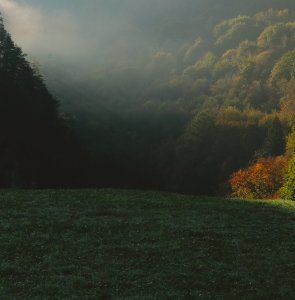
At the very beginning of “Cedolins,” the cricket chorus declares its presence, making Cedolin the accompanist. His guitar work rests in the American Primitive style, warm and wooded, like a hike toward the shady glade portrayed on the cover. As the notes drop down, they do not intimidate; their function is to produce mystery rather than fear. The crickets continue to chirp at the end; this is their territory after all. “Poças,” the first of three long tracks, ups the ante with guest performances on hardy gurdy, shruti box, percussion and double bass. This time the first impression is created by soft rain and the call of a local bird; the piece develops into a thick drone, a mossy blanket of mood, the earth is sending notes through the loam. The players pull back to reveal Cedolin’s banjo, the rain still falling like the accumulation of years, reappearing in the next track with a slightly different timbre, like the memory of a different summer. This time cello colors the mist of memory, producing a wistful, melancholic tone.
At some point we hear – or have already heard without recognizing – the artist playing “woods and bones.” The land creates its own music; Cedolin draws from its treasures to make more. The taps in “Cerdevol” could be bones; or the tapping of stones by the creek. The flow receives a generous allotment of time at the end, setting up the crackle of “Benaandants,” an extended work filled with accordion, synth and fire. Val D’Arzino is woven into the artist’s story as the artist’s story is woven into the woods. Echoes and reverberations populate the background of “Cjanâl,” but to the woods, the guitar is the more temporary sound.
Warm, gentle narration introduces the final track, which at 12:18 is also the longest. Layer after layer rise to the surface, the artist exposing different facets to the light. In the sixth minute there arrives a softening, with leafy rustles, a slower pace and light percussion that swiftly dissipates to allow the notes to take center stage. The impression is like the region seen from afar, regarded in memory rather than in person, the scratching like notes on paper. In the tenth minute, the music disappears, leaving only scribbles of sound. One cannot pinpoint exactly when the album ends, just as one cannot trace the extent to which a memory can linger in the mind. (Richard Allen)


Pingback: Recent Reviews from A Closer Listen – Avant Music News