
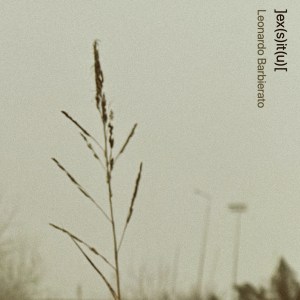
The title gives it away. ]ex(s)it(u)[ is a “concept album.” The cover photograph might initially suggest a bucolic collection of field recordings, but Leonardo Barbierato has other ideas. Birdsong is indeed one of the first sounds we hear, accompanied by delicate guitar plucking and live processing. From the outset, the surrounding environment enters into the performance alongside instrumental gestures, electronics and the acoustic properties of each location.
Each of the seven Patchwork pieces functions as an individual study within a larger trajectory. Their subtitles — “margine” [margin], “l’ora di punta” [peak hour], “la mania del controllo” [control freakery], “frammenti di frizione eco-tonale” [fragments of ecotonal friction], “infestazione” [infestation], “condizionamento” [conditioning] and “hauntology” — provide a loose conceptual map. As Barbierato explains in the accompanying interview, the recordings grew out of five years of site-specific performances, with the characteristics of each location feeding directly into the music. The album only came into focus retrospectively, when excerpts from those performances were edited into a coherent sequence.
Throughout ]ex(s)it(u)[, electronics, acoustic gestures and environmental recordings continually interact, their respective roles shifting from one piece to the next. Barbierato calls this condition “eco-tonality”, describing the intertwining of ecosystemic and performative sounds and the fluid identities that result.
“l’ora di punta” allows guitar melodies to emerge from and disappear back into circuitry; “la mania del controllo” frustrates attempts to impose stable order through heightened sound levels; “frammenti di frizione eco-tonale” places different sonic ecologies within a rarefied environment; while the textures of “infestazione” proliferate across the acoustic field. The extended “condizionamento” reintroduces birdsong, which grows increasingly synthetic before giving way to a slow accumulation of density and abrasion and a roughening of texture. “hauntology” turns towards the residue left by sound, retrieving voices that seem to belong to another timeframe.
For all the variety of its source material, ]ex(s)it(u)[ holds together remarkably well. Guitar, electronics, birds, voices, resonance and the acoustics of individual sites move in and out of focus across the seven pieces. Barbierato’s “eco-tonality” ultimately describes something quite practical here: a way of performing in which the sounds already present in a place can alter the direction of the music as it happens.
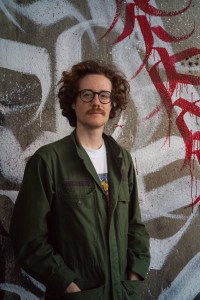
photo by Devadatta “Sk!” Valmiki, 2025
To help us piece things together, we reached out directly to Leonardo Barbierato.
Throughout ]ex(s)it(u)[, the seven Patchwork pieces seem to form a conceptual progression: from “margine”, where different sonic worlds first come into contact, through “l’ora di punta”, “la mania del controllo”, “frammenti di frizione eco-tonale”, “infestazione” and “condizionamento”, before arriving at “hauntology”, where what remains is no longer the sound itself but its residue in memory.
Were these seven pieces conceived as successive stages of a single compositional journey, or did that overarching narrative emerge only retrospectively? At what point did you realise they belonged together as one work rather than as independent electroacoustic studies?
The seven pieces belong to a single performative and compositional process that unfolded over the course of five years. At the beginning, I was interested in exploring the ecosystems in which I performed through improvisation. This led me to develop a series of site-specific performances entitled [in situ], where the aim was to engage with the place to the point that it could actively shape the performance itself, avoiding to treat the place as a backdrop.
Initially, I had no intention of releasing this material. In a sense, doing so seemed to contradict the very idea of site-specificity on which [in situ] was based. Those performances were conceived as experiences in which listening was inseparable from the materiality of the place: its light, its physical presence, and the network of relationships and perceptions that define a particular environment.
However, when I listened back to the recordings, I realised that publishing selected excerpts could open up another layer of meaning. I became interested both in the sonic interactions that had emerged during the performances and in the idea that these recordings would be heard in places completely different from those in which they were created. I was curious about how this displacement might reshape the listening experience.
So, to answer your question more directly: although all seven pieces originate from the same artistic process, the overall narrative of ]ex(s)it(u)[ only emerged retrospectively, during the editing and listening phase. It was then that I recognised the trajectory connecting the excerpts, a trajectory that, to some extent, also follows the chronology of the original performances.
Your background combines jazz improvisation with artistic research in ecology, and your current doctoral work explores the relationship between improvisation and cultural and environmental ecology. Listening to ]ex(s)it(u)[, I was struck by how the field recordings — birdsong, environmental ambiences and site-specific sounds — never function simply as documentary material. They seem to interact with instrumental and electronic sounds until their identities become almost indistinguishable.
How do you approach this dialogue between recorded environments and composed material? Are you trying to preserve the identity of a place, or are you more interested in allowing those places to be transformed through the compositional process?
While working on my PhD at the Conservatory of Rome, which I recently completed, I became increasingly aware of how environmental sounds and what we conventionally call “musical” sounds gradually overlapped and entered into dialogue. Interestingly, this was also something noticed by people attending the performances. In my research, I describe this quality as eco-tonality: a condition in which ecosystemic and performative elements become intertwined.
In most of the pieces on ]ex(s)it(u)[, the environmental sounds are not field recordings added afterwards. They are the actual sounds that were present during the performances and were processed in real time through an electroacoustic setup. Only in a couple of pieces (“frammenti di frizione eco-tonale” and “hauntology”) I used dedicated field recordings, which were nevertheless recorded in the same environments where the performances took place.
My intention was to place all these elements into dialogue without establishing a clear hierarchy between them. Ultimately, the project has both an ecological and a political dimension. It seeks to encourage a more attentive mode of listening and a deeper engagement with the ecosystems we inhabit. I believe that composition can function as a device that subtly transforms the way we perceive and experience the places we live in. In that sense, I am less interested in preserving the “identity” of a place than in exploring its transformative potential through listening.
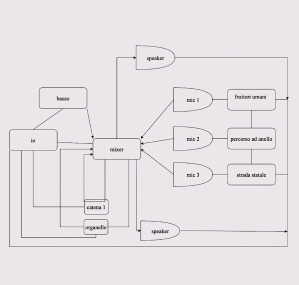 One of the most remarkable aspects of the album is its treatment of listening itself. By the time “condizionamento” unfolds, the music seems to have subtly altered the listener’s expectations: instead of following individual events, one begins listening to relationships, resonances and the spaces between sounds.
Was this gradual transformation of perception something you consciously composed? More broadly, do you think of ]ex(s)it(u)[ as a work that conditions the listener’s way of hearing as much as it presents a sequence of sounds?
I’m really pleased to read your observation, because it touches on something that was central to the project. Yes, the gradual transformation of perception you describe is something I consciously sought during the performances over the years, and later tried to recreate through the selection, editing and sequencing of the material that became ]ex(s)it(u)[.
As I mentioned earlier, the album aims to influence the way we listen. This intention is rooted in the belief that aesthetics, ethics and politics are deeply interconnected. I believe that changing the way we listen can also open up different ways of thinking, relating to others and inhabiting the environments around us. However, I don’t think there is a “correct” way of listening or a predetermined ethical outcome. What interests me is the possibility that listening differently may enable each person to inhabit and relate to the world in their own way, according to their
experiences, memories and ways of making sense of them.
In times of social and ecological crisis, I believe that the possibility of listening and acting differently can become particularly meaningful. For me, this is where the political dimension of the work lies: in creating the conditions for a different mode of attention. Whether that change lasts for a few minutes or extends beyond the listening experience is, of course, something each listener will discover in their own way.
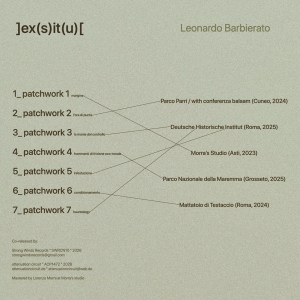 The album artwork quietly maps the Patchwork pieces onto a series of specific locations — from Morra’s Studio in Asti to the Parco Nazionale della Maremma, the Mattatoio di Testaccio and other sites — suggesting that geography itself forms part of the composition. Combined with the recurring use of field recordings, this gives the impression that ]ex(s)it(u)[ is almost a cartography of listening rather than simply an electroacoustic album.
How important was the notion of site in shaping the project? Do you see these places as sources of sound, as collaborators in the creative process, or as traces that continue to resonate long after the recordings themselves have been transformed?
At the beginning of the project, I spent a long time questioning what it means to act in a site-specific way and, more fundamentally, what a place actually is. Each piece on ]ex(s)it(u)[ is an excerpt from a specific performance of [in situ], connected to a specific location. The geography of these places is mapped in the artwork, allowing the listener to associate each track with its original context while listening. I really enjoy the expression “cartography of listening” that you used, as it captures an important aspect of the project.
Throughout this process, I always tried to avoid treating places as soundscapes from which to extract material to manipulate freely. When I used field recordings, they emerged from encounters with the ecosystems themselves: for example, through conversations and interviews with the communities I encountered in different locations, who often pointed me towards sounds, events or relationships that were meaningful to them.
In most cases, however, these sounds emerged directly during the performances: the movements of participants, objects being touched or activated, birdsong, cicadas, wind, my playing and all the other sonic events that became part of the situation. This is central to my understanding of site-specific practice: a place is an entanglement of personal, human and other-than-human stories, relationships and forms of agency that actively shape the compositional and performative process.
For me, a place is a kind of patchwork, where each patch (each element that contributes to its identity) follows its own trajectory and interacts with others, sometimes in harmony, sometimes in conflict, and sometimes with indifference. Through this work, I try to make these relationships perceptible on a sonic level and to reflect on them actively. In this sense, the place collaborates with and co-produces ]ex(s)it(u)[. It remains beyond the production of the work itself, continuing to resonate and transform through each new listening experience.
(Gianmarco Del Re)


Pingback: Recent Reviews from A Closer Listen – Avant Music News