
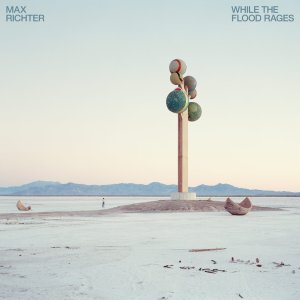
 While the Flood Rages is Max Richter‘s third collaboration with choreographer Wayne McGregor, following Infra and Woolf Works. Commissioned by the National Ballet of Canada and the Royal Opera House and inspired by Margaret Atwood’s acclaimed MaddAddam trilogy, the new album is intended not as a score but an homage, tackling the trilogy’s grand themes through a different artistic lens.
As befits the trilogy, the album unfolds in three movements, each occupying one side of vinyl; the fourth is reserved for an etching. While it’s tempting to match them up with Oryx & Crake, The Year of the Flood and MaddAddam, it’s better to allow the music to flow, wordplay intended.
Perhaps the most important thing non-readers should know is that the books describe a waterless flood. The flood is used as a metaphor for an apocalypse of corporate greed, ecological collapse and plague, leading to the rise of a new form of bioengineered life. Presciently, both the album and the trilogy were developed pre-COVID. Fittingly, the album begins with a pulse that is comprised of the processed sound of water. “Wave After Wave” is clearly manipulated, the natural shaped to meet the needs of the machine. The orchestra creates a stunning contrast that lengthens and deepens over the course of the album. The “their” in “Their Eerie Music” refers to internal technological systems, obscure and unnerving sounds brought to light. While the piece begins with the same wave as the first, it heads in a different direction, plunging into a morass of glitch recalling of a bank of dial-up tones.
The title track introduces a warm piano melody, which serves as an anchor for the soul. Different piano melodies emerge in the subsequent pieces and recur throughout the album: in the novels a memory, in the music a recalibration. The early frigidity, pulsating center and growing tension of the industrial “The City Was a Chaos” are the first signs that something is very amiss; the threat is no longer looming, but here. Even so, the vibraphone attempts to be a stabilizing force. The wind-filled “Sensorium” sounds like a cloud of ghosts, leading to “Quiet,” a rest stop along the way.
By the second movement, the apocalypse has already taken place, but at least the bees are all right, based on the buzz of “Ask the Bees.” Their reassuring drone is countered by the violence of “Data Ballistics,” constructed from the sound of gunfire. With little left, humans continue to fight rather than to band together. As the sound of what seems like a single bee is reduced to an ominous loop, one worries about the hive. A mid-piece acceleration fuels the album’s most percussive sequence, raising questions of desensitization; at the ground level, losses devastate, while to the wealthy they are only numbers. Richter invites a choir to enter as the percussion recedes: a holy reminder of what has been lost and may yet be regained. As disjointed radio transmissions join the fray, they draw a pleasant line way back to Pink Floyd’s The Wall. The piano melody of “Quiet” returns like a lullaby, a possible nod to Richter’s own Sleep. Then in “Amniotic,” humans seem to sing the part formerly occupied by the bees, reflecting the bio-engineering of Atwood’s trilogy.
Just as MaddAddam ties all the threads together, so does the closing movement of While the Flood Rages. “Dawn” includes both orchestral and electronic elements, a synthesis. The harp, brass and bells finally wrestle control, implying a breakthrough soon underlined by the re-entry of the choir. “Now We Can Sing,” the album’s finale and first single, closes the set in tranquility and hope. Here Richter diverges from Atwood, whose ending is more fragile: a hint of transformation in the wake of dual sorrow. This bold move underlines the fact that While the Flood Rises is Richter’s singular vision: a standalone work with its own take on humanity and its prospects. While Atwood uses words, Richter proves himself to be a storyteller through sound. (Richard Allen)

