
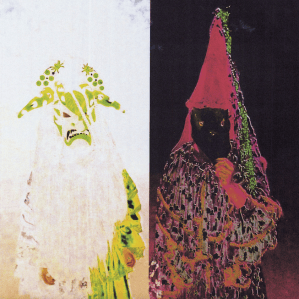
Cicatrizes do Futuro droops in an ecstasy of fear, but Deafkids turn that fear into propulsion. From the glitching opening of “Parasita”, the album accelerates and scarcely lets up, sweeping everything in its passage. Its sonic terrain is studded with peaks and corroded by rhythmic mountain streams: a rocky coast of disjointed percussion, indented and broken up like naked reefs. There are few tempered acclivities here. D-beat, 808s, acid bass, distorted guitars and Afro-Latin rhythmic structures collide in successive chains, creating something tumultuous yet fiercely controlled.
The record’s morphogeny is rhythmic. Percussion doesn’t sit beneath the other instruments so much as spread through them: guitar becomes impact and abrasion, electronics splinter into pulses, bass supplies both weight and momentum. Guaguancó and other diasporic rhythmic forms intersect with punk until distinguishing one vocabulary from another becomes increasingly beside the point. The music forms a current of propulsive force breaking through its strata, dense and feverish but continually opening new fissures in the surface.
Vocals surface intermittently from this turbulence, distorted and frequently carrying images of colonialism, genocide, poisoned air, blood and psychological manipulation. The accompanying visual language is similarly apocalyptic: Horror, Pain, Fear, Guilt; Brainwashing; Drug Wars; “What is reality?”; “I see Genocide”; “I feel poison in the air.” Frantz Fanon’s description of colonialism turning towards the past of the oppressed to distort, disfigure and destroy it provides a key to the record’s conception of time. The scars in Cicatrizes do Futuro belong neither securely to history nor to some hypothetical tomorrow. Past violence, present technologies of control and future catastrophe seem compressed into the same moment.
Yet the music refuses despair’s inertia. Its bleakness is inseparable from an almost unparalleled exuberance. The body is continually implicated: rhythms collide, accumulate and circle until repetition shades into trance. Deafkids make the dance floor feel simultaneously like a site of contamination and a possible means of purging it. The distinction between collective delirium and collective release remains deliberately undefined.
This tension exercises an irresistible pull through the closing “Possessão Coletiva” and “Em Transe”. The titles suggest possession followed by altered consciousness, but offer no certainty as to who controls either state. By then the album has become a harshly stereographed landscape of rigid folds, ruptured strata and broad plains of rhythm, with scarcely a depressed thalweg in which its momentum can drain away. Tumultuous, corroded and feverishly physical, Cicatrizes do Futuro maps a sonic backland in which the fault lines of colonial history continue to deform the future.
 To discuss the punk ethos behind the album, we reach reached out directly to Deafkids.
Cicatrizes do Futuro presents a striking paradox: the subject matter is bleak—a society poisoned by manufactured realities, political violence and collective delusion—yet the record is intensely physical and often exhilarating to dance to. You describe movement as a form of “mental cleansing.”
Do you see trance and bodily exhaustion as ways of breaking through the psychological mechanisms of control that the album is addressing?
Mariano: For sure! It’s not that dancing and bodily movement is intrinsically revolutionary – it too can be coopted as part of a broader reactionary project. The thing is that the separation between mind and body is something that prevents us from connecting to each other, and from feeling the fevers we need to channel in order to burn the apathy that prevents real change.
The comprehension that our body is our mind is vice-versa is central for many cosmovisions that we feel connected to, and that is reflected on the ethos of our music.
On “Cicatrizes”, D-beat, 808s, acid bass and distorted guitars are driven by percussion based on the Afro-Cuban guaguancó rhythm. Throughout the album, punk and electronic music seem increasingly inseparable from Afro-Latin rhythmic traditions rather than simply layered on top of them.
How did you arrive at this rhythmic vocabulary, and has working with these traditions changed your understanding of what punk can be from a Brazilian and Latin American perspective?
Mariano: The album is completely punctuated by those claves and resources, not only from Afro-Latin sounds, but diasporic music writ large. We have been deeply immersed on these forms of music for more than 10 years now, listening to percussive and psychedelic sounds from all over the world. I think the fact that we both play percussion, and that we see all the other instruments as percussive tools first, combined with the daring spirit that punk imbued on us, of rearranging, recombining and reclaiming forms of music that we both understand to be relative to each other.
In that sense, D-Beat is a groove, a rhythimc foundation to be expanded upon, just as much as Guaguancós, Mozambiques, Guajeos and Tumbaos. Creating music like that means combining the challenging spirit of punk to the feverish, entrancing loops of “traditional” music. Punk is not only an ethos, a doctrine you use to organize your approach, but also something to have its aesthetic tenets shuffled around and rewritten. Understanding that our existence as third world, post colonial experience can’t be expressed in just three or fours timbres and sonic textures is what created that hybrid feeling of what this updated conception of punk is to us.
The title Cicatrizes do Futuro—”Scars of the Future”—suggests something more unsettling than scars inherited from the past: that the violence taking place now is already inscribed into a future that hasn’t happened yet. At the same time, you describe a “brutally stolen past” reflected in that future.
How do you understand the relationship between historical memory, the present political moment and this idea of a future that has already been wounded?
Mariano: The idea of the title is twofold – We are referring both to the scars that are yet to come, the scars that are yet to carve our collective flesh, and also to the scars that the future as a concept have created. As we depend more on technology, its control is concentrated in less and less hands.
Speaking from our corner of existence, I think the colonial reality is one of reiterating perpetuity. Technology and the its manufactured dependency have now eroded the public debate, while demanding us all to engage with to advertise or publicize any and everything, from ideas, concepts, art, even one’s subjectivity. We essentially became our own products, content to conform while selling ‘individuality’. Those media cannons were able to shrink the size and variety of media diet, and its owners have their own agendas and hunger for data and control.
In that sense, the alliances and agreements are always in favour of strengthening the power of old forms of domination. We see a rise in disinformation and the extreme-right in general. We see generative AI removing the last shreds of dignity from creatives, pushing human creativity aside while feeding on the history of our race and its achievements…
The future is being destroyed by the forces that claim to be building it, and more than ever tomorrow sounds like a distorted yesterday.
The sequence of titles—”Parasita”, “Cicatrizes”, “Profecia”, “Simulacro”, “Advertência”, “Reflexo”, “Feitiço”, “Possessão Coletiva”, “Em Transe”—almost reads as a progression from infection and false reality towards ritual, possession and finally trance.
Was the album conceived as a narrative journey, and should we understand the closing “Em Transe” as an escape from the “great delirium” described earlier in the record, or as another, potentially more liberating form of altered consciousness?
Mariano: This was the first record where, even if it’s all connected through this thematic thread, we didn’t think on a specific cohesive narrative, from beginning to end. The songs all deal with those very same themes, but it’s nice that you saw a greater strucure like that, as that would be very fitting to the idea of what we’re doing. Maybe it’s about the battle on how we can try to influence such collective possession in order to generate a more propositive trance. In that sense the album would have two possible conclusions – a more favorable and hopeful ending, and a way more somber one.
(Gianmarco Del Re)

