
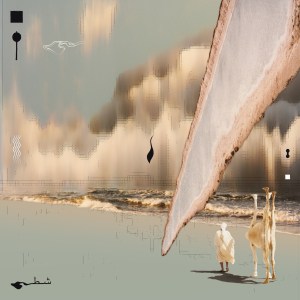
Artwork by Marie Brosius
Deeply rooted in place rather than merely referencing it, Chott, the latest work from Taroug, seems to emerge directly from the landscape. Named after the vast salt lake of Chott El Djerid in southern Tunisia, the record unfolds as both a return and a reconstruction—memory filtered through distance, then reassembled through sound.
The opening track, “Wehmut,” sets the tone with a quiet, suspended melancholy. The title itself—combining Weh (pain) and Mut (courage)—encapsulates the album’s central tension: longing for something already lost, yet facing forward nonetheless—“I wish the days were longer.” From here, the record moves like a mind rifling through fragments, honing in on the mundane. Images surface and dissolve: “the scent of jasmine,” “rows of plastic chairs,” “we play hide and seek between the laundry on the lines,” “blue squares filled with beaming faces.” Memory itself becomes elusive, flickering like faded photographs, their colours slowly disintegrating in the light.
This instability is mirrored in the music. Rhythms push forward even as textures seem to erode at their edges, as though the act of remembering is inseparable from the act of losing. Nowhere is this more apparent than in “1995,” where childhood recollections blur into something more ambiguous—innocence edged with unease, familiarity tinged with distortion. What begins as recollection becomes reconstruction: a filling in of gaps, of unwritten diaries, of moments slipping away.
Elsewhere, Taroug translates landscape into sensation rather than description. “Saraab”—the Arabic word for mirage—moves with a heavy, almost exhausted pulse, evoking not the image of the desert but the physical strain of moving through it. The track advances slowly, burdened, as if each beat carries weight. By contrast, “Sirocco” feels internalised: a push-and-pull motion, centripetal and centrifugal forces locked in tension, the repetition of its vocal fragments mimicking breath under pressure. These are not soundscapes in the traditional sense; they are environments inhabited from within.
The interplay between organic and electronic elements is central to this effect. Taroug’s background as a drummer is evident in the physicality of the rhythms—percussive, tactile, grounded—yet these are continually reshaped through synthesis and processing. On “Nakhla,” the movement of palm trees is transformed into cyclical patterns where natural and mechanical gestures converge, as the liner notes indicate. Across the album, sound behaves like matter: it bends, decays, corrodes. Even warmth carries a trace of abrasion, as if time itself were audible.
At its core, Chott is held together by two emotional pillars: composition and memory. The latter is most powerfully expressed through the inclusion of family voices. On the title track, Taroug’s father reads an original Arabic poem, anchoring the album in a lineage that feels both intimate and expansive. Elsewhere, voice memos and recollections—particularly those tied to his aunt and grandmother—extend this sense of continuity. These are not decorative gestures; they function as connective tissue, binding personal history to sonic form.
The album’s structure reflects this dual movement between past and present. It drifts between contraction and expansion—between the inward pull of memory and the outward push of abstraction. Some tracks feel almost centripetal, drawing everything toward a dense emotional core, while others open outward, dissolving into space. This dynamic gives the record a subtle physicality, as if it were governed by unseen forces.
The closing title track, “Chott,” arrives not as resolution but as release. After the friction and instability that precede it, the music settles into something more serene—an acceptance rather than a conclusion. The sense is not of having arrived somewhere new, but of recognising something that was always there: a continuity beneath fragmentation, a quiet affirmation of the persistance of consciousness and recollection.
If Taroug’s earlier work often felt like a search—an exploration of systems, patterns, and possibilities—Chott marks a shift toward something more grounded, more cohesive. It is less concerned with discovery than with understanding. The result is an album that does not simply revisit the past, but reshapes it—allowing memory, landscape, and identity to coexist in a state of constant, delicate transformation.
What lingers is not a single image or idea, but a sensation: of heat, of distance, of something just out of reach. Like a mirage, it disappears as you approach it—yet remains, unmistakably, real.
To find out more about the production process I spoke directly to Taroug.
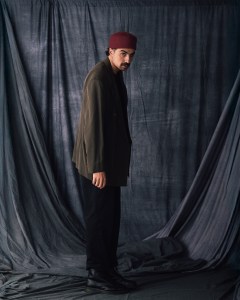
Photo by Jacek M. Wesolowski
Chott feels like a return to your roots—both personal and geographical. What led you to explore your Tunisian background more directly on this album?
When I came of legal age, I was advised to be careful about traveling to Tunisia because of my dual citizenship and the possibility of compulsory military service. So for a long time, there was a certain distance.
I finally visited Tunisia and my family again in 2022. I was 33 at the time and that trip really shifted something in me. It made me want to explore that part of my identity more consciously.
You can already hear fragments of that journey on my previous album Darts & Kites, but when I started working on Chott, it unfolded much more naturally. After sketching a few half-finished ideas, I realized this was becoming the core of the whole project, so I decided to fully dedicate the album to my roots.
The whole process turned into a form of self-therapy and became a way of reconnecting and understanding where I come from.
You translate landscapes—heat, wind, mirage—into sound across tracks like “Saraab” and “Sirocco.” How do you approach turning physical environments into musical textures?
I usually love working with field recordings — for me, it’s one of the most powerful tools to bring a sense of place, environment, and emotion into a track. It creates a kind of physical space and something familiar around the music.
Interestingly, with these tracks, that feeling emerged without using any field recordings in that way. With Saraab, I had this very clear image in mind: an exhausted caravan of dromedaries moving slowly through the heat, with that shimmering mirage in the distance. I wanted to translate that sense of weight, slowness, and almost physical exhaustion into the music. When I first played it to a few people, their immediate reaction was that it could fit into the soundtrack of Dune, which I found quite interesting.
“Sirocco”, on the other hand, feels much more internal. It’s less about a concrete image and more about a sensation. Something that pulls and pushes at the same time, like heat that almost feels alive. The repetition in the lyrics reflects that: a constant movement, almost like breathing. It’s not so much describing a landscape, but being inside it.
On pieces like “1995” and the title track, you incorporate family voices and memories. How did working with such intimate material shape the emotional core of the record?
There are basically two pillars that give the album its emotional depth. On one side the composition and sound design, on the other side the use of very personal fragments. When I work on something this personal it felt important to preserve certain memories, moments and voices.
With “1995” it was more about bringing back childhood memories. Kind of filling in these missing diary entries I never wrote. Memories start to blur when getting older and I just wanted to hold onto some of it before it disappears.
On the title track “Chott” you hear my father reading a poem. I really wanted his voice on the record. And I think for him too, that recording session was something special.
On “Najet” you hear voice memos from my aunt Najet, singing this old lullaby from my grandmother. For me it wasn’t even only about the memory itself, but more about how the raw intensity and energy of the track reminded me of the impact she had on me when I was younger. That’s also why I named the track after her — it just felt right, like the music already had her in it somehow.
There’s a strong interplay between organic and electronic elements—cicadas, palm trees, voice, and synthesis. What draws you to transforming natural sound into rhythm and structure?
I grew up playing drums, and there’s something very primitive and direct about hitting something and making it resonate. It’s much more tangible than anything happening inside a computer.
Of course I also use digital tools, but it’s always been important to me that the music feels organic, imperfect, alive. I record a lot of random things with a field recorder, and I just enjoy taking those sounds and shaping them into something musical. I like the idea of building rhythms out of organic textures to create something that maybe feels familiar, but at the same time a bit hard to place. I also prefer working with analog synths and actually performing parts, instead of drawing perfect automation curves.
Compared to your earlier work, Chott feels more personal and grounded. Do you see it as a shift in your practice, or part of a longer evolution?
I’ve definitely grown over the past few years. My skills in production, mixing and songwriting have improved. My earlier work was often a collection of tracks from different phases, sometimes spread out over years. With Chott, I really took a few months to fully focus on the writing process and dive into it. I think you can hear that it’s much more cohesive.
Back then I was still searching a lot more. Now I feel like I have a clearer idea of what I want to express and how I want to present myself. So I’d say it’s a natural progression, but who knows how I’ll feel about it in five years…
(Gianmarco Del Re)


Pingback: A Closer Listen Reviews – Avant Music News