
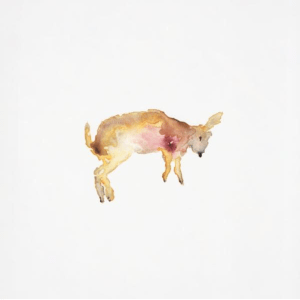
artwork by Ali Cherri
There is a quiet contradiction at the heart of May a soft sun bless your sky while you wait for the inevitable, the latest work by Charbel Haber. It is an album that breathes in softness while exhaling inevitability—holding beauty and catastrophe in the same fragile space without attempting to reconcile them.
Recorded in Paris, mixed in Beirut with Fadi Tabbal, and mastered in Montreal by Harris Newman, the record is shaped by a geography of distance. But rather than sounding fragmented, it feels refracted—like the same emotional material viewed from multiple coordinates. The album emerges from a very precise psychological condition: displacement.
Structurally, the record unfolds as a temporal loop. It opens with “This show starts in the future” and closes with “This show ends in the past,” collapsing linear time into something recursive and unstable. The result is an album that feels perpetually in-between: not beginning, not ending, but circling.
This circularity is mirrored in the sound. The compositions are built from long-form loops that evolve gradually, hovering around six minutes, where change is subtle but constant. These are not static drones; they are living textures, shifting in density and tone, always on the verge of dissolution. In “I stutter when I speak of love and death,” the sonic field trembles, as if sound itself were failing under the weight of what it tries to articulate. Elsewhere, shorter pieces like “Phosphorus resting by the entrance of a quantic maze” and “The unfortunate meeting of an accident and the goddess of time on a dissecting table” introduce ominous ruptures.
Haber’s titles function as parallel texts—allusive fragments of a script that never fully reveals its narrative. Each title opens a space rather than describing it, interfering with the music instead of explaining it. The listener is left navigating between language and sound, where meaning flickers but never settles.
The album’s sonic architecture is deeply tied to its conceptual concerns. Loops evolve like consciousness itself—constantly updating, feeding back into their own transformations. Death is not treated as an event but as a horizon: something that shapes the trajectory of the sound without ever fully arriving. This gives the music its peculiar tension—slow, restrained, yet always moving toward an unseen endpoint.
Visually, the album is anchored by a watercolor of a shot hare by Ali Cherri. Like the music, the image exists in a suspended state: soft in execution, violent in implication. It captures something essential about the record’s emotional landscape—a world where tenderness does not negate violence, but exists alongside it.
To find out more I have spoken to Charbel Haber via email.
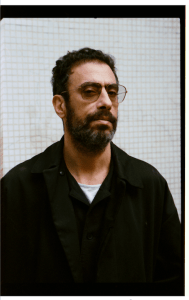
photo by Yasmina Hilal
Your new album May a soft sun bless your sky while you wait for the inevitable was recorded in Paris but mixed in Beirut and mastered in Montreal. How did this transnational production process shape the sound and feel of the record? Did working between places influence your sense of space or distance within the music?
The record really emerged from that very specific moment of displacement described there—walking through Paris in 2025, carrying Beirut with me, but also trying to create a necessary distance from it. What struck me was this strange coexistence: the city appearing almost idyllic, luminous, while the awareness of war and destruction remained constant, unresolved.
That’s where the title comes from—May a soft sun bless your sky while you wait for the inevitable. It’s not ironic, but it is contradictory. The “soft sun” is real—it’s the light in Paris, the sensation of walking, of perceiving beauty—but it exists alongside an inevitability that is equally real: death, collapse, even something as extreme as nuclear annihilation. The transnational process—Paris, then working with Fadi Tabbal in Beirut, then Montreal with Harris Newman—extended that feeling. Each place reframed the same material differently, like observing the same system from different coordinates. The music became a space where these contradictions could remain unresolved, coexisting.
The album unfolds like a kind of temporal loop—beginning with “This show starts in the future” and ending with “This show ends in the past.” How did you think about time as a structural or conceptual element while composing the record?
The album’s temporal structure is directly tied to that sense of inevitability. If you’re “waiting” for something like death—or even a larger-scale end—then in a way, it’s already present. The future is folded into the present.
Beginning with “This show starts in the future” and ending with “This show ends in the past” reflects this collapse. I was thinking of time less as a line and more as a recursive loop, or even a feedback system that continuously rewrites itself. But unlike a clean loop, this one degrades—it accumulates noise, like memory does.
There’s also something theatrical about it, which connects to the idea in the text of the world as a “living theater.” The album unfolds like a performance that is already aware of its ending, death is not the final act—it’s embedded in every scene.
You’ve long had a penchant for extended, narrative titles—almost like fragments of prose or poetry. What role do titles play in your work? Do they precede the music, emerge alongside it, or act as a parallel layer of meaning?
The titles function almost like fragments of a script within that theater. They carry a narrative charge, but they don’t resolve into a story. Instead, they open spaces—emotional, conceptual, sometimes even contradictory.
They’re very close to language like Rilke’s—“Let everything happen to you: beauty and terror.” That line was important for me while making the record. The titles operate in that space between beauty and terror, between intimacy and abstraction. They often feel like something you would say to yourself quietly, while being aware of something much larger unfolding beyond you.
So they don’t describe the music—they interfere with it, or reframe it. They create a feedback loop between language and sound, where each alters the perception of the other.
In fact in almost every record of mine there’s a track with a title from or inspired by a writer I admire, in the case of “It Ended Up Being A Great Day Mr Allende”, my solo on Al Maslakh, all four track titles are from Bolaño. In Of Palm Trees And Decomposition it’s the first track, also Bolaño. In A Common Misunderstanding Of The Speed Of Light, well it’s Pedro Páramo a tribute to Juan Rulfo. In May A Soft Sun its track number 4, “Across A Flower Bed Dressed In Sunday Best, Lay The Bodies Of Docile Beasts” a tribute to W.G. Sebald. Finally, the title for track 6 [of the new album] is a reference to Isidore Ducasse’s Les Chants De Maldoror.
Even though the album was recorded in early 2025, many of the titles feel uncannily resonant with the present moment. Do you see your work as responding to specific events, or are you trying to tap into something more cyclical or universal?
Even if the record wasn’t conceived as a direct response to specific events, it’s impossible to separate it from the current geopolitical condition. Especially coming from Lebanon, where cycles of violence and collapse are part of lived reality, there’s a heightened awareness of how fragile systems are.
What interests me is how this awareness becomes normalized—how you continue to live, to perceive beauty, even as destruction feels inevitable. That’s where the “softness” in the record comes from. It’s not escapism—it’s a form of survival.
The titles might feel prophetic or resonant now, but I think that’s because they tap into recurring structures—collapse, repetition, waiting. These are not new conditions; they’re cyclical. The difference now is perhaps the scale, and the growing sense that the endpoint is not abstract anymore.
Sonically, the record leans into ambient and drone territories, but there’s also a strong sense of tension beneath the surface. The tone is mournful and elegiac at the same time and feels liminal. How do you approach building these slow-moving structures—what guides decisions around density, duration, and restraint?
Sonically, I approached the record as a field of slow transformations. The loops I use don’t just repeat—they evolve over time, and their transformations guide almost every compositional decision: density, duration, and restraint emerge from how they behave. The layers build into these almost orchestral textures, but they’re always on the verge of dissolving, never fixed, always impermanent.
There’s a parallel here with theories of consciousness, where perception functions as a continuous feedback loop—constantly updating. Death enters this system not as an event, but as a horizon shaping the music. Everything moves toward it subtly, imperceptibly, and the loops carry that inevitability through each layer.
On this album, you worked again with Fadi Tabbal, an old time collaborator, on the mix. What does that collaboration bring to your music, and how much of the final shape of the record is determined during mixing rather than composition?
Working with Fadi Tabbal is essential because the mix becomes another stage of composition. It’s where the material is re-heard, reconfigured.
There’s a kind of trust there that allows the music to transform. Elements are brought forward or pushed into the background. It’s almost like observing the same organism under different conditions.
In this record, the mixing stage helped articulate that sense of fragility—the balance between presence and disappearance. It’s where the music becomes most aware of its own impermanence.
The artwork—a watercolour of a shot hare—is striking and unsettling. What drew you to that image, and how does it relate to the emotional or conceptual landscape of the album?
The artwork is a watercolor by Ali Cherri, with whom I work closely. During the making of this record, we were in constant dialogue, and I think his practice began to bleed into mine in a very natural way.
Ali’s work often deals with bodies, ruins, and violence. The shot hare reflects that: it’s not just an image of death, but of a suspended state, something caught between presence and disappearance. The softness of the watercolor contrasts with the violence of the subject, which felt very aligned with the album’s title and its tension between tenderness and inevitability.
That way of thinking—of layering, of revealing traces rather than constructing narratives—influenced how I approached the music. The image and the sound exist in the same space: both holding onto something that is already gone, but not entirely absent.
Across your work—whether in music, text, or visual media—there’s a recurring engagement with decay, temporality, and fragmentation. Do you see these as aesthetic concerns, or as reflections of lived experience? On this topic, I was also struck by your reference to Pedro Páramo in A Common Misunderstanding of the Speed of Light with its constant transition between realms/dimensions that encompass a nonlinear chronology.
The themes of decay, fragmentation, and nonlinear time are deeply rooted in lived experience, but they also resonate with broader ideas—philosophical, literary, even scientific.
The reference to Pedro Páramo is important because it presents a world where the dead are not separate from the living, where time is porous. That feels very close to how memory operates, especially in Lebanon, where histories overlap and never fully resolve.
At the same time, there’s an affinity with certain scientific models—where reality is not linear, but composed of overlapping states, like in quantum theory. I’m not applying these ideas directly, but they echo the way I experience time and memory—as something recursive, constantly feeding back into itself.
Death, in that sense, is not an endpoint but a transformation within that system.
In 2025 you collaborated with Sary Moussa and Nicolas Jaar on Crashing waves dance to the rhythm set by the broadcast journalist revealing the tragedies of the day. How did that collaboration differ from your solo practice?
Working with Sary Moussa and Nicolas Jaar introduced a different dynamic—less introspective, more relational.
Collaboration creates interference. Each person brings their own internal logic, and the process becomes about how these logics intersect or disrupt each other. It’s less controlled, more unpredictable.
That unpredictability can be very generative. It produces structures that feel more alive, more open. In contrast, my solo work tends to be more closed, more recursive—like a system folding in on itself.
You’ve contributed to the Land fundraising compilations supporting displaced communities in Lebanon. How do you see the role of such collective projects in moments of crisis, especially coming so soon after the latest round of bombings and when the international attention is divided on several different fronts?
Projects like “Land” feel especially important in moments where destruction is both immediate and diffuse. They create a space for collective attention, for shared presence.
In a context where narratives are constantly fragmented or erased, these compilations act as a form of memory. They don’t resolve anything, but they insist on continuity—they keep certain realities visible, even if only temporarily.
There’s also something about collectivity that counters the isolation implied in the title—the idea of waiting alone. These projects create a sense of being together in that waiting.
Lebanon has a strong musical diaspora, and you’re now based in Paris. How do you see the relationship between artists working abroad and those still on the ground? Is there a shared space, or does distance create a different kind of perspective?
Living in Paris while remaining connected to Lebanon creates a kind of double perception. You’re physically removed, but emotionally and historically still entangled.
Paris allowed me to experience a certain softness—to walk, to observe, to let the music emerge in a different way. But that softness is always layered over something else. It’s never neutral.
The diaspora becomes a network of these layered experiences—different distances from the same realities. That distance doesn’t erase anything; it reframes it.
In moments like this, what role can music and sound play for you? Do you see it more as documentation, solidarity, resistance—or something else entirely?
For me, engaging in the practice music and sound is a way of holding contradictions without resolving them. It can contain beauty and terror at the same time, like in the Rilke quote.
It’s documentation, a kind of resonance rather than a statement.
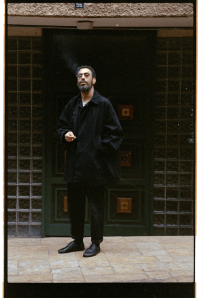
photo by Yasmina Hilal
Looking back at projects like A Common Misunderstanding of the Speed of Light, where text, image, and sound intertwine, do you feel your practice is moving further toward multimedia forms, or returning to something more reduced and purely sonic?
The movement between sound, text, and image reflects the complexity of these concerns. None of these elements are sufficient on their own.
My practice always centers on sound, but it sometimes moves fluidly between text, image, and sound, depending on what the work calls for. For me, these other elements aren’t separate—they’re part of the same conversation, ways of exploring ideas that can’t be fully expressed in one medium alone.
Even when I focus on sound, the music carries traces of text and image within it, and when I incorporate them more directly, it’s never about shifting focus—it’s about expanding the space in which the sound lives. The process is personal and intuitive: I follow where the material leads, but sound remains my anchor, the element I return to again and again. (Gianmarco Del Re)


Pingback: A Closer Listen Reviews – Avant Music News
Pingback: Press Review // Charbel Haber // May a soft sun bless your sky while you wait for the inevitable – Ruptured Music