
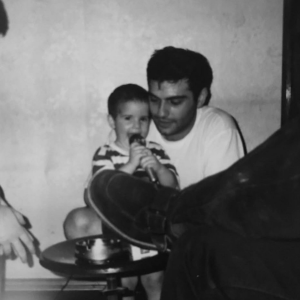
Cover image is my memento [still a mic-yapper but with bangs] back when i had lice and they called me Casper the Friendly Ghost
From the opening stretch, the record establishes its language: fragmented, luminous, and faintly disorienting. Tracks like “Endless Redirections” and “Deja Vu Dust” drift through recursive loops of memory, while “Entering Denied Memories” suggests a subconscious archive that refuses to stay buried. FH HF doesn’t treat memory as something to preserve or mourn, but as a continuous process—something to revisit, stretch, and move beyond. “To me, the past and memories aren’t something to hold onto,” she explained to me over an email exchange, “nor something to accept as gone. It’s more about continuity—revisiting, exploring what has outgrown itself, and how it moves beyond.”
This sense of motion—of becoming rather than being—runs throughout the album. Even its most conceptually striking moments feel transient. “QuickSilver Explosion: Born Of Implosion” frames growth as something that begins in darkness, echoing the image of a seed buried before it can emerge. Elsewhere, “Slurping Bytes” delicately balances noise and ambient textures, while “Between_Tabs” leans into glitch aesthetics, evoking circuitry unraveling in real time. These are not just sonic gestures but states of mind: unstable systems mirroring internal turbulence.
Yet Rewind never collapses into heaviness. There’s a surprising playfulness in how it approaches hardware—its sounds shimmer, flicker, and occasionally feel almost mischievous. Tracks like “Jump In My DeLorean” and “Grandpa Had A Niva And Lots Of Jazz” introduce flashes of humor and nostalgia, grounding the album’s more abstract tendencies in lived texture and a strong sense of narrative. The latter track, in particular, is a touching portrait of her grandfather, acknowledging human flaws and vulnerabilities. Even at its most fragmented, the record feels tactile, almost handmade.
At the heart of Rewind lies a compelling tension between machine and tenderness. FH HF speaks of “injecting tenderness into malfunctioning systems,” not as an act of control but as a form of coexistence. The machines here are not tools to be mastered; they are interlocutors. “They answer back,” she says, offering impulses that shape her understanding of both sound and self. What emerges is not dominance but intimacy—a dialogue between human instinct and synthetic response.
This dialogue reaches its most explicit form in the two “Spoken Word [Live Cut]” pieces, which act as philosophical anchors within the album’s otherwise abstract terrain. Here, FH HF articulates an ongoing struggle: how to hold onto softness in a world that feels increasingly harsh, how to “slay the dragons” without hardening into armor. It’s an existential inquiry, but one grounded in material practice—the shaping of noise, the modulation of energy, the search for balance between extremes. “How is it possible to hold on to the light when the world feels like terror and rising shadows, but without going blind?” FH HF asks.
Compared to her earlier work, Rewind is undeniably more exposed. Where I Saw His Plane Taking Off To The Clouds moved with a kind of ambient cohesion, this album embraces fragmentation as a method. It feels, as FH HF describes it, like “stretching the body awake after a deep, heavy slumber”—a reorientation rather than a conclusion. There’s also a subtle but persistent pull toward her homeland, Georgia, not as a fixed identity but as an emotional undercurrent: restless, eclectic, alive.
Ultimately, Rewind is less concerned with answers than with processes. It’s an album about searching—through memory, through sound, through the porous boundary between human and machine. It doesn’t resolve its tensions; it inhabits them. And in doing so, it opens up a space where fragmentation becomes a form of clarity, and where even the most unstable systems can carry a quiet, persistent warmth.
“Still, there is so much underneath, and I keep mining,” FH HF says. Since putting Rewind out, she has released a short EP, Hey, Can I Pick Your Ears?, described in her own words as a “pocket-sized diary: on weekdays, when I come home from work, I go directly to my computer and improvise. These are brief memoirs I’ve picked—gratitude for those moments, without post-processing.”
In this brief work, FH HF continues her dialogue with machines, as the track “What My Screen Is Looking At” exemplifies. The tendency to treat the computer as a sentient being—one to converse with in daily exchanges—produces quiet moments of reflection. This playful interaction allows the incidental to emerge, giving permission for shapes to evolve freely before dissipating into thin air. (Gianmarco Del Re)


Pingback: A Closer Listen Reviews – Avant Music News