
 The fourth iteration of the If Strangers project continues to refine a methodology that has, since its inception during pandemic lockdown pedagogy at the CES school in Tbilisi, treated collaboration less as dialogue than as circulation. Tracks are not so much co-authored as passed along, accumulating residues of decision-making — gestures layered, eroded, reconfigured. If earlier releases such as Dust (2020) and No Signal (2022) foregrounded the conditions of their making — remote exchange, imposed collectivity — Kookooland feels more assured in its internal logic: a system now self-generating.
Curated by Nika Machaidze (Nikakoi) and Natalie Beridze, the collective here expands to eleven contributors drawn from across Georgia’s electronic and experimental scenes. The premise remains deceptively simple: unlikely pairings, short timeframes, distributed authorship. Yet the resulting 21-track sequence resists the fragmentation such constraints might imply. Instead, Kookooland unfolds as a porous continuum, where distinctions between ambient, downtempo, and fractured electronics dissolve into a mutable, often unstable sonic field.
Beridze’s presence is gravitational, though never dominant. On “Foam Whisper” (with Solo Tsitsuashvili), her interest in expansive ambient forms surfaces in slowly dilating textures, where harmonic drift is punctuated by granular interruptions. Elsewhere, in “Faces” (with Spilled Ambiences), the atmosphere thickens into something more ominous: low-frequency undulations suggest distant mechanical hums, with post-industrial echoes piercing through the distilled ambience.
If Strangers’ structuring principle — the constant reconfiguration of authorship — finds one of its clearest articulations in tracks such as the Georgian-titled “ღვარად ჩამოედინა, დანაწევრიანდა და სამუდამოდ გარდაიქმნა” [“It flowed down, disintegrated, and was transformed forever”] by Eld Less / Fotgjengeren. Here, process becomes audible: the track seems to collapse and reassemble in real time, moving from fluid, almost aqueous synthesis into jagged segmentation, as if mirroring its own title.
Across the record, Spilled Ambiences’ textural sensibility — “shaping emotion with machines” — recurs as connective tissue. Their contributions tend toward dense, asynthetic surfaces, often anchoring more volatile elements. By contrast, Sadrah’s bass-oriented approach introduces weight and propulsion, most notably on “Elements”, where sub-frequencies operate less as rhythmic foundation than as a destabilising force. Rasseterya (Sandro Chirgadze) contributes a complementary palette: rhythmic fragments hovering between dub-inflected repetition and more erratic, noise-adjacent articulation, as heard on “Boiler Fluid” (with Natalie Beridze) and “Renne Froid” (with Nikakoi) — a symphony of crackle and crinkle lifted by light piano notes.
Vocals, when they appear, are rarely foregrounded. On “Humming Bomb” (Lilé / Mariam Galogre), the lyrics — “Humming bird dance with me / through the skies of mist and light / humming bird play with me / in the quiet of the night” — subvert the track’s title. The voice drifts through reverb before gradually dissolving into rustling digital textures, while a vintage piano introduces a faint hauntological trace. Elsewhere, voices are absorbed into the mix, treated as malleable sonic material rather than carriers of narrative. The cumulative effect is one of de-centred subjectivity: no single voice claims authority in favour of collective agency.
This relinquishing of authorship — with no dominant perspective yet allowing each artist’s singular voice to emerge — is central to the album’s coherence. The spectrum of approaches is wide, from the hip hop-inflected take of Denivarlevy to the ethereal vocal presence of Mariam Galogre, and the analog sensibility of Fotgjengeren (Christopher Manning), yet the sequencing allows for fluid transitions between these registers. The result is an album that moves unpredictably, full of subtle shifts and unexpected turns, without ever losing its sense of continuity.
There is also a persistent playfulness, signalled in track titles such as “The Wizard Who Melts Everything” (Nikakoi / Spilled Ambiences) or “Saturn’s Shepherd Moons Draw Their Lines” (Solo Tsitsuashvili / Fotgjengeren). Yet this is not whimsy in any straightforward sense. Rather, it reflects a compositional openness, a willingness to let tracks move through states without resolution. Pieces such as “Abandoned” (Fotgjengeren / Denivarlevy) or “Lost It All” (Mariam Galogre / Fotgjengeren) are notably concise, almost sketch-like, while others extend beyond six minutes, favouring slow accretion over linear development.
What distinguishes Kookooland from its predecessors is the sense that the collective has moved beyond the initial pedagogical framework that birthed it. The CES Studio ethos — collaboration as education, constraint as catalyst — remains implicit, but here it is subsumed into a more fluid artistic identity. The album does not present itself as a document of process, even though process remains its defining condition; instead, it proposes distributed authorship as an aesthetic in its own right.
If the “whole is greater than the sum of its parts”, as the liner notes suggest, it is because the parts themselves remain transient and fluid. Kookooland operates in a state of ongoing transformation relying on a temporary convergence of trajectories held together by the coherence of shared intent.
Kookooland is realeased on CES Records. To give more context I am including a preaviously unpublished interview with CES founder sTia which was conducted in person in Tbilisi in August 2025.
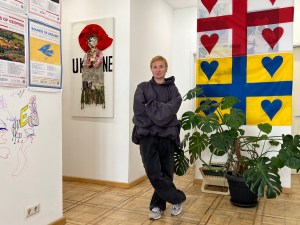
sTia in the CES school entrance
Could you start by introducing yourself?
I am Natia Sartania, although everyone calls me sTia or Nastia. sTia is my artist name, and Nastia was my DJ name, so sTia comes from Nastia. I am a musician. I started my music career as a pianist when I was five years old. Then I changed my profile a number of times, but always within music.
First I was working in radio presenting, then I was DJing at the end of the 90s in Georgia. I think I was one of the first female DJs at the time. I am also the founder of CES (Creative Education Studio), which is an electronic music school—we’ve been running it for 14 years now. I am also the founder of CES Records, inspired by the school. It is a platform for our students and teachers, so it is strictly about Georgian music, at least for now. And I am also a co-founder of Georgian Legacy Collection, a vinyl-only music label.
Could you describe this place?
We are at CES. This is my office, which turns into a classroom after hours, because most of our students want to study in the evenings, so we mostly have evening classes—that’s why I said after hours. I work here, I compose here, I do all the label stuff here. Basically, this is my office, but we also use it as a classroom.
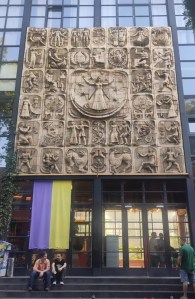
Fabrika
Could you also describe Fabrika?
Of course. CES has been part of Fabrika from day one. Fabrika unites lots of Georgian startups. You will notice many studios in the courtyard—the vinyl shop, ceramics, Georgian fashion designers, lots of cafés, and the hostel, of course.
We are on the left bank of Tbilisi. I know this is your first time in the city, but if you had come 10 years ago, you would have left without even visiting the left bank. I think since Fabrika, the left bank has changed so much. There were almost no cafés or places to hang out, but since Fabrika was established, it became the heart of Tbilisi, I think.
Did this place start off as a squat before becoming what it is?
No, it is privately owned. This is a Soviet building—it used to be a sewing factory. I think they only did women’s wear at the time. I think it closed down around the 1970s or even the 80s. Then it was privatized. I mean, the government wouldn’t give you anything anyway. This is private property, and everything here is business-oriented.
Normally these kinds of places start off as squats before being institutionalized.
Not in Tbilisi. First there was a concept of Fabrika, a vision. My husband is one of the founders, so I know a lot about the place and how it was created. First there was an idea of what Fabrika needed to be like, then they found the space and the investor. So there was a business plan from the start, and everyone—from the president of Fabrika—was hand-picked.
So is there a committee who decides the kind of business that can move in?
It’s just the founders. They are very nice people (laughs).
Let’s talk about the school—what prompted you to open CES?
I lived in London for 16 years. I went to the conservatory there—Trinity College of Music. I was very good at what I was doing. Being a pianist, I took part in competitions and was quite successful. But after I had my first son, I realized I could not handle sitting at the piano for eight hours a day—it just wasn’t for me.
At the same time, I was very interested in different kinds of music, and I started playing with my computer and composing when my son was asleep. It became clear that I wanted to create music in a very different style and with a very different workflow—something I knew nothing about at the time. We are talking about the early 2000s.
When I came back to Georgia in 2004, I already had some music and was commissioned to do a gig in a nightclub. I wanted to have a string quartet, piano, MC, and electronic sound—a full performance. Because I was very fresh in Georgia after 16 years, I went to one of the classical schools to help me with this gig.
In London, we had message boards at the conservatory—if you needed a string quartet or someone to write scores, it was easy to find people the same day. I thought it would be similar here.
In the end, I found an amazing quartet, but for example, I couldn’t find anyone to make scores from my program, because they were instrumentalists. So I ended up doing everything myself—making scores, acting as a music engineer—and the result was not something I was fully happy with.
But everyone was very impressed, because this kind of combination—electronics with a string quartet—was not happening in Tbilisi at the time. That’s when I realized we were very undereducated in that sense. There was a huge gap between academic musicians with formal training and my friends who had been creating music since the 90s without knowing how to read music.
So it was really badly needed for the city.
So it was really vital…
Yes. When we started 14 years ago, our very first course was sound engineering. We also had graphic design, music production, and a DJ course. Many people who came were 40+, already in the industry, but with gaps in their knowledge because they had never been taught—we were all self-taught, because there was no place like this before.
CES became really popular straight away, and lots of people came. Thanks to those first 15 students who trusted us, we are now a big music community, 14 years later.
I don’t know if the situation is similar or comparable to what happened in Ukraine… Do you have any relationship with the conservatoire here in Georgia?
Yes, it was actually two years after that they opened the department of New Music Technology, as I believe it is called. And yes, they are trying. There is a very amazing musician who runs the department, and most of their teachers are CES graduates, to be honest. They could be doing much better than they are doing, but still, there is progress. At present, it might not be a department to be proud of, but it is a step forward.
What kind of students do you get?
All kinds—you name it!
Do they have a classical music background?
No, no, no. They start from zero. They just need to love music and listen to music.
Are there more DJs?
All kinds. We have DJs—obviously, that’s a different world. And sound engineering, which is also a slightly different world. Now we even have teams of sound engineers who are our graduates.
We have basic music theory. We have Ableton Live, which is where they start their journey. Then we have music production with Nikakoi and Natalie Beridze. We also have lots of guest teachers for music production, depending on what genre you are into.
We have a live performance course, modular synth courses, and we even started music as a business and journalism. We also have a platform with our students from the music-as-a-business course. During the full-scale invasion of Ukraine, we started a series called “Sounds of…”. I can show you the posters.
We have covered around 15 countries, and each country has about 20 hours of music. It’s a charity initiative, obviously, held at Mutant Radio, which is our lifesaver. When the war started, we felt we had to do something, so we organized a two-day charity event with 20 hours of Ukrainian music—different genres, different cities, different eras—and we raised some money. That’s how it started, and now we have covered 15 countries already.
And what kind of audience do you get for live events?
It depends.
Is there an experimental and electronic music scene here in Tbilisi?
There is one. There are clubs. We like Mutant Radio a lot—it’s not a club, it runs during the daytime as well, and it’s all about music and for music lovers.
I think, music-wise, we are doing much better than in any other field. We do have lots of amazing bands and artists.
Could you talk about the label now?
We have 16 releases on CES Records so far. The very first release was back in 2019—it was Sleepers, Poets, Scientists. I can show you.
The idea came when Natalie and Nikakoi had their course with amazing women somehow. We always get amazing girls, but this time it was just so obvious—the group was full of girls, and the music was fantastic. Natalie knew I was starting a label and said, “What a fantastic concept—most of my students are girls, they are all amazing, let’s do an album with only female artists.”
I do have that.
You have?
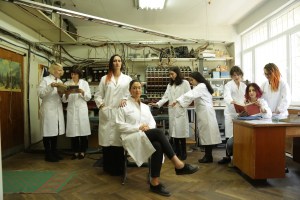
Sleepers Poets Scientists
Yes, not on vinyl. I got it on Bandcamp.
Thank you. So we started with Sleepers, Poets, Scientists, and then we made a second volume. We also had a very big performance directed by Nikakoi.
Then Anushka Chkheidze was one of the newcomers—she wasn’t even 20, I think—and we released her debut album Halfie on vinyl, which took off really well.
Then, through Sleepers, Poets, Scientists, we met this amazing person, Jan Chudozilov from Switzerland, who wanted to interview the girls. He kept asking about women in music, and it was from him that I first heard about the female composer Natela Svanidze.
He said, “I am trying to research her—do you know anything about her?” I said no. Then he sent me a recording from 1974 on the Synthi 100. So actually, the very first Georgian electronic music was made by a woman—Natela Svanidze. I was stunned.
So we released it on vinyl, with an amazing cover by the Georgian artist Lado Kobakhidze.
With the label, because it’s connected to the school—even though many people don’t realize that—I don’t see CES Records as just a label for popular music. I wanted it to be eclectic, covering many genres, and in cases like Natela’s, also educational.
Now, with Sleepers, Poets, Scientists, we know where we come from. Because 50 years before us, there was Natela Svanidze, who was brave enough to go to Moscow, where they had the only Synthi 100 in the entire Soviet Union, and record her vision.
So when people ask what genre CES Records is—electronic, experimental—it depends. We follow the vibe of the CES School. It’s more like the school dictates the direction of the label.
So all the artists released by CES…
It’s not a must that they are CES students, but it’s hard to find anyone in Tbilisi who hasn’t studied at CES at some point. So yes, mostly it’s CES people.
Also, CES was one of the first labels here to start digitizing music. For example, we digitized Nikakoi’s entire discography and put it on streaming platforms, and even made some fun merchandise.
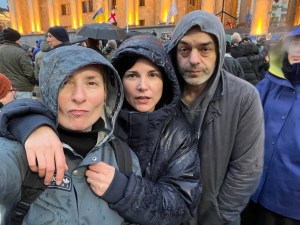
sTia with Natalie Beridze and Nikakoi during the Tbilisi street protests
We have been talking about Tbilisi, but is there an electronic music scene in other parts of the country?
To be honest, we worry about it. I love to travel and explore, but yes, it is mostly Tbilisi and Kutaisi. Kutaisi is even more musical than Tbilisi—there are fewer opportunities, obviously, but a lot of Georgian music comes from there. It has an amazing scene.
Batumi also has a scene because of tourism and clubs. In the rest of the country, there is less, but we are really trying to change that.
At the moment, many people are leaving the country, and even holding onto your city is difficult. We are going through very difficult times. Over the past year, I hardly worked, simply because it was so hard to concentrate—we spent so much time in the streets. And with no results, it becomes very difficult.
Some people are leaving, and those who stay are in shock. It’s not the same as before. I even started thinking that I care less about work when the country is in such a state. But then I remind myself—this is something important, something meaningful. The school, the label—bringing young people together under one roof where they feel good—that matters.
Still, it’s very hard to concentrate. It has been extremely hard for us. It always is, but this year especially so.
After the elections, the cultural sector went on strike. Clubs closed, theatres stopped—everything was paralyzed. CES stayed open, but we hardly had classes, because classes are in the evening, and in the evenings we were all in the streets.
Now things are slowly operating again, but not fully. It has been over 200 days. Some festivals and small businesses never reopened after the strike.
CES has never been funded, but many organizations relied on EU support, and that has now been cut. NGOs have also been forced to stop operating.
Yes, like USAID…
Yes, but that’s global, not just Georgia. Now NGOs are labeled as foreign agents. Step by step—it’s very similar to Russia.
Are there any lessons you can learn from Ukraine?
I don’t know. The same patterns are happening. Russia always operates in the same way. What can we learn? Maybe to keep fighting until the end. We cannot compromise.
You released a few singles in support of Ukraine…
Yes, at the same time as the “Sounds of Ukraine” initiative. When the full-scale invasion started, we were completely paralyzed. For two weeks I couldn’t get out of bed—I was watching everything 24/7.
The only thing that helped was contributing in some way. So we made some singles for Ukraine.
How do you think recent laws will impact the cultural sector?
I don’t know how we will survive, but we will remain creative. That I am sure of.
We were creating in the 90s, on the ruins of the post-Soviet space. The Georgian electronic music scene started when we didn’t even have electricity. Do you understand?
We will survive.
What worries me is that many people are leaving. But I know that creativity will remain.
Supporters of Georgia’s European integration are still protesting outside parliament for the 513th consecutive evening. The Georgian Young Lawyers’ Association filed a complaint with the European Court of Human Rights on behalf of demonstrators who suffered at the hands of security forces in November and December 2024 as reported by the Caucasian Knot.
(Gianmarco Del Re)


Pingback: A Closer Listen Reviews – Avant Music News