
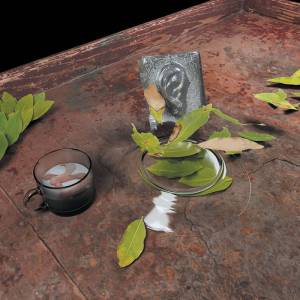
 Due to tariffs, I was unable to obtain an ear, so I’m a bit jealous of the ten fortunate people who are each proud owners of a stainless steel votive ear, made in Greece as a tactile representation of the album. The Reintegration of the Ear reflects everything about our website, including the fact that we once considered a stylized ear as our logo. Most importantly, the album highlights the rewards of slow, careful listening: the appreciation of micro sounds, intricate textures and subtle shifts. As the notes proclaim, “To truly listen is not a passive gesture but a radical, embodied act of attention.”
The compositions are so subtle that they begin as background music, but they refuse to remain there. Christina Vantzou leads an incredible ensemble of Irene Kurka (voice), John Also Bennett (flutes, synthesizers), Roman Hiele (double bass) and Oliver Coates (cello). Their play is fluid and instinctive, requiring each performer to listen to each other for small cues and inspired turns. Glissandos rise as waves crash against shores; the tides reflect the vagaries of time, and the birds are as much a part of the composition as the voices.
When the music retracts to reveal Kurka, it is as if the tides have receded to expose sea glass. Her incandescent voice sparkles atop a soft drone. And yet it is important to note that the music does not disappear; it simply shifts to a supportive role. Syllable by syllable, the title is recited. Chimes offer soft emphasis; off to the left side, a synthesizer plays. Momentarily, the music is reduced to chords, silence and breath. The intervals prove as important as the notes. Quiet, lapping waves return. Late in the sixteenth minute, it seems as if the performers have switched to a subway station, Coates taking the lead as commuters pass by. A final drone emerges and fades.
Side B, “Observations, edits, a cure for restlessness,” first appeared on Longform Editions in 2023. This companion piece, a collection of integrated parts, is as intimate as a family film. The mood is set by harp, birds, piano, cutlery and a friendly, looped voice, as if Vantzou is entertaining while a meal is being cleared. A gorgeous ambient segment follows with ivory and throat, neither entity straining. Again the water begins to seep in, connecting the sides.
When a church bells chimes, the listener is moved from the timeless to the temporal, though this impression is subjective as the peals appear at unusual intervals. The lesson may be that ordinary sounds are heard, but not always perceived. After few minutes, the peals reappear, this time more even, accompanying two types of worship: one religious, as conveyed through cadence and chant, and one natural, heard in the chattering of birds and the barking of a dog. To which does the ear gravitate? Might all listening be holy, hallowing the sources of the sounds? (Richard Allen)


Pingback: A Closer Listen Reviews – Avant Music News
Pingback: A Closer Listen Reviews – Avant Music News