
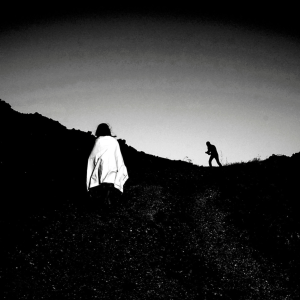
Cover photo by Sotiris Lamprou – Artwork by incepBOY
On Hìeratico, Nicolas Remondino approaches sound as both matter and invocation, shaping an album that exists in a state of charged duality—light and darkness, presence and absence, the sacred and the material. Contrasting tendencies are constantly at play, balancing control and dynamism, precision and chance. And yet, for all its crepuscular tones and liminal elements—suggested from the outset by the album artwork—this is not a whispered work. It develops through clamour, moving across rugged terrain, only at times flowing beneath the surface like an underground river, as in the track “cuerda de pietra.”
Percussion is dismantled and reassembled into something sculptural, almost geological. Rather than functioning as rhythm, drumming becomes a resonant habitat, surrounded by objects that extend its voice into wood, air, and mineral textures. Subtle electronics and environmental traces form a “silent room” around these sounds, gently amplifying their overtones without displacing their physical presence, preserving the intimacy of a drum solo while quietly transforming it. The title itself becomes a guiding principle: not austerity for its own sake, but a form of concentrated listening. “Sei rivoluzionario dell’ascolto” (“You’re a revolutionary of listening”), recites Natalia Rogantini on “muracetra.” “Listening, listening,” reiterates Limpe Fuchs on “blue hymne.” And again Rogantini, on “lode”: “Ascoltavo un immenso spazio” (“I was listening to an immense space”).
Remondino invites a number of guest musicians to expand the sonic palette, adding harmonium (Marco Baldini), acoustic guitar (Giuseppe Ielasi, Nicolò Francesco Faraglia), piano (Jonas Torstensen), and soprano saxophone (Cosimo Fiaschi), alongside sampler (Roberto Musci) and homemade instruments (Pierre Bastien), all in search of pure timbre. He creates a distinctive aural environment by testing different registers—words, like wood and stone, suspended in the silent void of contemplation and ecstasy. A clash of sighs and breaths emerges in “sospire.” Hìeratico is, in his own words, “a silent scream, ancient seed, a sprout of sand and noise.”
Much as Remondino’s music draws from poetry, so too do his reflections when articulating the creative process behind this singular album, as evidenced in a Q&A conducted via email.
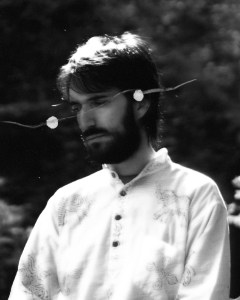
Nicolas Remondino
Hi Nicolas, thank you for joining us. The album brings together multiple voices, dialects, and collaborators, from Carnic to Italian and from English to Japanese. What role does language play in the record, and how do you think about voice as sound versus meaning?
There is a sense of an imperfect spoken language, with a mixed accent in these sounds, a language that enhances the characteristics of the tracks, narrating a part of a story that surfaces at times but does not reveal all its contours; only some of its chapters, like reports, appear alongside the voices — a mystery that is both luminous and shrouded in chiaroscuro, much like a prayer.
I felt a sense of liberation in linking these languages—some of which are truly very different from one another—but linking them in this way was like highlighting the larger pattern of Hìeratico, which at times eludes us.
There’s a strong sense of ritual and listening in the lyrics, or texts, I should say, with references to water, light, silence, and transformation. Do you see Hìeratico as a kind of sonic rite or passage, and what kind of space were you hoping to create for the listener?
I was deeply inspired by the dimension of silence; I wanted to recreate some of its moments of stillness, while also exploring how rich it can be to listen to, opening up portals within and around us. The idea was precisely to connect with this, to create a space for pause—both intimate and open—to share the listening experience that brings the lyrics to life, to create a continuation of the album’s process, expanding outward from the ears of the listener. To resonate.
You treat percussion not just as rhythm but as texture—evoking stone, wood, wind, and earth. How did you approach transforming the drum kit into something almost elemental or sculptural?
I explore the instrument through the very materials it is made of, taking it apart and reassembling it into a counterfeit of resonances amplified by materials of the same nature, surrounded by evocative objects that help fuel an immersive flow. I seek to turn it into a sculpture of poetry, a source and habitat where one can be surrounded, experiencing the music through timbres and tones to be explored.
You began the album at Giuseppe Ielasi’s studio and then expanded it through additional recordings and collaborations. How did that workflow shape the final sound—particularly in terms of layering acoustic elements, electronics, and the prepared percussion?
I wanted to create a sort of silent space around the percussion, with subtle textures that gently envelop the space and enhance it, while respecting the strong, central presence of the percussion, maintaining the concept of a drum solo, and coloring its harmonics with other elements.
The narrative then resonated strongly with the guests’ voices; as we explored the path of the word—written, spoken, and read—a parallel story emerged that I sometimes like to describe as the album’s “post-spoken” element… I don’t know if it makes sense; I’ve never been particularly passionate about the idea of spoken word in music, but I felt the need to “say” things, with sounds and accents blended into a strong oral quality—not recited, but lived.
I felt a strong need for these presences as solemn figures, as if encountered by chance in a dream, in the form of an oracle
Listening to Hìeratico feels like stepping into a dark landscape where forms slowly reveal themselves—shadows turning into textures, silence into presence. What does it mean for you to “listen into” darkness rather than illuminate it?
Hìeratico highlights the full intensity of black; the album’s dark undertones were something that emerged naturally, not necessarily intentional. I wanted to create an album where people could feel at ease in its chiaroscuro, without rejecting or excluding it.
Experimental music often builds a fortress of incomprehensibility around itself, but I believe that a beautiful mystery can be discovered in sharing the listening experience together, in that connection — something that goes beyond the concept of music, like rediscovering an ancestral sound that becomes empathy, prayer, healing, and revolution. Life. Sacred striving to expand. (Gianmarco Del Re)


Pingback: A Closer Listen Reviews – Avant Music News