
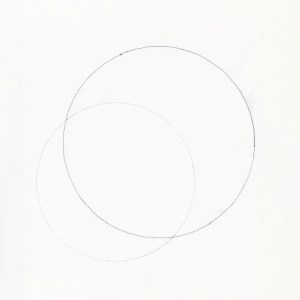
Cover artwork from Sylvain Chauveau’s #2 score
In Diastima, Luigi Turra delivers what could be labelled “the Chauveau variations”—not because he takes a foundational musical idea from Sylvain Chauveau and repeats it in multiple iterations, but because he departs from Chauveau’s graphic scores in ways that are intentionally arbitrary and deeply personal.
That said, the scores themselves are deliberately ambiguous, at times verging on the surreal, consisting mostly of vertical and horizontal lines, circles, and dots. A productive disconnect emerges, as when score #14 reads “Instruments: None / Performers: None / Duration: 0,” yet is realised here as a single quivering tone lasting 16 seconds.
Elsewhere, the Italian sound artist is more inclined to follow the instructions, particularly with regard to duration, as in track 4 (“play for 33 seconds,” #33—visualised by three black dots and four grey ones inside a square). Turra’s varied approach is far from random and remains respectful even when it appears to diverge. Leaves taped to the page in scores #112 and #115 are rendered, respectively, through echoing voices, piano, and electronics (track 7), and wind instruments (track 15).
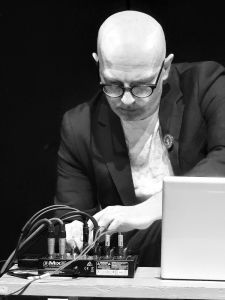
Luigi Turra
Turra threads these disparate notations into a single, coherent arc, segueing seamlessly from one prompt to the next—as when he picks up the word “dilemme” [dilemma] from track 2 (#21) and loops it into track 3 (#86). Toward the close, he is joined by guest musicians Vittorio Guindani on electronics (track 18, #2—“for two performers, with any instruments, softly, length: free,” visualised by two intersecting circles) and Pierre Gerard on bass clarinet (track 19, #117—visualised by a sheaf of mostly parallel lines).
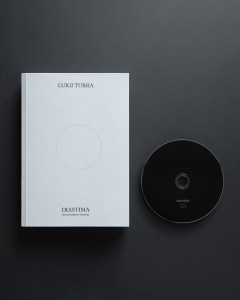
Chauveau himself appears as a sampled presence on track 12 (#9—visualised by a single grey circle with a black contour). Like one of the indications in #70, Diastima (meaning interval or space) aims to deliver “a bit more than orchestrated silence,” and it does so with careful deliberation. A beautifully produced release from 901 Editions, the album is accompanied by an elegant book reproducing all the scores.
Luigi Turra himself was kind enough to answer a few questions about the production process for his latest album.
Diastima engages with Sylvain Chauveau’s graphic scores, yet your interpretations often diverge in subtle ways. How did you navigate the balance between fidelity to the score and personal intuition?
Sylvain Chauveau’s scores do not prescribe—they orient. I have always felt them more as invitations than instructions, as open spaces to enter with care. I have never perceived them as objects to be “faithfully realized,” but rather as fields of tension to move through—places where something can happen only in the moment of listening.
For me, fidelity is not about precision of execution, but about respecting their fragility and openness. It is a way of remaining in a state of listening, of not forcing the material toward a predefined form. Intuition enters precisely at that point where the sign becomes sound: a delicate, almost exposed moment in which you feel you must respond rather than decide. In this sense, speaking of interpretation is perhaps reductive. It is more a matter of assuming a perceptual responsibility, of allowing the sound to emerge without closing it.
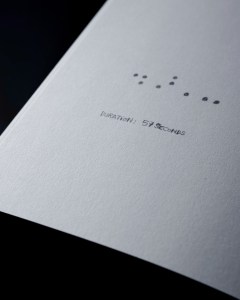
from Sylvain Chauveau’s #57 score
There’s a compelling tension between instruction and interpretation—such as realizing a “zero” score as a sustained tone. Do you see these decisions as acts of composition, translation, or negotiation with the score?
I would describe it as a form of continuous negotiation. Some indications—such as the “zero,” or other scores like no. 24—are never truly neutral: they are extremely reduced signs, but precisely for this reason they demand a position to be taken. They do not offer a clear direction; rather, they open a space of possibilities that must be inhabited. Transforming a “zero” into a sustained sound, for example, is not a literal translation but a way of making audible a limit condition: something that exists between presence and absence, between sound and silence. In this sense, every choice arises from a direct confrontation with the apparent emptiness of the score, which is in fact anything but empty. It is an active void that calls for a response.
In my exchanges with Sylvain Chauveau, this aspect was central: from the beginning he encouraged me to move freely, not to seek interpretative “correctness,” but rather an internal coherence of sound. This reinforced the idea that the work was not to perform, but to enter into a relationship with the scores, accepting the risk of every decision—and personally, I am very fond of risk. In this sense, every gesture is simultaneously composition and translation, without ever settling into either category. Translation, because it starts from a sign; composition, because that sign does not already contain its sonic outcome.
The album flows as a continuous work rather than a series of discrete pieces. At what point did these individual scores begin to cohere into a unified structure?
At the beginning they were isolated episodes, almost skeletal studies, each tied to a single score and a very essential gesture. They did not yet have a common direction, except for a certain affinity of atmosphere and timbre. Coherence emerged later, during prolonged listening, when I began to hear them no longer as autonomous fragments but as parts of the same space.
I realized then that it was not a sequence of pieces, but a perceptual continuity: as if each episode were a minimal variation of the same state, the same threshold crossed multiple times, each time under slightly different light. This perception changed the way I worked on the material. From that point, the idea of building a flow emerged rather than a sequence. I began refining transitions, removing any overly evident discontinuities, but without making everything uniform: what interested me was that the passages remain porous, almost imperceptible.
The materials call to each other in a subterranean way, through resonances, returns, and small timbral persistences. The project thus began to behave like a single body, in which listening is not guided by clear beginnings and endings, but by a slow adaptation of the ear to what changes almost without declaring itself. After all, when you touch a fabric, you don’t distinguish each thread—you feel the complex weave of the whole texture, don’t you?
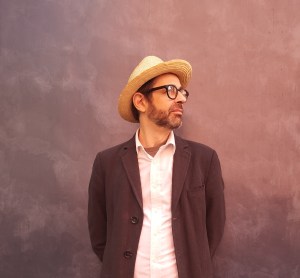
Sylvain Chauveau by Virginia Arribas
The title Diastima points to interval and space. How do you approach silence as an active element within the composition?
In Diastima, silence is a form of active tension, a space that structures listening. Often it is precisely silence that determines the weight of a sound. It is an element that expands time rather than interrupting it. This way of understanding pauses is also linked to my work on aleatoric processes. In an online project I developed, based on a random structure, the pause becomes an unpredictable variable: it is never identical to itself, it can extend, contract, appear unexpectedly. In that context, silence ceases to be a simple interval and becomes a generative element, capable of continually redefining the relationship between events.
In Diastima, this idea is less explicit, but it remains in filigree. Silence is not only what separates two sounds, but what relates them, creating a perceptual continuity that is not linear. What interests me most is that point where it is unclear whether one is still listening to something or has already entered silence: an ambiguous zone in which time seems suspended. The title is also a homage to Gillo Dorfles’ book L’intervallo perduto.
In your collaborations with Vittorio Guindani and Pierre Gerard, did you invite them to interpret Chauveau’s scores directly, or respond to material you had already shaped?
With Vittorio Guindani and Pierre Gerard I worked in a slightly different way compared to a direct interpretation of the scores. I did not ask them to start from Sylvain Chauveau’s indications, but rather to enter a sonic context that I had already begun to build. I shared materials with them—sketched-out tracks—while leaving ample space for their sensitivity. Their contributions were not meant to “complete” or comment on what was already there, but to insert themselves organically, as new elements capable of slightly shifting the overall balance. This was precisely what interested me: not a hierarchical or illustrative collaboration, but an open dialogue. Their parts introduce new directions, sometimes even unexpected ones.
 You often work with voice and spoken elements. How did you approach introducing the voice in Diastima, especially in scores that offered no explicit indication for it?
For me, the voice is never merely an expressive element: it is always also a trace, something that carries a “before” within it. In Diastima I approached it in this way, even when the scores did not suggest its use. I like to think of it as an archive: it contains memory, but in an unstable, partial, often fragmentary form. When it appears, it does not necessarily introduce a clear meaning—rather, it reveals its remnants, like a signifying residue that can never be fully grasped. It is a presence that suggests more than it declares. Sometimes it is little more than a whisper; at other times it emerges as if it had already been there, hidden within the material. I did not want it to organize listening or become a center, but to remain lateral, like a memory that surfaces and immediately withdraws. In this sense, even when it is not prescribed by the score, the voice becomes a possible extension of its space.
The influences I carry with me—radio drama, literature, radio as a site of transmission and dispersion, sound poetry, musique concrète—have certainly contributed to this approach. I am interested in a voice that is never fully present, that seems to arrive from a distance, as if it were received rather than emitted. A voice that does not occupy space, but passes through it, leaving behind an uncertain trace, almost fading away.
Across your recent works, including Liminale with Elio Martusciello, there’s a strong engagement with liminality and transformation. Do you see Diastima as part of that same exploration?
Yes, I see it as part of the same trajectory, though not in a linear way. Some materials from Diastima actually predate Liminale, and the two projects have influenced each other over time, almost as if reflecting one another from different angles. Rather than a continuation, I perceive them as two points within the same line of research that developed almost in parallel. In both works there is a strong focus on thresholds, transitions, on what is not fully defined.
The liminal threshold, for me, is not just a boundary between two states, but an active space where sonic identities transform without ever fully settling. It is a place of suspension, but also of possibility: the sound is not yet something, or perhaps it already has been, and remains in that intermediate condition. Diastima, however, radicalizes this approach: it further reduces the materials and focuses even more on the interval, somewhat like my 2016 album Alea (released by LINE). This reduction makes the thresholds even more perceptible.
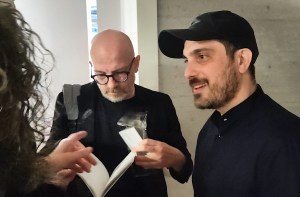
Luigi Turra examining a physical copy of Diastima for the first time while Fabio Perletta from 901 Editions talks to Belinda Guerriero
In works like Ressac with Belinda Guerriero, there’s a strong attention to tactility—the sense of sound as something almost physical. Does that sensibility carry into Diastima, even when working from more abstract graphic material?
The tactile dimension remains central, even when the material is abstract. Even a graphic sign can suggest a physical quality of sound—a resistance, a grain, a pressure. Sylvain’s marks, being drawn in pencil, already carry this component: you can sense the gesture, the friction on the surface, a kind of minimal but real weight. In translating them into sound, I tried not to lose this sensation, but to render it in timbral and dynamic terms.
In this sense, Diastima continues that line of research: making sound something that is not only heard, but almost physically perceived, even in its extreme rarefaction. It is not about density or volume, but about the quality of contact—how a sound occupies space and relates to the listener. Compared to Ressac, however, the starting point is different. There, there was a more explicitly narrative dimension, linked to a text by Belinda Guerriero: a kind of film without images, or perhaps what remains after the images have dissolved. In Diastima, by contrast, narration is absent. Tactility does not serve to support a story, but becomes a structure in itself. (Gianmarco Del Re)
 a closer listen
Pingback: A Closer Listen Reviews – Avant Music News