
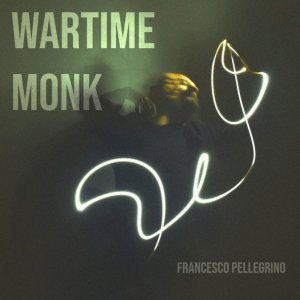
Cover art by @anita.intothewoods
Francesco Pellegrino’s Wartime Monk emerges from a space where abstraction can no longer remain insulated from reality. Framed by the return of war as both lived condition and conceptual rupture, the album translates this pressure into a physical language: sound shaped not just electronically, but through the body itself. Performed entirely via self-built controllers, the work collapses the distance between gesture and composition, allowing movement to sculpt pitch, density and form in real time. What might otherwise risk remaining cerebral becomes insistently embodied.
Dressed in black against a black backdrop, Pellegrino performs with eyes closed, oscillating between control and surrender. The interplay of circular and sudden vertical movements creates constant tension. Drops punctuate the flow, revealing the material weight of sound, while fragments of field recordings like children’s voices in “Ode”, intrude with perturbing intent. In “A Fragment of Distorted Calm”, these traces verge on documentary, evoking what could be the blurred edges of displacement or conflict zones, yet never fully resolving into identifiable narratives.
Pellegrino moves through calculated distancing, even when creating alluring gestural sounds. There is a purposeful imbalance between precision and instability, between silence and clamour, or contemplation and rapture. Opposing forces are at play as if continuity itself were under strain. Time “creaks,” to borrow his own description. This instability becomes expressive rather than chaotic: the body, placed at the centre of a field of sonic forces, attempts to guide, absorb, or at times simply endure them.
Wartime Monk carries a ritual dimension suggested by titles like “Missa” and “Pray for the Dead” but avoids transcendence, looking instead to question. Pellegrino approaches ritual as a means of sharing what might otherwise remain unspoken, transforming private tension into a communal experience or, rather, exposing collective responsibility. The “monk” of the title does not withdraw even when looking inwards; instead, he tests whether values forged in peace can survive the violence, whether culture itself can still claim relevance when it fails to engage with the world.
What results is a work that resists easy categorisation: neither purely immersive nor overtly confrontational, but suspended between states. The digital coldness of its textures is offset by moments of stillness—bells, dissipating tones, echoes of laughter—suggesting that even within collapse, traces of humanity persist. Wartime Monk avoids being didactic while acting as a process of reorientation: music answering the call of current times and articulating the sense of disarray and loss of meaning.
To help understand the intentions behind the album, I sent a few questions to Pellegrino himself.
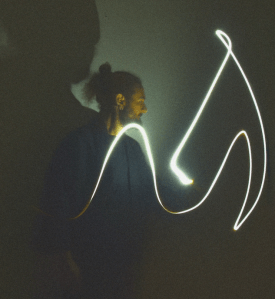
photo by @anita.intothewoods
The figure of the “wartime monk” evokes a tension between contemplation and violence. How does the idea of war function in this project—do you approach it as a concrete reality, a psychological condition, or a broader existential metaphor?
The figure of the “wartime monk” emerges at the moment when our ideas and practices are put under pressure by the return of violence into our lives. It stems from a double kind of anger: on one hand, witnessing how many seemingly compelling reflections, when tested by an unaccommodating reality, reveal themselves to be empty and self-referential; on the other, realizing that principles we once took for granted—indeed, as foundational to our contemporary condition—can so quickly be eroded, bent toward a form of degradation we had conveniently allowed ourselves to stop engaging with.
In this sense, I approach war as a concrete reality that becomes the driving force for a deeper reflection on the self, on the value of one’s cultural framework, and on one’s practices.
The monk, in his nature, cannot yield to the cynicism of the present moment; instead, he puts his spirit and his values under strain, and finds himself compelled toward transformation.
The work reflects on whether values and ways of living formed in times of peace can survive conflict. Did creating Wartime Monk shift your own thinking on this tension between continuity and rupture?
Yes, for me it is a work of reorganizing thought and one’s posture in the world. One of the shifts I’ve been engaged in for some time—and which comes into sharper focus in this project—is the move from an idea of musical research toward an idea of music that has absorbed that research, assimilated it, and now expresses itself through it just as naturally. In other words, not a work that studies a language, but a language that has become personal, placed at the service of the most sincere expression possible.
This shift also stems from reflections shaped by these “wartime” conditions: questioning to what extent the culture we cultivate truly belongs—or wants to belong—to our community, and whether a form of knowledge that does not, in any way, engage with the world can still be called culture.
Your performance is built around self-designed controllers that translate gesture into sound. What role does the body play here, and what does it mean to engage with themes of war through physical movement and control?
The project behind the two handheld controllers had been in development for a long time, and I’m very glad they have finally come to life. This line of research into new ways of controlling sound is central to me not only on a performative level, but above all in compositional terms. Although my background is in electronic music, in recent years my practice has been closely tied to wind instruments. This is because composition that emerges from a direct engagement with an instrument—from the body in relation to it, with all its constraints and possibilities—has given me a great deal; it feels like the mode of composing that comes closest to what I need.
What was missing was the ability to establish the same kind of relationship with electronic material, which often remains highly “mental,” with a very rational, design-oriented approach to building pieces. I developed these sensors in order to achieve that same instrumental relationship with electronics.
In this process, the body has become central. At first, my intention was not to foreground the body itself, but to remain an instrumentalist: just as a violinist’s body moves on stage to produce sound from the instrument, my body would simply act as a vehicle for sound creation. However, through working with these gestures, a physical force and expressivity have begun to emerge almost inevitably—something that becomes inseparable from the sound, and that I will certainly continue to explore.
The theme of war has only intensified and given weight to these practices: when a movement is controlling the sound of a child crying, it is impossible for the body not to become involved in some way, not to undergo a tension that then returns as sound.
There’s a striking contrast between the precision of your instruments and the instability suggested by the subject matter. Do you see the body and gesture as a way to contain chaos, or as something equally vulnerable?
The relationship between the complexity of electronic sound and the body is absolutely central to this work. I wanted the instrument to be fully invested with that complexity, as well as with its intrinsic variety: in some cases, the gesture is able to articulate a behavior, to give direction to complex sounds, guiding them toward a more instrumental form of expression; in others, the movement is itself overtaken by the possibilities of the sound, by the simultaneity of multiple sonic events, drawn into their dynamics.
It’s as if, through these instruments, the body places itself at the center of a field of tensions that it must both structure and allow to flow through it. The body becomes the boundary of what sonic evolution is possible: I wanted, even in a radical sense, for no sound to exist outside my physical ability to perform it live. The entire record was recorded live, without overdubs.
Field recordings seem central to the album, especially in pieces like “A Fragment of Distorted Calm.” How do you approach these sounds—are they traces of real environments, or more abstract compositional material?
Across the entire record, I sought to maintain a sense of ambiguity in my relationship with the sonic materials: at times, field recordings drift toward being used as compositional material, while at other moments they present themselves almost in a documentary manner, with other sounds acting as a counterpoint to these landscapes. The aim is to sustain a sonic condition that encompasses and allows different layers to interact—layers that can constantly transform into one another.
In previous works, often in dialogue with acoustic instruments, I explored this possibility of building compositions that could host and activate very different sonic planes. I’m interested in the contrasts and disorientation these interactions produce, as well as in the emergent meanings and sonic qualities that arise from their collision or their collaboration.
Several tracks — “Missa”, “Ode”, “Pray for the Dead” — suggest a strong liturgical or ritual dimension. What role does spirituality or ritual play in the album?
The ritual form is what the monk can offer to his community: the proposal of a practice through which silenced themes can be brought back into the shared space of a social group. It becomes a way of sharing a concealed suffering that, once ritualized, can take on a cathartic dimension—bringing a deeper awareness to a despair that might otherwise dissolve into a muted nihilism.
Ritual allows for something beyond simply informing the listener: it makes it possible, in a single gesture, to share a situation together with the emotional state it generates, to give back a movement of the soul shaped by external shocks. If the ritual works—if it finds resonance among those who take part—it carries a force capable of moving not only ideas, but actions as well.
Your work often explores listening as a temporal practice. How does Wartime Monk engage with time—does the presence of war alter how time is experienced or structured in the music?
The theme of war has certainly led to a construction of time that is unstable, trembling—one that, each time it begins to establish a sense of continuity, creaks under a weight it cannot sustain. Time, and also how we might wish it to be structured, is central to conveying certain tensions: to fracture temporal continuity, to create situations of uncertainty and inconsistency within the flow of time, produces a form of destabilization—perhaps even frustration.
But I didn’t want to stop there: it is within this destabilized landscape that I can place narrative elements, which gain strength precisely because they endure within a hostile space—like a monk in wartime.
Finally, what kind of listening state do you imagine for this album? Is it meant to be immersive, confrontational, meditative—or something that resists these categories?
As this work emerges from my own body, I feel that my listening to the album is, more than ever, inward and intimate. I like to think it can be approached in two ways: the first as a participation in a ritual, with a listening that is fully immersed in the material—offering one’s time to it as something meaningful, granting it a certain weight.
The other—and I would be very curious to explore this with performers—is to involve the body in the act of listening: even without dancing, simply through movement, or by approaching this music as something born from gesture, and placing one’s own body within the listening process, it may be possible to reach a different, more expansive form of engagement and participation. (Gianmarco Del Re)


Pingback: A Closer Listen Reviews – Avant Music News