

Mohamed Bourouissa has long treated sound as an integral part of his artistic practice, but LILA marks the first time it fully steps into the foreground. Conceived as a “musical object,” the album functions as an inventory of relationships: each track is dedicated to someone who has shaped the artist’s life, transforming memory into vibration rather than portraiture. Just as Bourouissa’s photographs and films explore lives at the crossroads of integration and exclusion, LILA constructs an intimate sonic space where people survive not through representation but through the emotional traces they leave behind.
Drawing on a decade of collaborations and experiments with sound, Bourouissa assembles a vocabulary that slips effortlessly between experimental electronics, contemporary sound art, fractured club music and Auto-Tuned pop without settling into any one tradition. Yet despite these diverse stylistic references, LILA remains remarkably cohesive, held together by its attention to texture, space and emotional resonance. Even at its most abrasive — such as the burst of distortion that closes “HFC” — the music never feels confrontational. Rather than assaulting the listener, these moments deepen the album’s emotional and sonic palette without disrupting its underlying sense of intimacy. Tracks such as “SEUM” drift between rhythmic tension, spectral drones and heavily processed voices, while “MG,” featuring Le Diouck, injects vocal energy without sacrificing the album’s dreamlike atmosphere. Throughout, frequencies, breaths and silences become as expressive as melody, giving the music an almost tactile quality.
The album reaches its emotional centre with the title track, where Valentina Fanigliulo (Mushy) lends an ethereal presence to one of Bourouissa’s most affecting moments. Throughout the record, Bourouissa’s lyrics are intentionally difficult to decipher, but this is far from an exercise in obscurity or verbal collage. Language is treated primarily as sound: vowels, consonants, breaths and vocal inflections become textural material that carries emotional weight independently of semantic meaning. Repeating the line, “What did you say, why should I cry,” through metallic distortion and uneven rhythms, the title track never seeks catharsis. Instead, it allows vulnerability to emerge through the sonic qualities of the voice as much as through the words themselves.
Ultimately, LILA reveals music not simply as another medium within Bourouissa’s multidisciplinary practice, but as the invisible architecture that has always underpinned it. It is an album that privileges resonance over narrative, relationships over representation and sensation over categorisation.
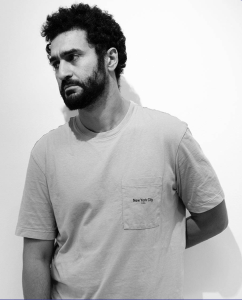 To help us delve deeper into the sonic world of LILA, Mohamed Bourouissa has kindly agreed to answer a few questions by email.
You’ve spent more than a decade integrating sound into your artistic practice, from Temps Morts through Si Di Kubi, Brutal Family Roots, Hara !! and the recent performance Why Did I Choose to Make Music. Why did LILA feel like the right moment to present yourself not simply as an artist working with sound, but as the author of a full-length album? What changed in your relationship to music?
Music has always been present in my work, even when it was not immediately visible. For a long time, I approached sound as one material among others — a way of extending an image, creating a space, or activating memory. But over time, particularly through various musical experiences with artists such as Mushy and Jordan Quiqueret, the desire to develop my own sonic language became increasingly present and essential.
LILA did not emerge from a sudden decision to make an album. It developed gradually through years of musical experimentation, and the need to structure these pieces came later, almost naturally.
I think music has a deeply therapeutic dimension within my practice. It is a way for me to engage with both sound and the world. This realization came through a more sustained exploration of frequencies, drones, and rhythm, as a way of gaining some form of control over a personal and traumatic dimension linked to the experience of screams, violence, and sound itself.
What changed, perhaps, is that I stopped thinking of music as something external to my artistic practice. It became a space for thought, memory, relationships, and trauma. The album format then emerged as a kind of journey through my relationship with others — a place where words sometimes fail me.
You describe LILA as a “musical object” in which each track is dedicated to a specific person. Rather than functioning as portraits, these pieces seem to capture emotional states, memories and relationships. How did you translate people into sound? Were these tracks shaped by concrete encounters and conversations, or by the feelings and traces those individuals left behind?
I have never been interested in making portraits in the traditional sense. What interests me is the space between people: the experience of the other, their energy, their presence, their vibration. The impact someone leaves within us — like a wave, a resonance, a kind of inner constellation — the way a person continues to exist within you long after an encounter has ended.
Each track begins with a person, but very quickly it becomes something else. Sometimes there are recordings, voices, shared moments. Sometimes words disappear altogether and become almost like glossolalia or vocal improvisation — what we call “yaourt” in French music slang — leaving only a sensation, a tension, a rhythm.
I think of these pieces as emotional landscapes, much like in some of my projects where the body itself becomes a territory. Certain sonic textures, frequencies, or silences can hold things that articulated language cannot convey. A breath can sometimes say as much as a word.
In that sense, the album is not about individuals themselves, but about the traces they leave behind and the transformations that relationships produce.
Throughout your work you’ve often spoken about sound as a vehicle for history, memory and sometimes trauma. On LILA, however, there is also a striking vulnerability, particularly in tracks such as “AF”, “SEUM” and the title piece featuring Mushy. Did making music allow you to express things that would have been difficult to articulate through photography, film or installation?
Yes, absolutely.
There is something both intuitive and naïve in the way I approach music, in the most positive sense of the word. It offers a kind of freedom that I could no longer find elsewhere, and it allowed me to reconnect with an intimate space, similar to the one I inhabited when I first began drawing as a child.
Tracks such as “AF” and “SEUM” are among the most personal works I have ever made. “AF,” in particular, is connected to a moment when someone very close to me suffered a stroke. An event like that changes a life completely. The person is no longer the same, and there is no way back. It affected me deeply, and I wanted to translate that experience and emotion through music rather than through words.
Music gave me access to a level of vulnerability that I sometimes find more difficult to reach through photography, film, or installation. It allowed me to work closer to sensation, to emotion in its raw state, without necessarily having to explain or narrate it. In that sense, sound became a direct way of expressing things that would otherwise remain unspoken.
The album occupies a fascinating space between experimental electronics, contemporary sound art, pop music and club culture. At times there are traces of Auto-Tuned R&B, elsewhere modular synthesis, abstract rhythms and almost sculptural textures. Were there particular musical influences that guided LILA, or were you deliberately trying to escape established genres in the same way your visual work often resists categorisation?
I am wary of categories, not because they are without value, but because lived experience rarely conforms to them.
The music I have listened to has always moved between different worlds: raï, hip-hop, R&B, electronic music, film soundtracks, and experimental music. Later on, I also became interested in musique concrète and in practices of listening itself.
All these influences coexist without hierarchy. I have never tried to organise them into genres or musical families. What matters to me more is creating my own space. I have always tried to draw inspiration from what I listen to without being seduced or confined by already-defined sonic identities. Of course, it is probably impossible to fully escape what has shaped us, but I try to maintain a sense of constant displacement.
As in my visual work, it is often the subject that guides the form. In music, this can be an emotion, a mood, a lived experience, or a meeting that shapes the construction of a piece. But I also leave a large place for accident — what emerges unexpectedly: a note, a distortion, a breath, a voice that slightly slips. These moments are often just as important as what I had initially planned.
I do not hierarchise elements. A mistake can carry as much value as a controlled intention. I try instead to listen to what is happening and to accompany the piece towards its own form.
Your 2025 performance Why Did I Choose to Make Music posed a deceptively simple question. After completing LILA, your debut album for PAN, do you feel you have found an answer? What is it about music—and especially frequencies, noise, breath and the human voice—that continues to draw you in as both an artist and a storyteller?
I don’t think I have found a definitive answer. If LILA has brought me anything, it is the understanding that I now think through sound. Breath, frequency, rhythm, and vibration have become tools that allow me to approach all of my other practices.
For a long time, I considered music as just one medium among others. Today, I feel it has become an invisible structure running through my work. It shapes the way I look at an image, build an exhibition, think about a film, or even approach writing.
I believe music has taught me to think differently about the relationships between elements. Architecture, for example, is a form of musical composition for me. It is built through solids and voids, silences and intensities, heights, breaths, and rhythms of circulation. This way of thinking can also be found in my installations, my films, and the way I compose an image.
What interests me in music is not only sound itself, but its ability to put things into relation. Breath, in particular, fascinates me because it sits at the boundary between the body and the world. It is close to certain forms of prayer, to Sufism, and to meditation. There is something almost metaphysical in sound. Within frequency, there is an invisible force that passes through us, connects us, and transforms itself through its multiple variations.
(Gianmarco Del Re)


Pingback: A Closer Listen Reviews – Avant Music News