
If C.S. Lewis’s A Grief Observed remains one of the most penetrating accounts of bereavement because it refuses consolation, Aleksandra Słyż‘s I Carry the Strength approaches grief with a similar honesty. Lewis famously describes grief not as sadness but as a form of fear: a state of suspension, restlessness, and waiting in which time stretches into what he calls “almost pure time, empty successiveness.” Słyż’s composition inhabits that same psychological terrain. Built around a monumental Buchla 200 drone, the piece unfolds as a continually shifting landscape whose contours change as one moves through it.
Compared to the multilayered textures of Everything tends towards chaos and order (2022), the music here feels markedly more austere, as though the immense weight of the drone is constantly threatening to engulf an underlying melody that remains only perceptible beneath the surface. In some ways, it resembles the darker counterpart to Pure Voices, her 2026 work for strings and electronics. Where Pure Voices felt luminous and contemplative, I Carry the Strength is heavier and more burdened, its harmonies carrying an almost physical sense of weight. A lone cello emerges from the electronic mass like a fragile human presence, while resonant metallic tones briefly illuminate the darkness near the end without ever fully dispelling it.
The work was conceived in response both to personal loss and to a broader atmosphere of collective grief shaped by contemporary wars and crises. Yet Słyż resists turning these experiences into a statement or a programme. Like Lewis, she understands suffering not as something that can be neatly resolved but as an ongoing process. The drone remains unresolved, refusing catharsis. Moments of beauty continue to surface from within the noise, suggesting not redemption but endurance.
What ultimately makes I Carry the Strength so affecting is this insistence on honesty. Beneath its overwhelming sonic mass lies an acknowledgment of grief as a profoundly human condition: fear, suspension, memory, injustice, love, and the difficult task of carrying on. It is not a work about overcoming loss, but about learning to inhabit its presence.
In the following interview Aleksandra Słyż reveals her production process.

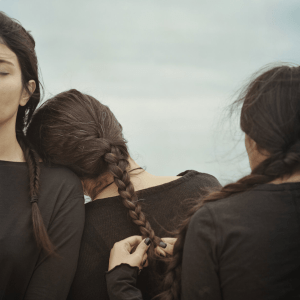
photo by Maciek A. Edelman for Vogue Poland
Your work often explores the tension between acoustic and synthetic sound, whether through modular systems, microtonal tuning, movement sonification, or orchestral writing. On I Carry the Strength, these elements seem to converge into a single, overwhelming drone that feels both fragile and immense. How did this piece emerge from your broader practice, and what made the Buchla 200 the right instrument for expressing these particular emotions?
One of my favourite compositional strategies is creating moments where it becomes difficult to tell whether a sound is electronic, electroacoustic, or purely acoustic. I’m often drawn to these kinds of qualities and regularly search for them in my work. I hope you can hear this in I Carry the Strength as well, particularly in the middle section of the piece when the cellos enter, or at the end, where I amplify the gongs’ resonances with electronics.
I Carry the Strength was commissioned by Swedish Radio last year. From the outset, I knew the themes I wanted to explore, but the final shape of the work developed slowly over time.
I recorded the electronic part during my residency at EMS in Stockholm. In fact, the piece emerged somewhat unexpectedly. At the time, I was working on an entirely different project that didn’t involve the Buchla at all. But I had reached a point where I felt stuck, so I turned to the instrument almost as a way of clearing my mind and stepping away from the work for a moment.
I started patching the Buchla very intuitively, and before long a five-chord phrase emerged almost by itself. I immediately realised that it sounded exactly how I wanted I Carry the Strength to sound. It carried the intense, piercing emotional weight I was trying to express and, perhaps in some way, emotions I was also trying to let go of, although I wasn’t fully aware of that yet.
I Carry the Strength was written against a backdrop of personal loss, but it also grapples with a collective sense of grief shaped by wars and conflicts experienced through screens and digital networks. The work asks, implicitly, what it means to care about suffering from a distance. How did you navigate the relationship between private mourning and this broader atmosphere of collective anxiety and helplessness?
What still strikes me is how the piece ultimately took shape, because at first it wasn’t intended to be about my own experiences at all. I wanted to write a work that reflected the reality of the world we live in today – a reality in which war, death, and chaos have become so ever-present that we gradually become desensitised to them. I was also searching for a way to move beyond my own sense of helplessness, to contribute something meaningful or to give purpose to my actions. I believe that change begins at the most fundamental level, and that even the smallest gestures matter.
But life added another dimension to the piece – last year, two of my friends passed away suddenly: Rafał Zapała and Gerard Lebik. Rafał had been my teacher- an exceptional one – and Gerard and I performed together many times, sharing many beautiful memories for which I will always be so grateful. Both were remarkable musicians, both died very young.
Death brings with it an entire spectrum of emotions, but for me the most difficult is a profound sense of injustice when someone’s life ends too early. And whether the person is someone we know intimately or someone we have never met seems almost secondary. The feeling of injustice remains surprisingly similar to me. Looking back, I think that this may have been one of the sources of the helplessness I had been carrying for so long.
At the same time, grieving together with others brought a certain sense of relief. Community and the presence of other people can help carry the weight of loss and, at times, reveal a strength we didn’t realise we possessed.
All of these experiences and reflections accompanied me throughout that year and naturally found their way into the piece.
The album never offers catharsis in a conventional sense. The drone remains heavy, unresolved, and at times almost unbearable, yet moments of beauty emerge through the cello, percussion, and shifting harmonic relationships. Were you consciously resisting the idea of resolution, and do you see the piece as an act of endurance, protest, mourning, or perhaps all three at once?
Yes, I wanted the piece to end in a state of suspension. The experiences and emotions I address in the work feel too complex, overwhelming, and layered to arrive at any resolution. This suspension felt like the most honest way to conclude it. And as for how the piece should be understood – as an act of endurance, protest, mourning, or something else entirely – I would prefer to leave that interpretation open.
Looking across recent works such as Tonarium Live, Pure Voices, Softness, Flashes, Floating Rage, and now I Carry the Strength, there seems to be a growing interest in scale: long durations, dense overtone structures, and sound as a physical environment rather than a sequence of events. Do you feel your relationship to drones and sustained forms has changed over the years, and where do you see this exploration leading next?
I think I feel most comfortable working with longer forms. They seem to offer the right space for me to shape time, build tension, develop narrative. Working on this scale feels both natural and intuitive to me. I hope that with each new piece my relationship to these forms becomes more conscious and refined. It is important to me to keep developing, to continue learning and searching for new directions, and I hope that commitment to growth is something listeners can hear in my work as well.
(Gianmarco Del Re)

