
“A sail to Puzzuoli, little trips by land, cheerful walks through the most wonderful regions in the world! Beneath the purest sky, the most treacherous soil; ruins of inconceivable opulence, oppressive and saddening; boiling waters, clefts exhaling sulphur, rocks of slag defying vegetable life, bare, forbidding tracts; and then, at last, on all sides the most luxuriant vegetation, seizing every spot and cranny possible, running over every lifeless object, edging the lakes and brooks, and nourishing a glorious wood of oak on the brink of an ancient crater!”
J. W. von Goethe – Italian Journey, Naples, 1 March 1787
On Acherusia, Manuel Carbone turns his attention to the Phlegraean Fields, the vast volcanic caldera stretching across the western edge of the Bay of Naples. Shaped by successive eruptions over thousands of years, the area encompasses twenty-four craters and volcanic structures, many now submerged beneath the sea. Since antiquity it has been associated with fire, myth and transformation: the steaming fumaroles of Solfatara were believed by the Romans to mark the forge of Vulcan, while Lake Avernus and the surrounding landscape inspired the belief that this was an entrance to the underworld.
Yet the Phlegraean Fields are not simply an archaeological or mythical site. They remain one of Europe’s most closely monitored volcanic regions, a place where geological instability, dense urban life and centuries of cultural memory coexist. Having grown up in the area, Carbone approaches this landscape neither as an outsider nor as a documentarian, but as someone tracing the intersections between personal memory, environmental change and everyday life.
“Driven to and fro by nature and history,” as Goethe would put it—both collective and personal—Carbone gathers sounds and acoustic cues over several days of walking through Pozzuoli and the surrounding area. As the walk progresses through gradual shifts in sonic perspective, Acherusia unfolds as a sequence of interconnected vignettes. Birds and wind dominate the opening passages before gradually giving way to water, turbulent weather and eventually the sounds of urban life: distant voices, traffic, footsteps and the subtle traces of habitation, as “the living live on merrily.” Beneath these recordings, restrained drones and discreet electronic interventions evoke the region’s subterranean forces, at times recalling the hiss of fumaroles or the imperceptible movements of the caldera itself.
Unlike many field-recording albums, Acherusia never fetishises the act of listening, nor does it mistake documentation for distance. The recordings retain a strong sense of the recordist’s physical presence while refusing to romanticise either nature or history. Carbone documents a landscape shaped equally by volcanic processes and human endurance, recording during a period of heightened seismic activity without ever turning the work into a disaster narrative, all set against a boundless view of land, sea and sky.
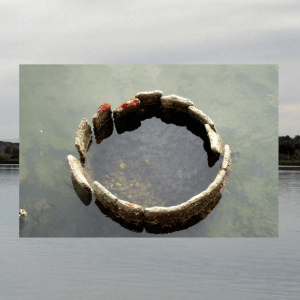
Alas, just as one might wish to meditate—even if feeling quite unfit for it—the walk is over all too soon. Should one have failed to make any notes amidst all this giddy excitement, Manuel Carbone’s PDF, included with the download, will facilitate any future recollection by virtue of his careful selection of photo collages. (With thanks to Goethe.)
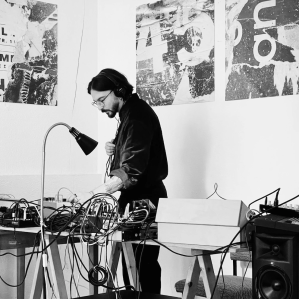
To walk us through the making of the album, we reached out to Manuel Carbone for an interview conducted by email.
 Acherusia takes its name from the ancient lake associated with the entrance to the underworld, and the Phlegraean Fields themselves have long been linked to myths of descent, transformation and instability.
How much did these historical and mythological layers influence your listening to the landscape, and how did you balance those narratives with the everyday realities of contemporary life in Pozzuoli and the surrounding area?
Acherusia is a work mainly based on my personal memory of these places and yes, those layers are definitely relevant to the piece. As a child, visiting those areas, since some of my siblings lived there, I could sense a certain aura of mystery. Surely back then I was influenced by what I learned at school, the tales and myths associated with the Phlegraean Field, but it is something I still experience even nowadays when I go there. It’s a familiar feeling, something dear to me and that hasn’t changed throughout the years. Something I still perceive when I’m there or just when I think about those places.
I made a conscious decision, when I went there specifically to collect sounds for the exhibition (and performance at Errant Sound, Berlin) to make those very personal feelings of reminiscence the core of the work.
As for the title, Acherusia, I wanted it to be a relevant aspect of the piece, but not really central to it, not predominant. I didn’t want the listener to think that this is a work based solely or mainly on some mysterious, ancient, dark mythology. These volcanic lakes, their neighbouring inhospitable fields, were thought to be the entrance to the underworld and that was a fact, nothing really occult (in the modern meaning of the term) about it. It was the natural elements, the geological features at the basis of that belief. And you can somehow understand why, when you are there – I recently went back specifically to collect new sounds for an episode of framework:afield (for Framework Radio) curated by myself and I managed to look at the Lake Avernus from above, for the first time, from the top of Monte Nuovo and I could clearly see why they thought the lake was the entrance to the underworld. It is difficult to put into words, you really have to be there to experience certain “optical illusions” given by the stillness of the lake’s water – and surely the landscape was radically different back then, with fumaroles and steams more frequent, yet it’s very strong and beautiful to experience nowadays.
People living there today, consciously or unconsciously, sense that mysterious aura, I believe. I don’t want to romanticise this aspect too much, but I think they have it in them. It shows, somehow.
Mostly, what I admire in the local people, and that’s another strong aspect of my affection for these places, is their strength and resilience in living there, their sturdiness in staying in a place so unstable. However, this covers many social and political aspects that I did not want to touch in this work. Many of these elements I surely stand for, but out of respect to these people and their conditions, and out of my personal incapability and unpreparedness of talking about these aspects, I preferred not to cover them… But at least I wanted somehow to show this resilience, even without giving it any clear explanation.
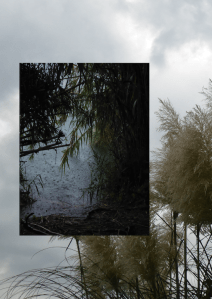
Photography & collage by Manuel Carbone
The work exists simultaneously as a soundwalk, an installation, a live performance and now an extended listening piece. In the gallery, the recordings were accompanied by photographs and found objects collected on site, creating a dialogue between sound and material traces. What is gained—or perhaps lost—when Acherusia is experienced purely as sound, detached from those visual and physical elements?
I wouldn’t speak in terms of gains and losses – I see this as different experiences. For the exhibition the pictures were printed in black and white, at a very low resolution, taped to rice paper and attached to resonant wooden panels where you could listen to excerpts of the soundwalks. And the guests could look at and touch the organic and non organic objects collected and displayed… The release from Falt Records comes with a digital booklet showing higher resolutions of the same photographs. The experience is different even more so if you listen only to the extended piece on streaming platforms – only audio and at lower quality.
And obviously also the live rendition of the piece is different, the way it might be performed, how the listeners take in the meaning of the sounds is different, but nothing is really gained or lost I think.
One of the most striking aspects of the album is the tension between geological time and human time. The Phlegraean Fields are shaped by slow volcanic processes, yet the work is filled with fleeting human presences: distant voices, traffic, footsteps and traces of habitation. Were you consciously trying to document a landscape in transition, or did the piece emerge more from personal memories and your own relationship to a place that is both familiar and precarious?
Yes, I was consciously trying to capture the human presence in a landscape that is in constant transformation. I did not want it to be something like “nature taking over a landscape slowly being abandoned by humans”…. Or anything like that.
Clearly, human presence is different now and that’s another aspect of the constant transformation of the area. I went there to record my soundwalks during a period of frequent seismic swarms. I didn’t experience any though, and that also affected the nature of the recordings. Local people were being careful, obviously preoccupied, concerned and alert. It wasn’t easy either to reach certain areas of the Phlegraean Fields as the public transportation was interrupted on several lines for safety reasons, I had to walk for kilometres, and most things were shut down, schools were closed… Streets were definitely quieter than usual but human presence was there. It is there. In the final piece, I had to be extra careful not to give the impression I was walking around some ghost towns or abandoned places. Nothing like that. Traffic, families in a park, children, people jogging along the banks of Lake Miseno and Avernus, the city center of Pozzuoli was definitely less lively than usual, but surely it was lived.
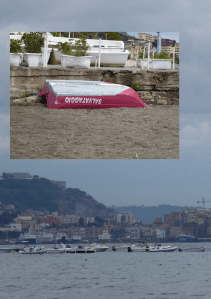
Photography & collage by Manuel Carbone
Your practice often engages with memory, hauntology and the transformation of field recordings through manipulation and collage. Acherusia, however, often feels remarkably restrained, allowing silence, wind, water and environmental sounds to speak for themselves. How did working on this project affect your understanding of field recording? Did spending time in a territory defined by uncertainty and constant subterranean movement change the way you think about listening, documentation and the role of sound as a witness to environmental change?
It is true that it sounds restrained and that surely was my intention. I wanted to keep the final recordings as close as possible to the original sources, so the editing was minimal, I only made a collage in chronological order, from day one to day seven, of my daily walks. Some recordings, such as the ones made with a geophone, are left out and I use them only when I play live.
I still applied some manipulation (effects and various sonifications) in some parts of the final edit, as an aesthetic choice and to evoke the feeling of memory drifting in and out because of a certain place, a certain sound and mood.
Working on this piece it has definitely changed my approach to listening and collecting/documenting the places I walk. I now keep the editing to a minimum, I don’t care much anymore about the imperfections that most field recordists comprehensively try to avoid or edit out – I now consider these as an inevitable part of the documentation, a way to establish my physical presence in these recordings.
(Gianmarco Del Re)


Pingback: A Closer Listen Reviews – Avant Music News