
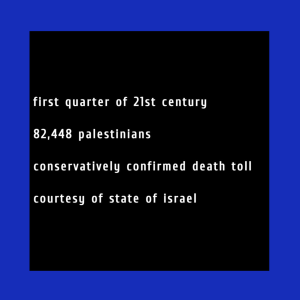
With first quarter of 21st century, Iranian sound artist Pé continues a trajectory that began with gold bars made in dubai (2025) and gathered momentum on 40.8 tonnes of freedom (2025), moving away from the metaphysical concerns of earlier releases towards an engagement with what he describes as “shrugged off crimes against humanity.” However, the shift is not as abrupt as it first appears. If albums such as æzæl: eternity of nonexistence (2025), æbæd: through imagining eternity (2024), and æm: representations of nonexistence (2024) used abstract synthesiser improvisations to examine nonexistence and cosmological time, the recent works retain the same compositional discipline while redirecting it towards contemporary history. For Pé, this is not a rupture but an evolution: an attempt to extend philosophical enquiry through what he calls a “transdisciplinary approach.”
That continuity is immediately apparent in the music itself. The four compositions remain resolutely abstract, built from slowly evolving drones, unstable resonances, distortion and spectral interference rather than melody or rhythm. Despite titles such as “82,448 palestinians,” “conservatively confirmed death toll,” and “courtesy of state of israel,” there are no documentary recordings, no explicit musical illustrations of violence, and no attempt to dictate an emotional response. Instead, the gulf between the factual precision of the titles and the ambiguity of the sound becomes the album’s central compositional device. As Pé suggests, that space is deliberately left for the listener to confront through their own cultural, political and personal position.
Compared to 40.8 tonnes of freedom (2025), first quarter of 21st century feels noticeably tighter and more compressed. The earlier EP allowed individual spectral layers greater autonomy, often opening vast acoustic spaces in which metallic resonances, drones and noise could coexist with remarkable transparency. Here the pressure rarely lifts. Each piece explores a different manifestation of instability: the slowly mutating density of the title track, the relentless fragmentation of “82,448 palestinians,” the devastating restraint of “conservatively confirmed death toll,” and the architectural synthesis of “courtesy of state of israel.” Throughout, Pé continues to compose almost exclusively through the redistribution of spectral energy, microscopic timbral shifts and long-form transformations, demonstrating an exceptional command of electroacoustic form.
The accompanying Bandcamp warning — “Listener discretion advised. Extreme frequencies low and high moderate volume suggested to avoid possible damages, please be cautious psychoacoustic effects intended” — proves more than justified. Pé’s music has always been deeply concerned with the physical experience of listening, and the sub-bass pressure, abrasive upper frequencies and carefully controlled beating phenomena are integral to the compositions. Those self-imposed limitations, including the recurring use of the ARP Odyssey and minimal post-production, have become a deliberately restricted vocabulary through which different conceptual territories can be explored.
Few contemporary electroacoustic releases negotiate the relationship between abstraction and political reality with such confidence. Rather than attempting to sonically represent conflict, first quarter of 21st century insists that the listener complete the work themselves. In doing so, it transforms listening into an ethical act, where sound becomes not an illustration of history but a space in which our relationship to it is quietly, and uncompromisingly, tested.
To better understand his production process we reached out directly to Pé who kindly agreed to answer four questions over an email exchange.
 Your earlier releases—ædæm: representations of nonexistence, æbæd: through imagining eternity, and æzæl: eternity of nonexistence—were concerned with philosophical questions of time, existence, and cosmology, often expressed through abstract titles and long-form synthesizer improvisations.
Beginning with gold bars made in dubai, which confronted the war in Sudan through the global trade in gold, and continuing with 40.8 tonnes of freedom and now first quarter of 21st century, your work has become increasingly explicit in its engagement with contemporary conflicts and political violence.
What prompted this shift? Do you see these recent releases as a rupture with your earlier work, or do they emerge from the same philosophical concerns viewed through the realities of the present?
To start with what has prompted the shift from philosophical topics to contemporary conflicts; it was an attempt to moving towards “transdisciplinary approach” and progressing from – so called – philosophical thought experiments, by borrowing from journalism. therefore i am a bit reluctant to view these projects as a rupture from past practices rather than some form of evolution, since they are still a call for attention to “ignorance”.
The titles of first quarter of 21st century—”82,448 palestinians”, “conservatively confirmed death toll”, and “courtesy of state of israel”—leave no room for ambiguity. Yet the music itself remains instrumental, refusing illustration or overt emotional cues. What relationship were you hoping to establish between these stark factual titles and the abstract electronic sound world? Did you want listeners to experience the tension between documentation and interpretation rather than being directed toward a single emotional response?
The refusal of illustration and a directed emotional response, as you mentioned, is the manner which I appreciate most in art, regardless of form/field; for its insistence on self reflection that the audience should bear. Trying to sonically represent (in the tone discussed) what the title says, or to be more precise the gap between them, would be filled by the audience confronting their stance, personally or culturally, on the subject.
Across your discography there is a striking consistency in your working methods: extreme frequencies, minimal editing, the recurring use of the ARP Odyssey, and an emphasis on limitation as a compositional principle. Even as the conceptual focus has shifted from metaphysics to contemporary history, your sonic language has remained remarkably coherent. What continues to attract you to these self-imposed constraints? Do they allow you to respond to radically different subjects without changing your musical vocabulary?
The self-imposed constraints are mostly for avoiding redundancy as well as driving creativity. Of course the personal preferences of frequency ranges, prepared signal chains and doing the least in DAW, are still shaping much of the sonic characteristics. Although, the limitations of choosing ARP Odyssey module as the sole source might be too many, its availability is what makes it convenient enough for now. Combining all these has given me access to some sort of primal sonic vocabulary (in my opinion) which leaves plenty room for expression in the manner discussed before, regardless of topic.
 You are an Iranian artist releasing music at a moment when questions of war, state violence, displacement, and historical memory don’t just affect you personally but resonate across the region. gold bars made in dubai, 40.8 tonnes of freedom, and first quarter of 21st century all engage with different conflicts while avoiding overt musical illustration.
Do you think artists have a responsibility to bear witness to political reality, or is your work simply a personal response to living through the first quarter of the twenty-first century?
Subjects of the releases you mentioned can be described as “shrugged off crimes against humanity”, and the responsibility of paying attention to these – and the normalized ignorance towards them – does not fall upon a certain group; bearing or avoiding these responsibilities can be rooted in different aspects of one’s identity and principles, as well as their dedication to cling to the bubble they live in. In short, the answer to this question is both, responsibility as an artist, and personal response as a witness.
(Gianmarco Del Re)


Pingback: A Closer Listen Reviews – Avant Music News