
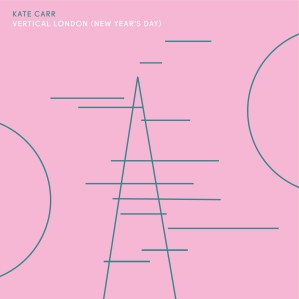
 Vertical London does exactly what it says on the can, establishing its premise from the very first minutes through a recording of birds and planes over Loughborough Junction. It is a sound I immediately recognised after spending twenty years living beneath the same flight path in South London, but Kate Carr approaches this familiar collision without lamenting noise pollution or searching nostalgically for a disappearing city. Birds and aircraft occupy the same acoustic plane, each accepted as part of London’s everyday ecology. From there, Carr moves through Tube stations buried beneath the city, the Greenwich Foot Tunnel, shopping centres, parks and lifts inside the Shard, eventually looking back down at London stretching and twinkling below. Verticality becomes a way of listening to the city across its different levels.
Although the record follows a journey across the capital, it never feels like a collection of sonic postcards. London identifies itself only in passing, through station announcements, tannoys mentioning the River Thames or fragments of public transport. People are everywhere, yet they seldom become protagonists. Conversations remain indistinct, with voices often arriving through loudspeakers instead of direct encounters. Titles such as “I don’t think you can hear but people largely discussed dogs all the way back to central London” quietly acknowledge the limitations of field recording itself: microphones never quite capture the same experience as the person carrying them.
One of the album’s greatest pleasures lies in its humour. Carr’s wonderfully verbose titles continually reshape the act of listening. “Celebrating a squeaky transport barrier…”, “A very long queue for the London Eye which is quite shit…”, or “It was New Year’s Day after all, and yes someone really was playing this at the overground station” all display a dry self-deprecation that gently punctures any temptation towards field-recording solemnity. The joke is never directed at the sounds themselves, but at the expectations we bring to them. The album takes listening seriously without ever taking itself too seriously.
A loose temporal framework also runs through the work. New Year’s Day appears only through fleeting details: someone wishing “Happy New Year” in Bloomsbury, an unexpected instrumental rendition of “Auld Lang Syne” at an Overground station. There are no celebrations or drunken crowds. The city simply carries on, making the choice of date feel quietly counterintuitive. Carr documents a public holiday through a London seemingly suspended between one year and the next.
The only explicit intellectual companion appears during the visit to Kilburn. At one point Carr quietly records herself (assuming it is her voice) saying the neighbourhood’s name, almost as if she were leaving a spoken geotag for reference. It has the feel of an aide-mémoire accidentally left in the finished work, but it also introduces Doreen Massey into the album. From this point, ideas about place begin to inform the act of listening itself. Massey’s understanding of place as something continually produced through movement, memory and social relations quietly echoes throughout the record. Every location remains connected to the next. High-frequency tones drift between recordings, drones appear among the crows and dinosaurs of Crystal Palace, and even Hampstead is characterised by the whisper imposed by private security and the sense of controlled space. London emerges as a continuum, its locations connected through sound and movement.
What I admire most about Vertical London is its trust in ordinary experience. Carr never appears to chase spectacular recordings. The only “climax” arrives midway through with a couple of “high drama” moments which are anything but. Both “Dramatic build-up to when I dipped into the shopping centre to find a man playing piano outside Aldi” and “Dramatic drummers on the street as I ran due to being late for my Shard viewing platform booking” animate the narrative with suitably understated theatricality. Carr allows the city to reveal itself through patient walking, public transport, chance encounters and small acts of attention. A squeaking ticket barrier, electromagnetic harmonics from the DLR and birds beneath aircraft all receive the same careful consideration. By the end of the journey, landmarks have receded into a living acoustic fabric, where every layer—from the tunnels beneath the streets to the flight paths overhead—contributes to the city’s constantly shifting identity.
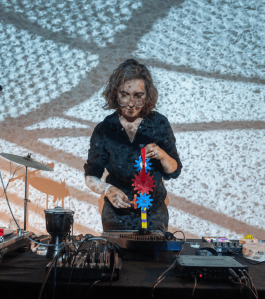 To walks us through the album, we have asked Kate Carr to answer a few questions for us by email.
You are a dedicated walker. One of your recent sonic explorations has been Transect – Heathrow perimeter walk with bird horns. You have circled London and frequently go on walks when traveling whether that might be in Italy or China. For this album, which is not strictly speaking just a walk as public transport is an integral part of it, you’re constantly moving between birds and planes over Loughborough Junction, the deep Tube stations, the Greenwich Foot Tunnel beneath the Thames, lift shafts inside the Shard, and eventually looking out over the city from above.
What made you decide verticality was going to become the organising idea this time round? Has living under the flight pathway in a city with an extensive underground system made you more conscious of what’s above and what’s below, so to speak? And did you have any expectations of the sounds, frequencies, resonances you were going to find?
I think ever since I did my album Midsummer, London a few years back and went across the city from one side to another on that long summer solstice day, I was sort of mulling what other sorts of trajectories I could trace. I was thinking about this vertical one for a while as it is obviously on the face of it a very different journey to moving across the city, and I suppose I wondered just how different it would actually be, both the experience of undertaking it and also how different it might sound within the recordings themselves. Movement and journeys are really central to my work, I am always asking: what version of this route is my movement producing in a recording, this combination of the chance elements, how I am recording, what gear I am using, my own personhood and identity and what or who I encounter. For a long while now I am interested in recording as a trace of how all those things come together, and what aural fragments of these encounters and moments is recorded or indeed not recorded by the in the recording device.
In terms of time spent at different verticalities, I have spent a lot of time obviously on the tube as most commuters have, but comparatively very little in London’s higher reaches. In doing the album I was interested in if elevation could be heard somehow or other, can something sound higher up? Or lower down? And I was also interested in the zigzag journey I was undertaking to bring me to these various elevations in the city. So it was a few different layers or questions to the project. I think yes you are probably very right that living under the the flight path has influenced my thinking about the vertical, I was actually planning at one point that the highest point in the album might be a recording from inside a plane, but once I decided to do it on New Year’s Day this was shelved as an idea.
The final component to the album as I was thinking about it revolved around the darkness of winter in London, I liked the idea of getting higher and higher, and closer to the sun as a way of gesturing towards the difficulties of this long dark period, and then this idea of the new year, new me sort of thing, and how the experience of new year’s day itself sort of punctures this. In the jumble of all these things the project lurks.
Human presence is felt, as it is to be expected since this is an urban work, but it is not always discernible, the only distinct speech one can hear come from “institutional” sources, loudspeakers, recorded voices, or formulaic propositions. Is this because of ethical concerns or purely for compositional purposes?
There are some voices in it, just snippets of people passing me, one person wishing another happy new year, and the sorts of murmurs you hear when moving through locations. I did not deliberately leave out conversations in this work, but I do have ethical considerations in regard to this issue. My practice is centred on the traces of activities, encounters, moments which unfold in public space, both ones I can be heard in and ones I am not. I think there is something of value in recording in public space in this sort of fragmentary and incomplete way, but that said there are of course conversations and encounters which I would choose not to use and would not consider it ok for me to use. In this case it was a cold, dark and quiet day, I was moving fairly quickly through locations and what reached me were just these small fragments.
The work is meant to convey the experience of commuting and I guess purposeful movement rather than the drift of psychogeography. Of course as we move through public space we do sometimes get drawn into listening to other people’s conversations, but here the work is more about an experience of being in my own head and thoughts, while also encountering these fragments of other people also going about their days.
One thing that really struck me is just how funny Vertical London is. Not because anything overtly comic happens, but because your titles quietly reframe what we’re about to hear. “Celebrating a squeaky transport barrier”, “A very long queue for the London Eye which is quite shit…”, “Dramatic build-up to when I dipped into the shopping centre to find a man playing piano outside Aldi…”—they all have this wonderfully dry, self-deprecating humour that somehow makes you listen more carefully rather than less.
Field recording and sound art can sometimes take themselves rather seriously, yet Vertical London never does. It seems to embrace chance, anticlimax and the absurdity of everyday urban life without diminishing the act of listening itself. Do the titles emerge naturally from the walks, or have they become your way of gently keeping both the practice of field recording—and yourself—in check?
Ha, well I am glad you found it funny. I do find humour just a really important component of basically just life. Not in a distancing way, or even in a not taking things seriously way but more just than humour and delight are part of the fabric of existence. I basically very often am quite astonished by people and what they do and say, and how different we all are from the smallest to the biggest things, and taking a trip and how this unfolds is no different. I find what people do, how they are in public space, how we encounter each other and organise ourselves sometimes just really charming, of course other times quite sad or even surreal.
I think undertaking this very random project on New Year’s Day just sort of adds to that feeling. Here I am racing to these different parts of London for no real reason except to see what they sound like and what is happening in them, encountering all sorts of people doing their own things, and in all of that there are just really absurd and bizarrely anticlimatic moments, as well moment of rushing and drama.
I don’t really feel I need to keep myself in check, or that sound art is too serious or takes itself too seriously, I just think humour is part of my orientation towards the world and others. I title the works after finishing the piece, but they come easily to me really. They just emerge from my memories of the day, both the felt memories and the narrative ones. I really like and enjoy the relationship between words and the sound work itself. I have always enjoyed that aspect of making work. I am basically obsessed with words, so I love to feel the dynamic between the composition itself and the words which accompany it and what this relation generates in terms of an experience of the work.
What made you decide to set this work within a 24-hour timeframe, choosing New Year’s day as its anchoring point especially when Vertical London doesn’t feel particularly jubilant or hangover?
I was going to possibly do it on the winter solstice so it matched my summer solstice work, and that would have been good as well, but I missed this date as I was busy I think and so I decided on New Year’s Day as I felt this trajectory of moving upwards resonated in quite interesting ways with ideas of new year’s resolutions, new starts, renewal. I did like the dry humour or irony which emerged in undertaking the work where this movement upwards was revealed as a shift into increasingly sterile, managed and privatised spaces. Increasing altitude does not prove revelatory or even particularly uplifting in this work.
In terms of the day long time frame, I tend to work with these strict limitations nowadays because I like how the paucity of time infuses the work. It makes it difficult to position the work as an attempt at some sort of ‘portrait’ of London in a definitive way. The strictness of the protocol for me lends the work these connotations of the fragmentary, the gesture, the moment, the random, the arbitrary. In my work I am always seeking to emphasise: here is my journey, full of moments, charm, annoyances, yes absurdities and surreal slices of existence but it is not London itself, just one version of London authored in time, movement and space.
(Gianmarco Del Re)


Pingback: A Closer Listen Reviews – Avant Music News