
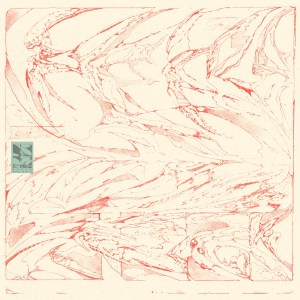
 One has to admire the boldness of the opening of Cacciamali. It doesn’t try to dazzle; instead, it opts for understated playfulness. A faltering folk wind instrument sets the tone as if the player were testing it rather than performing on it. This is not an artist trying to impress but someone searching. Rosso Polare introduces the album as an act of exploration. The hesitant breaths soon give way to rougher growls before the music gathers momentum through the increasingly insistent drumming of Cinna Peyghamy’s tombak.
“Falò” immediately shifts the atmosphere. Beginning with recordings from a bonfire, the track slowly thickens until a guitar emerges from the electroacoustic fabric, introducing one of the album’s rare melodic moments. Its simple folk-like phrase briefly offers a point of orientation before gradually dissolving back into the surrounding texture. Equally striking are the barely audible voices: “la carezza di un ricordo… il rifiuto di un ventre… il rifiuto di una madre… il rifiuto di un figlio…” (“the caress of a memory… the rejection of a womb… the rejection of a mother… the rejection of a son…”). There is no explanation and no obvious narrative. The words are uttered almost like a spell.
That reluctance to foreground melody becomes one of the album’s defining characteristics. Even when recognisable instrumental gestures appear, they are never allowed to establish themselves as fixed themes. They emerge briefly before being reabsorbed into a constantly shifting ensemble in which electronics, acoustic instruments and environmental recordings occupy the same musical plane.
The collaborations expand this vocabulary without disrupting its coherence. Riccardo Sinigaglia’s presence introduces a subtle dialogue between electronic abstraction and ritual memory. “Monte” overlays dense electronic textures with ritualistic drumming, children’s voices and the distant bells of grazing animals, creating a landscape that feels inhabited rather than merely observed. “Hastilude” — named after the medieval martial games derived from hasta (spear) and ludus (play) — is one of the album’s thickest sonic environments, its layers continually reshaping one another without ever settling into stable hierarchies. “1744”, created with HMOT (Stas Shärifulla), opens in an almost cinematic manner, or perhaps like the score to a contemporary dance piece, before gradually giving way to the denser electronic textures that characterise the album’s second half.
The liner notes provide an illuminating framework without dictating how the music should be heard. Side A draws upon the rhythmic traditions of medieval quintain games and flag throwing, while Side B is structured around a local legend recounting a fatal duel between father and son in 1744. Yet Rosso Polare avoids illustrating either narrative. Instead, ritual and rupture become compositional principles: repetition gradually gives way to fracture, while tradition quietly coexists with loss.
Equally important is the album’s treatment of place and everyday life. No location is identified, yet the accents of the spoken voices suggest northern Italy, while one overheard remark hints that the recordings were made shortly before Christmas. These details are never highlighted; they simply exist alongside the music. In “La Cruma”, snippets of perfectly intelligible conversation drift in and out of the texture without carrying any obvious symbolic meaning. They are not clues to be deciphered but reminders that this music belongs to inhabited places. Throughout the album, field recordings never function as scenic decoration. They remain part of the same sonic fabric as the instruments and electronics.
That approach has characterised Rosso Polare’s work from the beginning. Whether in Lettere Animali, Bocca d’Ombra or Campo Amaro — whose “Testamento Fermo” includes an impromptu chorus formed by those present — his music has consistently embraced participation over authorship. Cacciamali is the first album released after the departure of Anna Vezzosi, yet it continues this collective ethos. Collaboration is never ornamental; it is embedded in the way the music is conceived.
The title itself, Cacciamali (“chasing away evils”), inevitably recalls Ernesto de Martino’s studies of ritual and popular belief in southern Italy, particularly La terra del rimorso, alongside Diego Carpitella’s groundbreaking field recordings documenting music as a means of confronting suffering and uncertainty. Rosso Polare never quotes those traditions directly, but he seems to share an ethnomusicologist’s curiosity. His music occupies a space where free improvisation, folk memory and traces of pagan ritual coexist without hierarchy. Whistling, traditional flutes, environmental sound, electronics and percussion are granted equal importance, while the natural world and human presence continually overlap. Rather than reconstructing folklore, Cacciamali uncovers the fragile traces it leaves behind, allowing stories, landscapes and communities to emerge through listening rather than explanation. To paraphrase Alice in Wonderland, “What is the use of music with no pictures or conversations?” Cacciamali has both in sonic form.
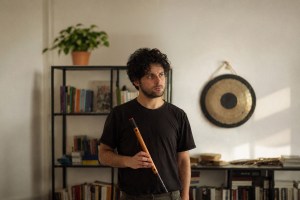
Rosso Polare photo courtesy the artist
To find out more on how to chase away evils, I reached out to Rosso Polare for an interview conducted by email, after which I followed up with a couple of clarifications.
One of the things I found most compelling about Cacciamali is that it never separates music from the world around it. Environmental recordings, recognisable human voices and fragments of everyday conversations continually drift in and out of the texture. They never function as documentary material, but neither do they become anonymous sound objects. Instead, they anchor the music within a living environment.
How do you approach the relationship between field recordings and instrumental sound? At what point does an environmental recording stop being documentation and become part of the composition?
Since the beginning of Rosso Polare, the threshold between environmental recording and tonal sound has always been some sort of challenge. In the project’s body of work, field recordings are simply treated as integral sonic material within the composition, and it’s more a matter of a mental shift: giving the same relevance to material that could generally be seen as background, and striving to put it on the same level as composed sound. On the other hand, it’s also about stepping down with regard to played music: treating it, as much as possible, as if it were a “piece of the story” rather than the highlight of the specific musician who played it. This very difficult proposition is an attempt to make these two distinct habitats coexist without one being preponderant over the other.
When does an environmental recording stop being documentation? I guess it happens in a very gradual way for me, as I gather sounds with no particular structure in mind in the first place and then assemble them afterward in the studio. Though I usually tend to avoid modern human anthropophony, it’s only with the last two albums, Campo Amaro and Cacciamali, that Rosso Polare started to embrace a bit of that as well. Before that, the project leaned away from the human voice in order to make the pieces feel as “in and out of this world” as possible, I would say. On these two albums, on the other hand, there’s some sort of investigation into folklore inside me that still has something to say, I think. So yes, as I gather sounds, they start to become part of a bigger picture, but they are always treated as just sounds, in much the same way that I treat instruments.
I recently spoke to Cinna Peyghamy, who described improvisation as “moderating a debate between two very different speakers.” Listening to “XIV – Pavo”, that image immediately came to mind. He brings multiphonics and an extraordinary physicality to the opening track, yet they seem to become part of a much larger sonic organism rather than taking centre stage. What attracted you to Cinna’s approach to sound, and how did the dialogue between the two of you shape the identity of the piece?
I met Cinna a while back in Basel. At the time, Rosso Polare was still a duo and we were playing at Würm on the very same night as him. Stas Shärifulla, a very good friend and artist I greatly admire, had invited both acts to play, and we almost instantly connected. I really like Cinna’s quote here and find it very fitting in this conversation too. “xiv – pavo” is the opening piece of what is, for me, a very difficult album, an album about balancing both music and personal emotions, making peace with changing aspects of my life.
Thematically, it started with the concept of quintain games, flag throwing specifically, as the main melodic column is made of environmental recordings from a flag-throwing game in Spoleto, which, uncommonly these days, featured horns alongside the classic drumming. Once back in the studio, I mangled these recordings into rhythmic patterns, and the horns that came with them got weird in a very interesting way: rather than resembling a specific melody, they became some sort of average fantasy of Italian folk music, not as a cliché but more out of a damaged memory, I’d say. Alongside that came what I’d describe as embracing my limitations: between starting and finishing the recording, I contracted a severe form of pneumonia, which highly affected my lung capacity and, subsequently, my ability to play wind instruments for long periods. Lots of whispers, pants, breath struggles and inhaled screams were sampled and implemented as assets to the track rather than obstacles in the process.
Cinna’s drumming and modular processing added great counterpoint to the already complex patterns of the track, while also grounding the second part of the piece in a more upfront dimension of musicality. His command of the tombak is really beyond anyone I’ve had the chance to listen to, and the integration of this very tactile instrument with modular synthesis is as difficult as it gets. I felt this track was a fitting opportunity to collaborate. He received from me what was, at the time, a somewhat finished part, and the dialogue started from that. You know, how do you integrate your voice into this? What and when should you play? Stylistic questions more than technicalities, I think, ideas about the shape of the music.
The role of this track as an opener was really hard to frame in the first place. The one before was an album about Italian folk traditional chants and their potential for a modern adaptation, and I still thought that thread had to be developed in some way, so that’s when the quintain came in. But, in parallel, I came across a local legend about a son dueling with his father and being fatally struck in 1744 in Lombardy, which sort of acted as a hidden subtext throughout the record, picking up this sense of loss and despair I felt while finishing the album. So “xiv – pavo“ is basically an introduction to a specific habitat for me.
One aspect I found particularly interesting is that Cacciamali brings together musicians who already share artistic connections. For instance, as a curator of the Korkut Triennale, Stas Shärifulla (HMOT) invited Cinna Peyghamy to perform while Riccardo Sinigaglia comes from an entirely different generation of Italian electronic music. Rather than sounding like a collection of guest appearances, the album feels like the meeting point of several different experimental music communities. Was that network of relationships something you consciously wanted to bring together, and did those existing connections influence the way the collaborations developed?
Firstly, all appearances on the record are either friends or musicians I met and shared a vision with. Stas, with his wife Julia, was part of the label (Klammklang, now inactive) that published Rosso Polare’s first album, Lettere Animali, in 2020. We’ve been friends ever since, and I was really happy to finally collaborate on something in the studio. Cinna Peyghamy, as said before, has been a staple connection since the show in Basel and resonated both in ideas and music.
Riccardo Sinigaglia is the unsung hero of experimental underground music in Italy since the ’80s. I fell in love with the debut of his band, Futuro Antico, a stunning example of cosmic experimentation that went beyond Italian music at the time. We met back in 2021 at Bääfest in Milano and connected. For me, his appearance on the record is a way to continue something that happened closer to me, a sort of homage to my musical ancestry, in a way.
The beauty of this scene is the possibility of bringing together communities, as you suggested: having friends representing different scenes of experimental music and making the ends meet altogether, be it on recorded media or live performances. This network is something you build along the way through true bonds and experiences. In Cacciamali, the aim was to bring together, on record, this friendship and kin built along the way.
Throughout the album I had the impression that you compose less by arranging sounds than by allowing them to find relationships with one another. Even the improvised pieces display an extraordinary sense of formal control, while the more structured works never lose their spontaneity. I’m curious about your working process. When you’re developing a piece, what tells you that it has reached its final form? Is it a question of balance, density, resonance, or is there another criterion you rely on before deciding that nothing more needs to be added—or taken away?
My process relies heavily on spontaneity, followed by very meticulous arranging which, as you rightly pointed out, strives to find relationships and conversation between them. I like to think of my pieces as chapters of a book or acts in a movie. Even though it’s usually not that pondered in the recording stage, I start with a few ideas. Lately, it’s
more about a series of “what ifs”: “What if this melody idea goes on top of this field recording?” or “What if I record this sound in this way?” or “What if I prepare a guitar with these objects?” etc.
I don’t really like to know the themes of my works at the start. At the same time, I know when I’m working on a series of tracks that will be part of a whole, and I like to think that the themes and concepts I later find words for were actually inside the sounds all along. So it’s more like extracting what I’m trying to say from the music itself. I’d say lately it’s become more common for me to have a few stories or loose thoughts in mind at the start.
Then there’s a very long time that I spend rearranging and mixing, continuously questioning myself, the tracks and sounds inside, but in a properly healthy way. I’m very picky, to the point that I even annoy myself at times, so it’s a bit of a struggle. Part of me wants to get the most out of the record, but I still need to fight this race for perfection, as it’s easy to lose a fair bit of spontaneity in the music. I always want it to feel slightly rough and to retain a sense of momentum as well.
When a piece has reached its final form? Fearing here that I might sound a bit trivial, but for me it’s also a matter of gut feeling. My role is to serve the music, much as a messenger serves his purpose, and I try to sense when my part is done. Usually, a piece is ready when it feels like it’s become part of the story as a whole, when it’s telling its part of the album and feels worthy of its conversation.
As a follow up, since you mentioned you had pneumonia, so did you play the flute one can hear at the very beginning of the album while recovering?
The flute playing at the beginning is the only flute I don’t play. I recorded it in Switzerland at the Goetheanum. On a hill, there was a man playing a sort of Buffalo Horn. I was with Stas, curiously enough. All the other flutes on the album, however, are mostly bamboo, very rough-hewn, both transverse and with traditional mouthpieces. I think there’s also a metal transverse flute at times, and a couple of recorders, of two different sizes (soprano and tenor, I think).
From the pneumonia period, the wind instruments featured are mainly the simplest to play, the small ones that require less air, plus, of course, the various reworked rattles you hear.
Finally, could you confirm that the voices one can hear in the track “la cruma” were recorded in Lombardy in northern Italy?
Exactly, the “Cruma” recordings come from the province of Lombardy.
(Gianmarco Del Re)
 a closer listen
Pingback: A Closer Listen Reviews – Avant Music News