
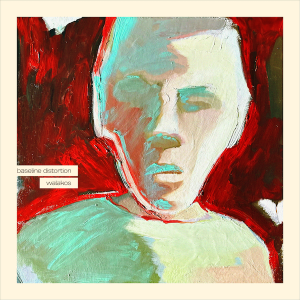
Despite the title, distortion isn’t the defining characteristic of walakos‘s latest. Much of the production is remarkably lucid, leaving enough space around the low end and harder electronic textures for small changes in timbre and rhythm to register. “Sapphire” establishes this physical vocabulary, while “Link State” opens it out, playing with depth and distance. “Recursion Error” is more nervous and insistent, its recurring rhythmic figures subtly displaced and reshaped as the track progresses.
The collaborations broaden that vocabulary. “Ray” features guitar from Maksym Borovik (Maxy Force), whose pink Jazzcaster, in walakos’s own words, fills the space in the arrangement. It also gives the track a looser rhythmic character, with syncopated layers producing an elastic, slightly off-centre groove. “-RWD” reaches further into walakos’s personal history. It incorporates samples from earlier jams with his friend Mykyta Troiepольskyi (mutedbirds), a previous collaborator on “Wyciczone ptaki” from Interrupted. Old sounds resurface within a hazier, more melancholic piece, driven by a digitally treated voice that slips in and out of the surrounding texture.
“1,74B COP” brings a very different voice into the album. A Colombian mother asking for news about her son serving in the Ukrainian military cuts through the electronic patterns. This creates a distancing effect giving the track an unexpected documentary weight. It is also a reminder that walakos is one half of warнякання with Anton Slepakov, a project that has produced one of the most effective ongoing chronicles of the full-scale invasion. What began as an attempt to register the war from the perspective of civilians living through it has inevitably changed as both Slepakov and walakos have since joined the Ukrainian military, shifting the project’s vantage point from life under invasion to the experience of those now serving within the war itself.
The closing “Pixel (im)perfect” gathers clicks, pulses and synthetic fragments into a buoyant groove, punctuated by brief vocals and the return of the digitally treated voice heard earlier in the album. It makes for a fitting ending: busy, playful and still moving forward.
Even when the music becomes melancholic or emotionally charged, baseline distortion keeps searching for movement. There is a tone of vintage in its sound but without the nostalgia. Rhythms change shape, layers thin out pulling details into focus and new variations flourish.
The album is released by Dnipropop, a label that continues to function as a focal point for the city’s scene and artists orbiting beyond it. Walakos’s own note accompanying the album perhaps provides the more important context: he thanks the Ukrainian music community for continuing to make music, support one another and keep the ecosystem alive “despite all the circumstances”, dedicating his respect to those defending the country and remembering those still serving.
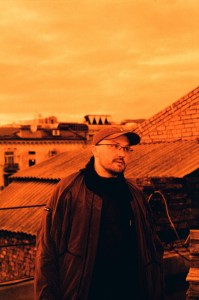
photo by Roksolana Deineha
To help us breakdown the production process of baseline distortion, I approached walakos directly. We have been in direct contact since I first interviewed him for the Ukrainian Field Notes series and it is always a pleasure and a privilige to get to speak to him.
The liner notes describe baseline distortion as music written after “the familiar conditions of life had already changed”, with the title referring to a change in the basic frameworks through which you perceive the world. Musically, though, the album is very precise and rhythmically grounded, often establishing a stable groove and then altering what happens around it. What does “baseline distortion” mean to you, and did that idea influence the way you approached rhythm and structure on the record?
“Baseline distortion” is a scientific term describing when an instrument’s readings begin to deviate from the norm under the influence of stimuli that are atypical for the sensor. Yes, our baseline settings have changed as well. It’s not just me, but I very often draw on my personal experience to interpret it through music. At first, one might think of constant stress, sleep deprivation, anxiety, and PTSD. But you say the tracks have become clearer and more balanced. And that, too, is baseline distortion.
We all wanted a freer, more relaxed, and easier life. But times don’t let us choose. They dictate their own terms. And just like the approach to creating tracks—that’s exactly how the life of a civilian, who was supposed to become a soldier, ultimately transforms. More discipline, more clarity, more obedience. In music, this manifests in crisp grooves and adherence to a specific style. Before, I could afford to “blur” my musical vision and approach to production, but now I can’t. And I think this is an honest interpretation of my storytelling.
Compared with Interrupted, there is a stronger pull towards UK club music here, but you rarely settle into a straightforward genre vocabulary. “Sapphire”, “Link State” and “Recursion Error” maintain recognisable rhythmic grids while constantly shifting accents and textures, while “Ray”, with Maksym Borovyk on guitar, opens up a much more spacious harmonic field. What drew you towards this UK-influenced rhythmic language, and how did the collaborations with Borovyk and Mykyta Troepolsky affect the direction of the album?
Here, the general concept is followed. A soldier has a sphere of obedience, a sphere for interpreting orders, and personal aspects that you won’t lose no matter what. All of this is reflected in the music: there’s the “order” of the style, your interpretation of the “assigned task,” and the personal elements that keep you grounded in all of this and remain constant. Accordingly, the UK dictates the style (yes, I genuinely love and submit to it), and there’s room for interpretation through textures and accents. But all of that is just the “frame,” and there has to be a precious gem that you set into it: whether it’s a sample from a jam session with a friend that’s dear to your heart, or a melodic ambient guitar track with a shimmer from a buddy with whom you’re always joking around and almost never have a heart-to-heart. And that’s his very sincere voice.
In “1,74B COP”, we suddenly hear the voice of a Colombian woman saying in Spanish that she is worried, wants to speak to her son and hasn’t heard from him for some time. Given that Colombians have travelled to fight on both the Ukrainian and Russian sides of the war, the recording introduces a disturbing ambiguity into the track. Where did you find it, who is the woman trying to contact, and what made you place this particular voice in “1,74B COP”?
This is the most heart-wrenching part of the release. I’ve previously worked with this particular group of soldiers in the Ukrainian army. I have the utmost respect for these men. I’ve had deep conversations with some of them and continue to stay in touch even after they’ve been wounded or returned home. I was struck by these experienced men who led orderly, comfortable lives, who flew halfway across the globe because they couldn’t stand by and watch the injustice unfolding here. They shared my contact information with their loved ones, describing me as someone they could trust. Sometimes the mothers and wives of soldiers would call me, often in the middle of the night (since we’re in different time zones), asking about their well-being, even after I had already left my previous unit.
As an empathetic person, I keenly felt the full range of emotions and struggles of a mother who, for a variety of reasons, couldn’t speak with her son. This voice is a symbolic representation of all the mothers waiting for their sons. I salute all the foreign soldiers who are helping us defend our land. As for the sample: I feel it would be unethical to use a recording of a private conversation, but I was able to convey the general meaning using modern synthesis.
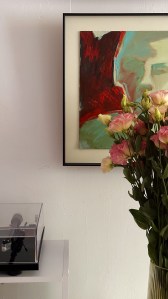
painting by Roksolana Deineha
The album artwork depicts the painting Lost by Roksolana Deineha. What made you go for that image in particular?
The painting is framed and hanging in our home. It has a very specific mood: danger, alertness, confusion, determination. I thought about the cover for quite a while; I even briefly considered going with the aesthetic of scientific instruments and their distortions. In the midst of this agonizing decision, we were talking with Roksolana — she asked me point-blank, “Describe what your album is about.” I described the moods and themes that guided me. Then she said, “Look at the wall. It seems like the guy in the painting knows what you’re talking about.” That’s when I stopped looking for another visual.
You are currently serving in the Ukrainian military, while warнякання, your ongoing project with Anton Slepakov, confronts the experience of war much more explicitly through Anton’s words and your electronic compositions. baseline distortion comes out of the same changed reality but largely avoids verbal narrative. How has serving in the military affected your ability and desire to make music, and do walakos and warнякання now provide you with different ways of processing what you are living through?
To be honest, war offers the living one gift amid the overwhelming horror, death, and destruction. A keener sense of life itself. Enjoying a cup of coffee, hugging a loved one, or passionately doing what you love. How does living under conditions of highly probable death affect me? In the same way. I want to drink in this life in big gulps: to greet the dawn, to see my parents, to drink coffee with friends, to create music… And yes… In warнякання, Anton’s voice truly sets the overall tone, and from that, I build music that serves as a framework and support for the stories Anton unfolds. This duo allows us to view our shared present through Anton’s eyes and highlight it.
In my own project, there’s only my life, my stories, and my storytelling which shapes and determines the artistic expression of the tracks. There are plenty of stories in my life, which means there’s plenty of color for the musical canvas. I conceptualize the chosen stories, select the “musical colors,” and write the composition. That’s why even under similar circumstances the musical interpretation differs slightly.
(Gianmarco Del Re)


Pingback: A Closer Listen Reviews – Avant Music News