
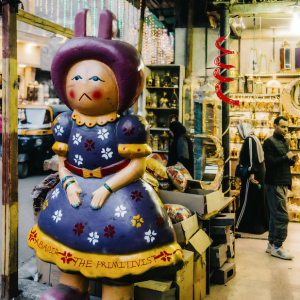
 After several records examining language (Pause/Stutter/Uh/Repeat), mutation (Mutate), liturgical memory (Ison), and the algorithmic logic of social media (Kitbashing), Abadir arrives at what feels like the conceptual centre of his work. The Primitivist is not simply a new collection of club tracks but a declaration of intent, rejecting electronic music’s enduring fixation with futurism in favour of a deeper engagement with the present and with the musical traditions that continue to shape it.
The title is deliberately provocative. As Abadir has argued in an article for Cartography of Darkness, electronic music has spent decades equating novelty with the future, often reproducing the same cyberpunk imagery, dystopian fantasies and technological narratives inherited from the 1980s and 1990s. For him, that obsession has become a form of nostalgia masquerading as progress, one increasingly detached from the realities of communities living through war, authoritarianism and displacement. The Primitivist proposes another direction altogether: creativity rooted not in speculative futures but in sustained engagement with living musical heritage and the political urgency of the present.
That shift is immediately audible. If Mutate revolved around the Egyptian maqsoum rhythm, this EP opens its vocabulary to rhythmic traditions and performance practices from across the Arab world. The opening “Habban” takes its name from the Gulf bagpipe, a celebratory folk instrument associated with communal dancing and percussion ensembles. Rather than sampling tradition as an exotic signifier, Abadir absorbs its rhythmic logic into a contemporary club framework where darbuka, khishba, mijwiz and intricate hand-clapping patterns become structural rather than decorative elements. The ecstatic propulsion of “The Primitivist” and the playful destabilisation of “Pass & Go” continue that trajectory, while the closing “This Is Not Another Maqsoum” knowingly acknowledges — and moves beyond — the rhythmic strategy that defined his previous album.
What remains constant throughout Abadir’s catalogue is his concern with transformation. Each record asks a different question, yet all are linked by the same compositional impulse: taking existing sonic materials — speech, liturgy, social media, club music or regional traditions — and discovering how they can be reimagined without losing their historical or cultural specificity. The result is music that consistently resists easy categorisation. It is uncompromisingly contemporary, yet never relies on futurist rhetoric to justify its newness.
In an electronic music landscape still eager to describe unfamiliar sounds as “futuristic,” The Primitivist offers a persuasive alternative. It suggests that innovation need not emerge from imagined worlds or technological fantasies. Sometimes it begins by listening more closely to the present and to histories that have always been there, waiting to be heard.
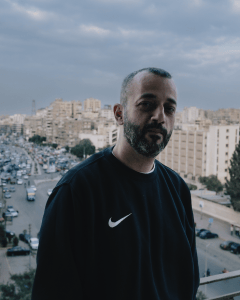
photo by Omar Elkafrawy
To helps us see beyond the future, we reached out directly to Abadir.
The Primitivist presents itself as a rejection of electronic music’s long-standing fascination with futurism. You’ve argued that futurist narratives often reflect Eurocentric ideas of progress while overlooking the lived realities of communities experiencing war or authoritarianism. Once you reject futurism as the dominant framework, what new possibilities does “primitivism” open up for composition? Does it change the way you think about rhythm, sound design or even the social function of club music?
My rejection of anything related to futurism has been going for five years, and each year it becomes more radical. I think this makes sense to me at the moment, since the future, futurism and the futuristic have been the main focus in electronic music since the 80’s (if not even before that) to identify what’s new, what’s next and the unheard for the western ears. This narrative of futurism has been already ruling for 40 years, which makes it outdated for me and repetitive to the maximum, to the point where it’s now reduced to a marketing label.
It became a habit to link newness to the future, and unfortunately there has been a lack of critique to this idea, or attempts to link creativity and newness to something else other than futurism. It’s even nostalgic that futurism in electronic music is still somehow based on the same concepts, sounds and perspectives that once existed in the 80’s or the 90’s. There have been cycles of criticizing Mark Fisher’s theories, with a general claim that the future didn’t stop and “gotcha Fisher you are wrong”, because X or Y (from the global north) made “futuristic” music. Honestly, this argument is haunted by an outdated vision of what futuristic music means, it’s also haunted by the urge of futurism. That’s nostalgia for futurism (which is different from Fisher’s concept of lost futures) that used to exist decades ago. It’s paradoxical, and in that sense futurism is eating itself.
But I think this sort of discussion doesn’t fit the Arabic context because we have different realities and priorities.
With the exception of Afrofuturism, the futuristic narrative is escapist and out of touch with the present. It chooses progress and speed rather than understanding and facing the present. The narrative for years has been about fetishising dystopia or the other opposite, techno-optimism led by the “punchline” of “Let’s imagine a future where…” I see both narratives out of touch with reality, especially now. Being able to think like that is a kind of luxury, rather than living the hard present reality which is unfolding in front of our eyes on a daily basis. So at least, an action must be taken to change that, and actions happen in the present. Once we reach a point where present issues are kind of fixed, then we can have the time and luxury to speculate, think about the future and imagine it. More thoughts about this topic can be found in this essay I wrote last year.
I chose the term Primitivism as a provocation, a way to say I’m happy I’m not futuristic, I’m busy with the present and I’m inspired by a deeply rooted music heritage. This way of thinking is definitely inspiring because making this claim means that I need to listen, revisit, read and learn a lot about music from the Arab region on the technical, cultural and historical level. During the last few years I learned a lot about Maqamat, rhythms from different parts of the Arab region. As you said, this also had an impact on sound design, because you can easily tell that the sound design in The Primitivist and my coming project is different from what’s in Kitbashing and Ison.
On Mutate, the maqsoum rhythm acted almost as the album’s organising principle, whereas The Primitivist draws from a much broader range of rhythmic traditions and instrumental references from Iraq, Kuwait, Syria and Palestine. Tracks such as “Habban”, “The Primitivist” and “This Is Not Another Maqsoum” feel less concerned with hybridising genres than with rethinking the vocabulary of club music itself. How did your compositional approach change between these two records, and did moving beyond maqsoum also change the way you thought about rhythm?
Usually I tend to link my projects together, as well as old and fresh ideas. What starts as a sound or an idea in one project will be revisited and developed more a few years later. You can trace that between Pause/Stutter/Uh/Repeat and Kitbashing or Ison, and between Mutate and The Primitivist. This marks the continuity of my work.
Maqsoum was the center of Mutate, next to the influence of other club genres that I listen to and DJ. I wasn’t making club music before Mutate, so it made sense to me to start with a sound I’m familiar with and stuck in my memory, which is Maqsoum. It was fun mixing Jungle and Footwork or Jersey with sped up and cut up Maqsoum samples, to come up with a mutated club sound.
In The Primitivist I decided to focus more on Arabic rhythms and dropping the influences of other club genres. During a 3 year period I got attracted to sounds from the countries you mentioned and I extended my knowledge to further other rhythmic patterns. The result was working with rhythmic sounds related to Dahhiya, Dabke, simulating a real drummer playing the Khishba or using the Sharbaka, which is a hand clapping technique rooted in the Arabian Gulf, especially in Kuwait. In my coming project, I’m going deeper in sound design, and more complex patterns with a focus on variations in time signatures.
There is a striking tension throughout the EP between recognisable Arab instruments—mijwiz pipes, darbuka, khishba, brass timbres—and an approach to rhythm and sound design that remains uncompromisingly contemporary. As someone who has also been exploring Arabic maqamat and instrumental playing techniques in your more recent work, how do you avoid turning these traditions into cultural signifiers or markers of authenticity, allowing them instead to remain living musical materials?
I think the idea is about avoiding orientalist and self-orientalist cliches, or lazy fusion, in addition to finding this common ground between the familiar and the unfamiliar, with surprise elements. Once you hear a Mijwiz or a brass synth for instance, you will get that sense of “yes I know that”, then twisting the expectations is the next crucial step. If I hear a Rast or Huzam or Bayati maqam used by an Arabic producer, I will see it as normal. But creativity appears depending on some other factors such as: the articulation and ornamentation in maqamat, the modulation between maqamat, how the producer is implementing these maqamat with drum patterns, how the sound design is made, how the arrangement is done and the structure is built. Here you have a lot of options to twist the expectations.
Yet, I still admire the musicians who are maintaining old traditions as they are, because we need that now in our region more than any time before, given the external threat by the infamous pariah state, liberal capitalist “values”, A.I, the Dubaification of our region. This is the very material reality we face and we have to deal with in the present, so again, what future exactly are we talking about?
Koleyet El Banat – photo by Omar Elkafrawy
Your work sits at an unusual intersection of artistic practice and critical writing. As the editor of the electronic music section at Ma3azef, you’re constantly analysing how electronic music is written about, categorised and historicised. Has writing criticism changed the way you make music? Conversely, has producing records like The Primitivist made you more critical of the vocabulary and frameworks through which electronic music — particularly music from the Arab world — is discussed in western publications?
My criticism towards the vocabulary and frameworks used in western publications as well as the westernised Arabic ones has always been there. I also believe that the music journalist or the critic has to read, follow and listen a lot, a good level of curiosity is required. I’m trying to do my best with that, so my critique can have some basis.
Maybe The Primitivist is a result of that. It’s about how to express critique through a medium other than writing; proposing that we don’t need to be obsessed with the future or futurism to be creative, alternatively, we can be focused in the present or we can draw inspiration from our cultural roots. The present is here already. The same applies on Kitbashing by the way, one can theorise about its concept in an essay or a book, but I wanted to represent the concept sonically.
Definitely, working in criticism has made me think differently about my own music, because it has made me much more self-critical. My music projects are slow cooked, and each one starts with a simple question: why am I doing this or what am I trying to say? This question can be frustrating or provocative to some artists, but for me it makes total sense and it’s the main critical question behind every project.ِ During the process, I can be very critical and harsh towards myself, but it helps me a lot.
With Kitbashing, you proposed feeding on the algorithm rather than feeding it, transforming the sounds of social media into compositional material. In retrospect, do you think the algorithm can ever truly be subverted, or does every attempt at resisting it inevitably become another form of participation?
On an individual level, we can benefit from the algorithm, whether by using it for learning purposes, an introduction to something, being informed about cultural or political topics, or simply watching something fun, because we need a break.
Apart from that, ِI wish in general that the algorithm is subverted for something good and I think this has to be collectively done. Take for instance the non-commercial electronic music scene which is now driven by the algorithmic scrolling mentality, everyone from the curators, to the spaces, to the artists, to the press, to the crowd, is so invested in an app. Everything has been highly dependent on Instagram. It has become the main way to be heard and seen and that’s exhausting and frustrating. A couple of slides or a polished one minute video from the peak of a live or DJ set defines an artist. But imagine that the press and curators are relatively withdrawing from Instagram, this can have a good impact on producers and DJs, they will spend less time on the app, and post less, only when it’s necessary. This will make the crowd spend more time listening and reading, and artists will only focus on their music and their work. That would be ideal, isn’t it?
(Gianmarco Del Re)


Pingback: Recent Reviews from A Closer Listen – Avant Music News
Abadir’s Primitivist leans hard into raw, stripped-back electronics — the kind of release where every hiss and click feels deliberate. The contrast between those jagged percussion hits and the smeared, wide pads kept pulling me back for repeat listens. Glad a closer listen flagged this one; I would have missed it otherwise.